Up next was supposed to be a post on Kanazawa, but that plan has been somewhat delayed as I try to get through the book Kanazawa: a 16th Century Castle Town. My first attempt was thwarted because its an incredibly popular title, as you can imagine, in great demand far and wide and the first copy I tried to purchase was already sold. Anyhow, a different copy was acquired, winged to me post haste and is currently being lustily devoured. The delay, however, got me thinking, possibly because this is now the second time I've been held up on a post as I've either waited for a book to arrive or waited as I read a book. The other time was when I was reading The Fox and the Jewel about contemporary Inari worship, and both times left me wondering about the sources I've been using on this site and whether it would be of value to do a bit of talking about them. I have, of course, put nary a citation or source on any of my posts for two very good reasons: first, I am inherently lazy about such things and even back in school I thought it was a pain that got in the way of the fun of writing and the enjoyment of reading. This site and its narrative are not part of a school research paper, so the need to clutter it up seemed pointless at best. Second, as this post itself and the reason for its origin should make clear, the reading I'm doing is ongoing and I'm constantly going back through old posts changing and updating as I feel necessary; to add constant updating of citations to that would get in the way of what is really just a glorified personal travelogue (see reason one). However, it seems it would be to my own benefit, as well as to the 3 people who've read anything on here to give a rundown on sources if for no other reason than because some of them really are quite good and could be of use if you want to learn more about a specific topic or are intending to travel to Japan. For the sake of not making this the longest post on here, I'm not at this point going to try to list everything. There's too damned much to list and not all of them are as useful as others, so to reiterate my previous statement about me being inherently lazy, I'm going to call this "Installment 1" and list books until I get bored, mainly focusing on ones I've used in posts to this point, and then add some more later down the line...maybe.
I think it would be good to quickly yap about online resources before diving into the hard media. There is so much available online that (stating the obvious) a bit of caution is warranted when dealing with even things that give the impression of being common knowledge. Of course this is the Internet we're talking about so if you don't already have a bit of critical eye than you're likely close friends with a Nigerian dictator and are just here to kill time as his millions wing their way to your bank account. That aside, one of the best uses for the Internet is as a resource for travel; besides being able to find websites for lodging and attractions, its the best place to find contact information about JRail passes, train schedules and of course find and buy any book, map or guidebook humankind has ever produced. Lodging is particularly easy because compared to trying to call and wrestle with language, we never had a single communication or reservation problem stemming from an email exchange. Talking with those we had made the reservations with, they tended to prefer email because it removed potential communication errors and allowed everyone to know they were literally on the same page well before you actually arrived at the place.
As far as general information, both for a potential trip and for research purposes, you of course will first smack headlong into Wikipedia, and you can take that as you may. Some information I've looked up there for other subjects has ranged from dubious to actually rather insightful and well written. Most of the Japan stuff has been fairly spot on and topical. Even at this point I still use Wikipedia a good bit, though mainly as a sort of shorthand for reference purposes and for the external links and references which are good if you need a quick example of something. Wikipedia is also a decent travel resource, considering those external links usually include the official English and Japanese language websites and homepages for tourist offices and other in country travel sites. JTBUSA is one of the best places to get JRail passes. I found them quick, efficient and pleasant to deal with; plus, having an office in the same state made it easy to call when I had a question which was also quickly answered. Both before we went and definitely while we were there we made copious use of Hyperdia for train schedules. It was always accurate and even made life easy when trying to make ticket reservations because it was usually easier to just pull up the trains we wanted on the iPad and show it to the ticket agent than fumble around with each other's languages. Other sites with general information and background are a bit more specific, but can be a lot of fun to poke around on. Two of my favorites are The Online Buddhist-Shinto Art site, which is chocablock full of photos and info and a place quite easy to get lost in for a couple hours, and another that is likely only of interest to me but is so full of stuff on the topic of Japanese trains and history it is a good example of the type of site you should try to search out when rooting around for info online. Basically, there is so much weird specialized knowledge online it can be difficult to sift through it all to get to what you want about specific Japanese topics, and given the inherent language difficulty with Japanese websites this is even trickier, but the amount of decent English language sites makes first forays a bit easier.
I'll start the printed sources with the travel resources we used. You certainly have your pick when it comes to maps and guidebooks, and to a large degree they are like a relationship with a living thing, in that you kinda need to find the ones you get along with. We had several general guidebooks but by the end of the trip had mostly begun using two almost exclusively. The first was the Lonely Plant Japan. I personally have always been a bit suspicious of the LP guides, feeling that they are sometimes a bit lazy, and if they didn't really spend a good bit of time someplace they don't really say so; but its likely that impression comes from dealing with them several years ago and is seemingly not the case any more. This one was pretty spot on and earned my love for listing a funky little okonomiyaki joint in Kanazawa that we never woulda known about otherwise, and which was incredibly friendly and delicious.
Sample text: "Free gaming urinals have been installed on the 2nd, 3rd,and 4th floors. At the moment, the displays are only in Kanji - if you can read Japanese, then urine luck."
The other guide we used extensively was Ramsey Zarifeh's Japan by Rail, which as far as I can tell is the result of him riding pretty much every train in Japan. I found it to be so incredibly full of useful information, especially regarding our train hops with route maps and station information it was like a security blanket whenever we left for a new place. Also its full of little tidbits that struck the author as unique or interesting and is full of snippets of gossip that come from this essentially being a guide written by one dude who has roamed all over the country, making it a bit more interesting than just a guidebook for people (like myself) who enjoy traveling by train as its own activity. The edition we had was the latest at the time, but still a couple years old, so some of the pricing was a bit out of date but was otherwise a really good guide. The good news, though not for us at the time of our trip, is that a brand new edition has just come out. I haven't picked it up yet (don't really need it at the moment) but its a must get if you're not gonna be staying in one place and using the trains a bit.
Sample text: "As health minister in 1998, Koizumi was asked which was more pressing: approving Viagra or reducing toxic dioxin emissions. He replied: 'Personally, Viagra'."
Another guidebook we extensively used was Judith Clancy's Exploring Kyoto, which is really the only guidebook you need for the old capital and its immediate environs. The author breaks down the city into strolling tour sized sections, then in great depth walks you through anything even potentially of interest on the walk, giving you a decent rundown without getting too wordy. It was because of this book that I knew about the Lake Biwa Canal museum, as well as numerous other tidbits and places to see. Not much else to say about this one, if you are going to spend any time whatsoever in Kyoto you are doing yourself a disservice not picking this one up. I would recommend combining it with the Periplus Kyoto map (which includes regional and Nara maps) and you should be pretty well covered.
Sample text: "Many Japanese are curious to enter because of the gate's association with the notorious robber, Ishikawa Goemon, who hid there. After his capture, he was boiled to death in an iron cauldron; hence the popular name for an old fashioned Japanese bathtub: goemonburo."
Kyoto, a Cultural History, by John Dougill is a great book that, for lack of a better phrase, adds texture to the narrative of the old town. As its framework it is a general purpose history, but in practice it meanders here and there focusing on specific topics from literature, traditions, arts and the like. It usually ties in the culture of a given time to the history of the time showing how they were very intertwined. This is a fun book, its well written by someone who really seems to like Kyoto and who has taken a lot of time to get the feel for its cultural past and then relate it in an interesting manner. I read this after I got back and wish I had gotten to it before I left, paired with Exploring Kyoto would have made for a good guide.
Sample text: "...on one such occasion the group I was with were told about the impending visit of foreign priests. 'We Japanese have a long history of Zen. Eight hundred years. Perhaps we have grown lazy.' the abbot smiled. 'Foreign priests are very strict. They follow the rules very hard. We are nervous to do our best,' he giggled, 'I hope we do not disappoint them.' Then, as if to reassure us after confessing such mundane worries, he taught us a Zen wisdom: 'Before a person studies Zen, mountains are mountains and waters are waters. After a first insight, mountains are no longer mountains and waters are no longer waters. But after enlightenment, mountains are again mountains and waters are again waters.' He giggled once more, and left us to ponder the deeper meaning."
General books about Japan are a bit trickier to come by. Its not like they don't exist, its just that your not likely to find much depth at your local Barnes and Noble or other friendly local neighborhood mega chain. In fact, mostly what you'll find at your average bookstore is that to American minds the most topical thing that happened to Japan in the past 2000 years is that they were defeated in World War 2 by America. Aside from that, you will likely come across Hirohito and the Making of modern Japan, by Herbert Bix, which is a good enough book but pretty much sums up the current notion that the only narrative that most Americans know about Japan is WW2 and how its aftermath shapes the Japanese nation to this day; which is simplifying things...a lot.
Used bookstores are a better bet, slightly, but considering their nature is to contain books that someone no longer wants, the selection of topics (given the limited interest most Americans seem to have in Japan) can still be quite narrow and often rather dated. Walking past the 20 racks of books about China and why we do/don't need to be worried about them, you'll get to the 5 or 6 shelves on Japan. Most of what you'll find are books on Japanese atrocities in China and Korea before or during the War, a rainbow of strange books about Japanese business in the eighties which are a rather amusing mix of racism, bull-laden pseudo-scholarly fake business/MBA jargon, and a variety of mostly wrong impressions about the "Japanese Mind". Mixed in will be a few decent books, as far as I can tell because back when people were actually concerned about Japanese companies taking over America some of the standard works were used as texts in classrooms and some decent books actually managed to sneak out of publisher's doors.
Your best bet is usually to hit old Amazon. I tend to hunt for some rather specific books and have never ceased to be amazed at what you can find on Amazon Marketplace. Whats that? you say you want some rare monographs likely stolen from a European monastery? No problem, 4 used starting at $23.95. Still, a bit of caution is required, and it is worth paying attention to the descriptions or you may end up with a middle school library book complete with check-out card in its little pouch inside the back cover. This was the case with The Meiji Restoration, by Monique Avakian. I list it here anyway for three reasons, one: because I think its funny; two: because its actually not that bad a book, especially if you have a middle school aged kid that you want to teach about the Meiji Restoration, I guess; and three: because it was mildly nostalgic to see a book with the old timey check out card from my youth where you write your name on the card and the Librarian stamps a due date....and Hell Yeah I wrote my name on that sucker! Although the fact that I'm apparently the only one that ever "checked-out" the book is perhaps a bit telling why it was on Amazon Marketplace.
Sample text: "It was expensive to dress completely in the new style every day, so it wasn't unusual to find Western style shoes underneath the traditional kimono robe. By 1900, married women of the lower classes had stopped their tradition of blackening their teeth and shaving their eyebrows."
A fun, light introduction to Japanese culture is A Geek In Japan, by Hector Garcia. Holly picked this up from Amazon before the trip and it proved invaluable as part guidebook, part cultural primer. Despite appearances, its chock full of information and helpful hints and is a plain old good time to read. I would highly recommend this one for anybody with a casual interest in the country because it covers a lot of bases without being too frivolous, but doesn't beat you over the head with too much info if you aren't interested in hard-core research.
Sample text: "Another characteristic of tanuki statues is their over sized testicles. If you take a close look at the photograph, at the base of the statue you don't see its feet but its kin-tama (literally "gold balls"). These large attributes are a symbol of good luck, and in many stories about tanuki they use the skin of the scrotum to play the drum or even as a parachute." P.S. this is 100% true.
There are several general overviews of Japanese history, and for the most part they all contain the same information, so you can mostly pick one based on which cover you like best. A fairly common one is W.G. Beasley's The Japanese Experience, and I happen to like it's cover. It is widely available and pretty darned thorough, and if you are looking for a single book about Japan that is reasonably accessible then I would say this one fits the bill reasonably well. Its narrative style isn't gonna set the world on fire, being somewhat dry, but it avoids the pitfall of overloading with scholarly sounding jargon that tends to make a lot of history books nearly unreadable. I know it doesn't sound like a glowing recommendation, but it actually is rather decent, you could do far worse.
Sample text: "Indeed, when the treasury faced unanticipated needs, such as might arise from a Bakufu demand for the contributions to the cost of public works, these 'official' merchants would furnish loans, the interest of which, invariably high, became a further burden."
Another book that covers the overall history that you are likely to find (likely at an actual bookstore) is Japan: Its History and Culture, by W. Scott Morton and J. Kenneth Olenik. This is another that is a pretty thorough overview of the country, but didn't sit as well with me when I read it or with Holly when she tried to read it in the lead up to the trip. Although it is quite a good book, the style is a bit off putting, and I often found myself getting distracted while reading it thinking about the syntax the authors used than the actual history they were relating.
Sample text: "The feudal pattern had therefore altered to a direct overlord-vassal relationship, operating locally with no strong central authority. The income from estates was not remitted to absentee owners, with the result that the emperors and court nobles were seriously impoverished."
Of interest is Ernest Wilson Clement's A Short History Of Japan, which we picked up somewhere and was a pretty easy read. Despite a few occasional clues something isn't quite right it flows along happily until the end when you suddenly realize the book was published in 1915 and ends with a rundown of "current events" in Japan. The "wait, what?" moment you get as you flip back to the title page and realize when it was written was pretty fun and then requires you to go back through it as it puts the point of view of the book into better perspective. Fun stuff, and interesting as a window on the accomplishments of the Meiji Era.
Sample text: "If another Urashima Taro(the Japanese Rip Van Winkle) had gone to sleep in 1867 and waked up in 1912, he would have been as much bewildered as either his Japanese or American Prototype. And as we contemplate the marvelous transformations of the Meiji Era, we can only throw up our hands with Dominie Sampson and exclaim, "Pro-di-gi-ous!" Awesome.
Japan Before Perry, by Conrad Totman is a good next step from the general histories into the increasingly more complex realm of looking into the history of Japan. Its purpose is to try to slightly lift the lens of the modern era to give a better view of the "origins" of modern Japan, and it does succeed at its task in a very readable way. It doesn't completely divorce the earlier history from our modern understanding, but it does make a good next step after the general overviews. The simple fact is that as you go back through time in Japanese history things get increasingly problematic, and some aspects are hellaciously acrimonious. Totman's book tends to not wade too deeply into contentious subjects, but doesn't gloss them over either. If you want a good introduction to the earlier realms of Japanese history, this book is a really good starting point.
Sample text: "From both choice and necessity, then, the introduction of literacy to Japan entailed the introduction of far more than a medium of expression. Both content and context shaped the transformation that eventuated the classical age."
After a while I was getting pretty tired of Emperors, samurai and Shogun. I wanted to know what life was like for regular people in Japanese history. Oddly, this is a harder subject to find information about than it would seem. After a couple false starts I came across Japan to 1600, by William Wayne Farris. The subtitle of this book is "a social and economic history", which I figured could go either way. It is, in fact, a fascinating book. From the earliest times through to the birth of the early modern Farris meticulously ploughs through every scrap of information apparently available about Japan and creates a narrative that fits all the pieces of that narrative together in a thoroughly thought engaging manner. He does a great job of balancing the entire picture of the multifaceted and complex stratification of Japanese society and shows how all the parts were intertwined. To be honest, when you have the entire picture laid out, it makes you a little curious why more attention isn't given to that entire picture of the society in other works. A great many things seemed to be left hanging in the air in other books after Farris makes you realize the impact of population changes, climate, disease, foreign migration, trade and conflict on the masses, making the rulers (so often the central theme in other works) often completely beholden to these larger, less flashy forces that shaped the lives of the ruled. These events and patterns greatly impacted the ruling classes, but the causes and effects are oddly not filled out in many other works, and certainly not as clearly as in Farris' writing. Part of this is likely because the author's main area of expertise is in archeology and pre-literate Japan, as addressed in another excellent book of his Sacred Texts and Buried Treasures. That book introduces some of the real tricky problems in early Japanese archeology, and the minefield that some of those problems have become. You get the feeling that because of the very touchy nature of archeology in Japan specifically and the larger world of East Asia in general, a great deal of importance is placed on the subtle interpretation of artifacts and documentation. Although it makes the field very much not for one to casually dive into, in books like Japan to 1600 you can certainly see the need and benefits of being meticulous. Great books, good writing.
Sample text: "Shingen, too, took his armies with him in the spring, when grain from the previous year had been exhausted, calling that season "the time when we have no provisions." An advantage of leading sizable armies outside the domain was that it lessened the potential for starvation at home by reducing the resident population. In this sense, the wars were an expression of peoples' most elemental instinct to fill their belies."
Where the books on Japan get interesting is when you start getting into the more specialized topics. As a general rule it seems that the people who actually bother to write about Japan and Japanese history tend to be oddly devoted to the subject. Given the almost minuscule volume of English language scholarship (comparatively speaking), the laser like focus on incredibly esoteric and narrow subjects treated in depth is amazing. There also seems to be a "style" to a lot of this writing that allows the author to remain in the book, so to speak. Perhaps due to the nature of having to submerge yourself in a culture that is so alien just to do basic research, the more specific the topic the more likely the book is to have an almost travelogue back beat in it, which I find wonderful.
An excellent example of this is the book that started me thinking about this post: The Fox and the Jewel, by Karen A. Smyers. The book is a fairly exhaustive study of Japanese Inari worship and its rather curious individualistic nature. She amply covers the historical and theological background of the topic, but spent a good couple few years immersing herself in the culture of Inari in modern Japan and seems to have realized that the incredibly diverse and personal nature of people's relationships with their beliefs does not acquit itself to a dry sociological or anthropological study. As a result, it has more the feel of a piece of in depth journalism and makes for entertaining as well as educational reading. You truly get the sense that the personalities involved are as interesting as the lore itself and the bits of downright gossip-like narrative makes for a very good book. Period.
Sample text: "Second, he goes overboard in describing all the phallic objects used in religious ways in Japan. In addition to fox tails and keys held in the foxes' mouths, which may reasonably be seen as phallic, he describes boulders on the mountain, stone lanterns, the Shinto fire drill, and Ainu inao worship sticks as phallic. Sometimes a cylindrical object is just a cylindrical object."
One of my favorite specialty books, for reasons that should be obvious if you read the post on Umekoji, is Early Japanese Railways,
by Dan Free. Free has apparently seen, collected or read every document
in existence from the first moment that anything even slightly train
related appeared in Japan. This is a book by an enthusiast for
enthusiasts. Through its very well illustrated pages it charts the birth
of what would eventually become the finest rail system in the world. Of
course you have to give a damn about trains in general to think this is
a good book, and you have to then give a damn about Japanese trains to
think its a great book, but if you do...well this is a great book.
Sample text: "Since compound locomotives used the residual power of
steam more efficiently than simple locomotives that exhausted the steam
after one passage through the cylinders, they were theoretically cheaper
to operate, as they burned less coal for the same amount of work. For
Japan, a country whose coal reserves were not overly abundant, this new
technology was of interest."
Shinto, the Kami Way, by Sokyo Ono (an older book, written in 1962), and Understanding Shinto, by C. Scott Littleton, a couple little wisps of books, are decent introductions that are likely to turn up in the religion section of your local chain bookstore. Neither is going to eat up much of your time, nor will you get to dive into some of the more complicated and interesting aspects of Shinto, but they do give a good overview. More than anything, they would be good as a general introduction to the sights and practices you would be likely to see if you were to visit a shrine and could therefore stave off some of the "hunh?" you would otherwise experience.
Sample text: "The origin of the gateway which may or may not have come from the Asiatic mainland, and the reason for writing the word with the characters meaning "bird" (鳥 tori) and "to be" (居 i), that is "bird perch", need not detain us here. The origin is obscure and has no particular relevance to its present use."
In contrast, A New History of Shinto, by John Breen and Mark Teeuwen is the English language book on Shinto. I goes into some fairly esoteric explorations in an attempt to dig through the many dense layers of history and accretion that make Shinto what it is today. It looks at the long, complex relationship between Shinto and Buddhism, how changing times lead to changing traditions, and goes into some depth on specific examples of rituals, lore, and sites that have evolved through the years. It is occasionally pretty dense and does require that A: you have a basic overview of Japanese history, and B: that you actually ever wanted to know this much about Shinto. It's not inaccessible to a casual reader, I'm just not sure why a casual reader would read it. Personally, I liked the meatiness of it, but I have no life so your mileage may vary.
Sample text: "If Kanetomo's Daigengu was entirely egregious in structure, his Shinto thought was suitably subversive. His achievement was to create a Shinto that turned the traditional medieval worldview on its head. For all its Buddhist influences, Kanetomo understood one-and-only Shinto to exist before and beyond Buddhism."
Along with the above mentioned Farris books any of the books by J. Edward Kidder are really good introductions to Japanese archeology. In particular, Early Budhhist Japan and Himiko and Japan's Elusive Chiefdom of Yamatai are particularly good. Both, however, exemplify the fact that a number of specialty books about Japan quickly run into tricky territory and therefore tend to expect a certain level of background understanding on the reader's part. I have found this to be the case time and time again that the contentious nature of certain topics and an awareness of the fact that these topics tend to be well off the mainstream English language reader's radar leads many of these books to be aimed squarely at a more scholarly audience. For a more casual reader Ancient Japan, from the "Making of the Past" series is a decent book. Its from one of those multivolume topic series that don't seem to exist anymore and reminded me in great measure of the Time-Life collections I loved when I was younger ("Planet Earth" was always a favorite. You can pick up individual volumes for, like, a buck on Amazon). Of course, this installment is by Kidder, so offers good info (as expected) but is of particular interest because it is extremely picture heavy, and therefore illustrates a number of specific sites and artifacts discussed in the literature, all the while being narrated by one of the stalwarts of the field.
Sample text: "The fatefully prophetic remark in the temple's records that 'all the copper resources of the country' went into making of the Great Buddha goes far to explain why there are virtually no bronze statues in succeeding centuries. The temple's own Four Heavenly Kings, which were in bronze, according to the archives, are of polychromed, unbaked clay. They stand in Kaidan-in. Perhaps even the originals were sacrificed for repairs to the Buddha, its lotus or altar decorations".
An Archeological History of Japan, 30,000 B.C. to A.D. 700, by Koji Mizoguchi probably shouldn't be included here because despite its title I have no idea what this book is about. At certain points it is written with a clarity that leads you to believe it is, in fact, a book about Japanese Archeology by a noted, knowledgeable person, who makes some keen insights into the importance of the subtleties of the field, but then quickly lurches off into odd conceptual and semantic discussions the likes of which I can't or don't want to follow. Of course, what do you expect of a book with a chapter titled "The Topography of Scheduling: The Spatio-Temporal Organization of Social Life and the Jomon Self". Which I think I'll use as the sample text.
And, Bam! There it is, the wall of boredom. I have officially hit the point where I can list no more books and remain awake, so I'll just leave it here and throw up some more later, maybe...if I feel like it. The good news is I've finished the book on Kanazawa that was delaying things so I should be back on schedule pretty soon.
Wednesday, February 27, 2013

Sunday, January 27, 2013
Monkeys! Poets! Darts! Huzzah!
This post is a bit different from most up to this point. No matter how much I've tried there's just no getting around the fact that this one tells the tale of a straight up touristy day. That's right, there is nooo educational value to this post. But don't get comfortable, next time we'll get into Japan after 1600, gold, and the Dutch, so enjoy this little break. Our time in Kyoto was drawing to a close and all the running around had us pretty worn out. We decided we were going to spend the last full day theoretically relaxing, but as is our way that meant running all over the place. Its kinda hard not to in jolly old Kyoto; even if you ever ran out of things to see or do in the city proper (not possible) the immediate outskirts are full of a variety of sights and activities that you could easily use to fill up lord only knows how much more of your life. In particular, Divyam and Yasuko had suggested heading northwest to Arashiyama and doing something called the "river run". I will admit being suspicious, at first, but honestly a straight up touristy day sounded kinda nice.
Up early, as usual, we were on the bus to the subway station with a quick stop at the Kyoto Museum of Traditional Crafts. We were originally also going to hit the Museum of Modern Art, but it was closed this day which was probably just as well as it would have eaten up time we later enjoyed in Arashiyama. The Museum of Traditional Crafts, however, was a really nice surprise. Beforehand it was difficult to tell if this was a straight-up museum or a tourist shopping spot, and in the end was a bit of both in a very good way. The museum is full of good quality displays of examples of traditional crafts, arts and regional products with an emphasis on showing the processes involved in making them. Not content to display examples of, say, traditional lacquer ware or woodworking sealed away behind glass cases, the museum instead has very nice step by step displays, videos, and even actual craftspeople sitting there making examples of the objects you are looking at. It is a very interesting place because it truly brings to life the objects we had already seen and would continue to see in museums and artisan shops; seeing contemporary examples of these crafts that would otherwise only exist as artifacts made them seem more accessible and provided a context that is often missing in museum displays of a culture's material heritage. On top of that, because these craft products are all contemporary pieces made by practicing artisans, rather than museum pieces or reproductions of historic items, nearly everything in the "museum" is for sale. Now, these are still mostly the pinnacle of their respective crafts, so don't think cheap tourist items, or cheap tourist prices, but there is a very wide spectrum of legitimate handcrafts that are much more authentic than most of your more standard souvenirs. All around, the Museum was a nice surprise and we definitely enjoyed it, spending more time there than we had expected.
We decided not to dally around too much (failing, perhaps) and started heading to the countryside. Taking the subway to pick up the JR line we headed past Toei Studios, which we didn't stop at, but it seemed like fun if you're into samurai movies; from the train it looked like a parallel universe version of the odd "western" theme parks with gunfights at high noon (every hour) my brother and I made our Dad stop at when we were kids. Soon after, the terrain changed remarkably suddenly as we began popping in and out of tunnels over a particularly scenic gorge that I hoped was part of our upcoming river trip. Before we could find out, however, it was time to locate a Post Office to get more cash. I had been slightly nervous about this because the guide books all said you can't use your Amurikun ATM cards in Japanese ATM's, but that you could use the machines in Post Offices. This all seemed rather odd, to me, conceptually, but what really had me concerned was that possibly not all branches would have these amazing ATM's that were more user friendly than the machines of even major banks. Amazingly, its all true; regular ATM's will scoff at your card, but as far as I can tell every post office has one of these magic devices, and they are idiot proof, almost. As I waited my turn behind a pair of dudes clearly getting nowhere with the device I grew moderately worried, but they gave up and let me have a go and it was actually very easy with nice clear English instructions and no sense that you were jumping through strange electro-financial hoops.
Preliminaries taken care of, it was a short stroll from the station to the Hozugawa Kudari River Run, located in a surprisingly big, fancy, new building by the river.
 I'm always pleased to see a certain level of fanciness with my boat excursions ever since I was a kid and we would go rafting or canoeing. Some of the places had a rather...how should I put it..."not gonna survive the experience" look to them. And this was back when I was far too young to have seen Deliverance, so you can imagine my opinion hasn't changed much since. Anyhow, eventually we boarded our boat and set off down the relatively sedate river through fields and backyards, happy as I watched the mountains we'd just left getting closer.
 Eventually the river hung a left and departed the flatlands, depositing us in the gorge we'd just passed over on the train. I could revert to pattern here and tell you all about logging in this region and the importance of rivers for transport before the advent of the railways...but I'm not gonna. I'm enjoying this being a fluffy tale of a nice day out and I'd rather talk about how enjoyable our happy little boat trip was.
 Part of the fun stemmed from the fact that the boatmen were incredible. Even with the heavily tourist-laden boats propelled only by their rowing and good spirits, they kept up a constant jolly banter the entire time. It was an all around fun trip, and pretty damned good value for money, too; this was no short, piddly boat ride, it was a 2 hour trip. It also had a bit of everything. The rapids weren't exactly ass kickers, but they were more exciting than you would expect given the kind of boat we were on and watching the crew pilot us through them chattering the entire time.
 I loved that because I've been white water rafting before where the clear intention was to make it seem like you were doing something dangerous and adventurous, when it really wasn't. These guys were having none of that and carefully hid the fact that they clearly knew what they were doing behind the image of a team of carnival barkers moving people through the log flume ride at Busch Gardens. Somehow that made the trip an absolute hoot and allowed us to take in the scenery as the lazy passengers we were, with my only concern that Holly might drop the camera in the water.
 One of our favorite parts of the trip, however, had to be the Snack Boat. Every 15 feet, no matter where you are in Japan, there is a vending machine selling drinks, cigarettes, beer, spaghetti, or whatever. I never figured out if this was a product of rampant consumerism or commercialism, but I can say it came as no surprise that just because you take a boat ride through a scenic gorge for a couple hours there is no way they aren't gonna try to sell you drinks and snacks. But I will admit that this certainly had more style than a Pokari Sweat machine on every street corner (and yes, that is an actual product...that you drink).
 And let me just say...you really haven't experienced Japan until you've been moored up next to a boat selling squid grilled right there in front of you by a dude in a Bubba Gump Shrimp Company shirt on a river outside of Kyoto...awesome
 Holly hadn't dropped the camera and we were both enjoying getting rowed down a river, so needless to say we were having a pretty good time
 But sadly, all good things come to an end and as the gorge widened into a valley and the river opened up it was clear we were approaching Arashiyama.
 As it happens, Arashiyama is a surprisingly interesting place. Given its proximity to Kyoto it is a popular day trip spot and is generally a pretty touristy joint. Having said that, I thought it was great. The place had a few Western tourists, but mainly it seemed to be full of families, younger Japanese out with friends or on dates, all mostly just roaming around eating ice cream. We happen to live in a small tourist town ourselves and to be honest it all felt kinda familiar. Like our town it didn't have any big attractions, no Disney World or such, just a cute little place with things to do, but the main draw is it's a quick trip away from other, bigger towns.
HOWEVER! It certainly has our hometown beat on one score; it has one of the greatest attractions ever! It has the Iwatayama Monkey Park. As with many things, the guidebooks and Divyam had been a bit vague about this, so we had to go. One thing that had seemed clear was that this wasn't a zoo situation, it didn't sound like you just went and looked at monkeys in some sort of enclosure. As it turns out, you were actually visiting their house.
 The map they give you when you pay to get in is your first hint something is up. Aww, cute monkeys, cute little map...wait, what's with the cautions? The stroll up the mountain is great, on the surface everything is leafy green calmness; a dry land extension of the boat ride we just finished
 And then the signs start. They're not scary, or somehow off-putting. They are just fantastic in the way that only Japanese signs can be.
 Though they were a little concerning given the quantity of them. They really did seem to be intent on hammering home a few things
 At no point had we entered a gate, enclosure or anything, leading us to increasingly believe we could be waylaid by marauding primates at any minute, especially after we reached the absolute masterpiece of monkey warning signs, maybe of warning signs period (certainly in competition with Nara's deer sign)
 Although an old lady with a cane being savagely gored by a deer still gets the edge in my book, a monkey in boxing gloves rates pretty close. Anyhow, by the time we actually saw our first monkey it was almost a slight anticlimax. I guess that the August heat was making the monkeys as disinterested in violence as the Nara deer. Booo.
 As we continued climbing, however, we were soon greeted by a sight out of a primate based sequel to The Birds.
 Most of the humans were pretty happily taking pictures of our little furry cousins, except for the humans in staff outfits who were nervously watching the scene with darting eyes as if trying to stave off a prison riot. Having taken great interest in the signs on the way up, I'm happy to report we didn't get scolded even once by the staff, though others certainly did if they appeared to be getting close to crossing some of the lines clearly spelled out in the numerous warnings. I got the distinct impression there was a delicate balance between the various higher primates on this mountaintop that the staff were eager to maintain. After snapping some pics we were ushered into the feeding area which I would best describe as a reverse zoo in which the humans were placed in a cage to feed the monkeys who were free to saunter about outside and generally be ridiculous.

 The reason for this was pretty clear, of course, it kept the varmints from expecting food outside and reduced the likelihood of them becoming aggressive with people just strolling around. This legitimate concern of getting your clock cleaned by a monkey was all somewhat interesting to me because when I was in middle and high school my mother was a volunteer chimpanzee monitor for a Jane Goodall led project called Chimpanzoo. I spent hours and days and months at the Lowry Park Zoo getting bored silly and scampering off to watch the foxes and bears instead as she observed the chimps do all the things that humans would do if they weren't allowed to get jobs or leave the house, short of watching television (but only because they didn't give the chimps a TV). By contrast, these critters were more like the deer in Nara than anything, not quite wild, but not really in captivity either. Aside from having the same awareness as the deer that they were safely off the menu, they clearly felt that as fellow primates they were at least as intelligent as the average tourist feeding them, and were quite happy to give off a vibe that they just needed a cigarette dangling from their mouths and a sofa to flop down on, not like the zoo chimps because they had to, but because they wanted to. I guess I'm saying I liked these monkeys a lot.
 Safely resisting the urge to put the proverbial load on outside, we prepared to bid farewell to our layabout primate relatives and explore the rest of Arashiyama spread out below our monkey infested overlook. As I said earlier, this is an interesting town. It has all kinds of little things to do, as well as the feel of being a decent quick escape from Kyoto. This became pretty clear at the monkey park because after getting off the boat down below it had seemed like it was a good bit up a side valley, but from the summit it was apparent we were very much IN Kyoto; its sprawl starting just at our feet.
 Happily resolved in being tourists, there was nothing more to do than head down and join the rest of the day trippers seeing the town. Holly decided the next stop would be Rakushisha, the "House of Fallen Persimmons".
 This little cottage was the retreat of one of Japan's more notable poets, who was the disciple of one of Japan's most notable poets.
 I'll be honest, I know very little about Japanese poetry not just because I don't have much interest in poetry (I don't, for the record), but more because I feel that it doesn't translate very well into English. The written language and spoken, descriptive language are quite structurally different from our tongue and though narrative and technical writing translates just fine, a great deal of the subtlety of Japanese poetry (which often involves several layers of meaning including the specific characters used) does not. But what the hell do I know. Anyway, no matter what your opinion of poetry in general, and Japanese poetry specifically, Rakushisha is an adorable little cottage.
 It is very traditional, simple and airy with a nice understated garden which makes you just want to sit inside and drink tea on a warm summer day, such as the one on which we visited. Sadly, you aren't allowed inside, and certainly not allowed to sip tea inside so instead you sit on a bench in the refreshingly shady garden and think of tearing down your own house and building something simple and airy. Or maybe just I do. That Rakushisha was a poet's retreat is interesting because it illustrates how Arashiyama was at one time well past the outskirts of Kyoto. The town gives the distinct impression that the bigger city snuck up on it when it wasn't looking. As you walk around you are surrounded by tourists, high school girls getting rickshaw rides to an attraction or sweets shop, then you turn a corner and are in rural Japan.
 Go to see some monkeys and cross a scenic canal once used to load and unload cargo for the city and now where they pull the river run boats out to haul back to Kameoka.
 Stroll past a quiet pond before crossing the railroad tracks with trains like the one we had been on hours before headed to Kameoka blasting by remarkably frequently.
 Which brings you to perhaps my favorite bit of city-country, the bamboo lane. This stand of bamboo wasn't just for looking at as it is today, it used to be an industrial resource. Big, protected, tended groves like these used to be everywhere, especially near larger towns or cities because bamboo was a valuable material the Japanese used for...well...everything. Aside from the scale of the place I was fascinated by a pair of
kids playing a game of sorts not unlike skipping stones by tossing small
rocks and seeing how many stalks they hit. That and the wind moving through the grove made a sound completely alien to our ears as the enormous stalks knocked together above our heads.
Which brings you to perhaps my favorite bit of city-country, the bamboo lane. This stand of bamboo wasn't just for looking at as it is today, it used to be an industrial resource. Big, protected, tended groves like these used to be everywhere, especially near larger towns or cities because bamboo was a valuable material the Japanese used for...well...everything. Aside from the scale of the place I was fascinated by a pair of
kids playing a game of sorts not unlike skipping stones by tossing small
rocks and seeing how many stalks they hit. That and the wind moving through the grove made a sound completely alien to our ears as the enormous stalks knocked together above our heads.
 When you've had enough strolling around you head to the station, which itself is surrounded by an interesting pile of stuff. Trains and pianos, anyone?

 And a few minutes later you are back in Kyoto to go about your life. And there are towns like this all around Kyoto, each with their own "thing" and things to do, and each just a few minutes away by train or subway. For us, however, our next stop was our official "out of context" item for the trip. This is a bit of a tradition that started many years ago because I had to know what an Italian McDonald's was like. Don't judge me, it was a cultural experience. Anyhow, I have carried on the tradition but am certainly no longer curious whether foreign fast food is different from ours (its not). An easy target of this is usually a British pub. There is at least one in every city in the world, and much like fast food the "brand" leads to a hilarious translation into each culture you find them. In Cuzco there is one owned by a British Motorcycle enthusiast from Ohio that is sufficiently bike themed, and as I sat under a framed Ariel Square Four Poster gazing out over the main square to the cathedral I had a fantastic "what exactly the hell is going on here" moment. You can always count on a British pub in a foreign land (probably even in Britain) to be a wonderfully out of context place. The Pig and Whistle in Kyoto, I'm happy to say, has just that feel. Beer and Buddhist temple: check.
 Fish and chips in the land of the worlds best seafood: check.
 Darts just because I could: check.
 I would have been content to hang around and drink a while, but with our time in Kyoto getting short Holly wanted to walk around a bit more and see downtown one last time.
 I wanted to hit Musashi Sushi, because I still thought (and still do think) it was the Greatest Place to Eat in the World (and create a problem because they had shirts for sale and trying to find one in my size was...challenging. Bless 'em for trying, the XXL they eventually dug up might fit Holly)
 And then we went for a stroll down by the river. There was a festive feel on the river walk, I'm not sure if its always like this or if it was because it was getting close to Oban, but either way it made for a wonderful little walk.

 At about this point Holly was ready to pass out. We started the walk back to Yonbanchi, but at the end of a long day and without the bikes this time it felt so darned much farther than it had seemed before. Holly started whining. She wanted a cab, we compromised and caught a bus. For what was supposed to be a "relaxing" day without getting too far afield we had once again not stopped moving the entire time. It was a good way to wind up our visit to Kyoto, if there can be such a thing. Kyoto easily made it to the top of my list of favorite cities, just barely below our hometown, that is. The next day we were on the train headed north to continue roaming around, or perhaps to actually start, but I could have easily spent several more days...weeks...months in Kyoto, its that good of a town. Some of the books I've read are a bit harder on Kyoto than I think is necessary, almost as if its hip to knock it a bit. "the Americans spared the city in the war, but the Japanese destroyed it afterwards" runs one saying I've seen several times. I don't buy it, I enjoyed the fact that the city was a mix of the old and new. It is the story of Japan, after all, the mixing, the reinvention and reshaping; Kyoto tells that tale well. In planning the trip we were involved in a tug of war between using the heck outta our JRail passes and stuffing in as much as we could or staying in once place for a bit and spending less time on trains. For the sake of logistics we chose the latter. We also figured it would be better to spend that time in Kyoto because it seemed better value for money than Tokyo, and likely less intimidating for new arrivals as well. Now, looking back I think that for the amount of time we had in the country we made the right choice, but not for the logical or logistical reasons we had originally chosen. Heck, when we got there we ended up spending the entire time running around anyhow, just centered on Kyoto. Simply, there was something very welcoming about Kyoto, and even in our short time we got very comfortable there. We had learned a lot in Kyoto about how to get on in the country which we carried with us on the rest of the trip, but I don't think we ever felt as "at home" as we did there. Which gets me to bit of an impasse. I've been trying to wrap this post up for a bit and find I just ramble on fairly repetitively about Kyoto's attributes. I guess the best way to sum up my impressions of Kyoto is to do it rather bluntly, no matter how much it may seem to be sneaking away from a proper conclusion. So these last couple lines are really just a very long punctuation mark: Kyoto, there was so much to see, we tried to see as much as we could, there was so much more to see. Go there....dammit, why do I have to explain why?

Up early, as usual, we were on the bus to the subway station with a quick stop at the Kyoto Museum of Traditional Crafts. We were originally also going to hit the Museum of Modern Art, but it was closed this day which was probably just as well as it would have eaten up time we later enjoyed in Arashiyama. The Museum of Traditional Crafts, however, was a really nice surprise. Beforehand it was difficult to tell if this was a straight-up museum or a tourist shopping spot, and in the end was a bit of both in a very good way. The museum is full of good quality displays of examples of traditional crafts, arts and regional products with an emphasis on showing the processes involved in making them. Not content to display examples of, say, traditional lacquer ware or woodworking sealed away behind glass cases, the museum instead has very nice step by step displays, videos, and even actual craftspeople sitting there making examples of the objects you are looking at. It is a very interesting place because it truly brings to life the objects we had already seen and would continue to see in museums and artisan shops; seeing contemporary examples of these crafts that would otherwise only exist as artifacts made them seem more accessible and provided a context that is often missing in museum displays of a culture's material heritage. On top of that, because these craft products are all contemporary pieces made by practicing artisans, rather than museum pieces or reproductions of historic items, nearly everything in the "museum" is for sale. Now, these are still mostly the pinnacle of their respective crafts, so don't think cheap tourist items, or cheap tourist prices, but there is a very wide spectrum of legitimate handcrafts that are much more authentic than most of your more standard souvenirs. All around, the Museum was a nice surprise and we definitely enjoyed it, spending more time there than we had expected.
We decided not to dally around too much (failing, perhaps) and started heading to the countryside. Taking the subway to pick up the JR line we headed past Toei Studios, which we didn't stop at, but it seemed like fun if you're into samurai movies; from the train it looked like a parallel universe version of the odd "western" theme parks with gunfights at high noon (every hour) my brother and I made our Dad stop at when we were kids. Soon after, the terrain changed remarkably suddenly as we began popping in and out of tunnels over a particularly scenic gorge that I hoped was part of our upcoming river trip. Before we could find out, however, it was time to locate a Post Office to get more cash. I had been slightly nervous about this because the guide books all said you can't use your Amurikun ATM cards in Japanese ATM's, but that you could use the machines in Post Offices. This all seemed rather odd, to me, conceptually, but what really had me concerned was that possibly not all branches would have these amazing ATM's that were more user friendly than the machines of even major banks. Amazingly, its all true; regular ATM's will scoff at your card, but as far as I can tell every post office has one of these magic devices, and they are idiot proof, almost. As I waited my turn behind a pair of dudes clearly getting nowhere with the device I grew moderately worried, but they gave up and let me have a go and it was actually very easy with nice clear English instructions and no sense that you were jumping through strange electro-financial hoops.
Preliminaries taken care of, it was a short stroll from the station to the Hozugawa Kudari River Run, located in a surprisingly big, fancy, new building by the river.


HOWEVER! It certainly has our hometown beat on one score; it has one of the greatest attractions ever! It has the Iwatayama Monkey Park. As with many things, the guidebooks and Divyam had been a bit vague about this, so we had to go. One thing that had seemed clear was that this wasn't a zoo situation, it didn't sound like you just went and looked at monkeys in some sort of enclosure. As it turns out, you were actually visiting their house.


Sunday, January 6, 2013
Fushimi Inari Is Cooler Than You!
Many, many, many, many...... many years ago when I was in Germany I heard a phrase that was described to me as an old German saying that could be roughly translated as: "If something is not specifically allowed, it is strictly forbidden". I'm not sure how true it is that it is actually a genuine German phrase, having since heard its origins are in old texts about pre-twentieth century European government, a US GI's joke from WW2, anything written by Orwell, Huxley, or Mencken, or... none of these. I do know the phrase has a corollary: "Anything not specifically forbidden is allowed", which seems less contentious and is likely of old English origin. Whatever, I bring up this pair of phrases not for their etymological interest, but because they are of particular relevance to this particular post. The first could be fairly accurately used to describe Japan (or Germany, of course, or my house when I was growing up) and its citizens in the popular imaginations of most observers, and the island society generally does itself no favors by often playing right into this stereotype. They seem especially proud of being perceived as a serious, hardworking, nose to the grindstone, solidly homogeneous and unified nation. But I think that in any society it is easy to see how the second notion often exists just below the surface, even if it needs to have a specific culturally accepted place to occur. Being interested in old bikes as my other off-the-clock main interest, I will often come across websites and pictures of groups of Japanese Rockers and greasers, and I'm tellin' you, they do NOT screw around when it comes to their own personal "thing". Even as casual observers visiting for a short while it was quite clear that this was no nation of robots; there was no feeling that the people are really frighteningly regimented. I'm not one to brush aside all cultural differences, but honestly I have yet to be anywhere on this planet (and granted I haven't been everywhere, or most everywhere, or hardly everywhere...gimme a break, its a big planet) where people seemed fundamentally different, you know, in a "are we really from the same species" kinda way. Large cultural differences are there, no doubt, and they provide the meat on the bones for the people of any given place, but going somewhere with the attitude that we are basically cut from the same cloth tends to make, for me at least, the differences less noticeable and the similarities less remarkable; perhaps a bit counter-intuitively, I feel this is very much a Good Thing.
So what is the point of this if I'm supposed to be be rambling on about Shinto? Why...its because we get to talk about Inari Worship! I knew a little about Inari and Fushimi Inari before we went there, which is why I knew it was a place I really wanted to see, but as with a lot of things in Japan actually experiencing in person the thing you have only seen in pictures and books often causes you to be more confused than before you were there. For a great deal of what I'm about to ramble on about I have Karen Smyers' book The Fox and the Jewel to thank, and you may notice this is one of the few times I've actually cited a reference on the site. That is because Dr. Smyers' book is wonderful, simply wonderful. She spent quite literally years doing fieldwork for the book; exhaustively exploring nearly every nook and cranny of the incredibly complex world of Inari worship. The book is a serious piece of sociological and anthropological scholarship, but it seems she realized quite early on in its creation that the intensely personal and varied forms in which devotion to Inari takes shape could not be handled effectively in a dry, clinical fashion. What you get, instead, is something that is part scholarly work, part travelogue, and part investigative journalism; it is as dense with information about the psychology of internalizing religious discourse as it is with introducing you to some really interesting people and their stories. If any of you 3 people who read this blog like what you may have read about Shinto, I'd pick it up. It really is a wonderful book.
Anyway, simply put, Fushimi Inari is (and I mean this truly in a good way) bonkers; flippen, crazy-ape bonkers. You're not likely to find a guidebook describe it that way, and that is most definitely not a good thing because the reasons behind Fushimi Inari's wonderful "bonkers-ness" are very interesting and derive straight from the points I touched on in the first paragraph. Don't get me wrong, this isn't a "oh, those wacky Japanese" kinda bonkers. No, no, this is the warm, uplifting kind of bonkers that stems from people expressing themselves as they see fit for very personal reasons in an arena where the are allowed. Its a messy, not always pretty, everyday people getting along (sometimes badly; but, that's part of it, too) kind of thing. It is also fascinating because it well reflects how over the past 150 years the Japanese people have been pushed and prodded in so many different directions that every now and then they just say "enough! this is how I want to do X!" and the authorities, just...let them.
Of course very little of what I was seeing at Fushimi Inari made much sense at the time. I kept looking through my books and ravenously devoured any English language material I came across as we climbed the mountain in the hopes of answering the "but why does the fox have a red bib on? is it about to eat lobster? Its gonna have to set that damned key down first!" types of thoughts.
 This all sneaked up on us, I must add. The JR train station was pretty much right in front of the shrine, and was barely a walk from there to the main shrine at the foot of the mountain. First you pass the stalls selling an array of products centered around Inari's foxes (properly, the kitsune, the Japanese notion of the fox, and specifically the spirit fox) that truly boggles the mind, but you eventually break through to the stately, almost modern and classy, promenade up to the shrine.
 This was a visually striking shrine. The conditions the day we were there certainly contributed to the ocular overload of the scene before us.
 This is one of the few sets of pics from the trip I really had to knead the shots from our beloved little Nikon point-and-shoot, honestly I think the crazy vermilion of the shrine and unnatural cerulean blue of the sky that afternoon overwhelmed the poor lil' bugger.
 We poked around the shrine a bit, but we were really anxious to get up the mountain and get to the sight that is used for nearly every image of Fushimi Inari, the "tunnel" made of thousands and thousands of torii gates, donated by businesses and individuals from far and wide for a blessing of success, good fortune, and prosperity.
 There is nothing that will prepare you for the seeing this, it is truly incredible. But what eventually starts to get to you is the sheer scale of the place and the number of donors it takes to allow something like this to exist
 The cost of putting up a torii is related to a couple factors, but the main one is size. Any yahoo can buy small votive torii that they just carry up the mountain and place at whichever shrine, sub shrine, rock alter or sacred hole in a log they want. I'm not kidding. If you look in most of these picks they're like an Easter egg hunt (hey kids, bet you can't find all 1,345,456!) lurking nearly everywhere in the background. Sometimes they're stacked so thick at the shrines you'd think they are making and selling them right there.
 The big torii in prominent locations can run to real money, think the yen equivalent of tens to hundreds of thousands of dollars, depending on just how big you want it and just how snazzy.
 Even the simplest of arithmetic means we're talking of millions of dollars spent by people believing that Inari is one seriously powerful deity that can seriously get things done.
 And it isn't just here, mind you, there are over 30,000 Inari shrines nationwide, not to mention home alters, little shrines scattered about the countryside, and even the slightly stickier Buddhist incarnation of Inari and her/his appearance in numerous temples. If this leads you to think that in the grand amorphous pantheon of Shinto divinity Inari must clearly have a long storied history placing him/her/it above the rest, clearly more powerful than other deities, therefore possessing a more refined and unified worship base....well you'd be completely wrong. There isn't really an Inari in the historical pantheon or official creation story; to fit him/her/it in, he/she/it has been sorta tacked on to other kami. No, Inari's popularity comes from somewhere else. As I briefly alluded to in an earlier post, Inari is the "whatever the heck you want him/her/it to be" of Shinto belief. There is an actual phrase to describe this: watashi no O-Inari sama, literally "my own Inari".
Anyhow, we're talking Shinto here, so it should be no surprise that the origins of Inari worship are veiled in pea soup thick darkness. Having said that, the history of worship at Inari Mountain has been followed quite some way back in time, archaeologists having found an old ritual site at the southern foot of the 233m "peak" that is around 2000 years old, give or take. What was actually worshiped there is of course somewhat hard to say, but to assume it was a local mountain/fertility/agriculture deity is your usual safe bet. This unknown, unnamed local deity really got a boost with the arrival of an immigrant Korean clan, the Hata, in the 400's. The Hata assumed the local deity as their own protective figure and as they prospered in their new land so did Inari. By the time of the arrival of Buddhism, as well as the later move of the Imperial capital just down the road to future Kyoto (and not hurt by the fact that the capital was established on Hata land, with the clan acting as sort-of real estate brokers on the deal) a Kami going by the name "Inari" had been worshiped just south of the new capital for some centuries. I use quotation marks here because exactly what the origin of this historical "Inari" is remains a bit unclear. It is generally stated as meaning "rice bearer" or "carrying rice" or "rice grows" or some such, but as soon as you scratch the surface of the name and the characters used to write it, things get murky quickly. Basically, as stated above "Inari" doesn't exist in the classical pantheon, and you need to do some etymological contortions to really get the name to make sense. I had been having a hard time trying to figure out the origin of the name for some time, as it seems a rare case where a modern Shinto Kami has been shown to have existed at or near the same site as its pre-historic ancestor and would have expected there to be some commentary on that. Nope, I came across one different explanation of its origins after another, and a couple sources which just gave up and listed all they could find, shrugged their shoulders and moved on. It wasn't until I was reading Dr. Smyers' book that it became clear that despite many attempts to tie the name "Inari" to various readings, concepts, and religions, the problem is the characters used to write the name found in the first extant documents just don't make any sense, possibly reflecting a tradition much older than even our historical understanding of Inari. Heck, its even possible that given it was a Korean immigrant family that brought an indigenous, pre-literate stone age Kami in to the times of recorded history, there's the chance the name "Inari" isn't even of Japanese origin.
 What we do know is that a legitimate old timey Kami of the land and its bounty had successfully wriggled past the Buddhist horizon. The transition to the new world was a unique experience for our Inari. From the past came the old land god notions of fertility, good fortune, and the reward of good harvest for those that give proper respect and perform the proper rites to their deities and land; while those that manage to anger the Kami are hit with the kind of wrath that can only come from deities born of mountains and the nastier side of the natural world as understood by old earthy folk traditions. The new Buddhist world Inari strode into brought structure, order and legitimacy to a great many of those old traditions. With the fine line the ruling class had to walk between the Shinto beliefs of the people and the modern "Western" (that is, Chinese) notions of government and religion, Shinto traditions that could couch themselves in the new beliefs were actually welcomed. Inari worship became connected with Buddhism quite early, around the end of the eighth century into the early ninth at latest. The story goes that Inari, already a respected local deity by the time the capital was moved from Nara to Heain-kyo (Kyoto), was made the protective deity of one of the first temples in the new capital, To-ji. Supposedly the construction of the temple's pagoda used timbers cut from Inari Mountain, which pissed the Kami off something fierce. To appease the deity, there grew a great deal of common ritual between the shrine and temple that exists to this day, as well as the awarding of Imperial Rank; both of which popularized and legitimized Inari in the court and emerging urban class' eyes. Because if this, Inari began to fill many different roles for a very disparate audience quite early. The most central concept, which made popularity so accessible across the spectrum was the older surviving notions of good harvest and prosperity. As society began to change from a rice based, agrarian society to a coin based, still mostly agrarian one but with the beginnings of modern commerce and industry, the desire for good fortune and prosperity in the new cities suited Inari just as well as in the old fields.
 This widespread belief and support structure continues to evolve and move with the times, and Inari is easily one of the more popular sects in modern Shinto. Over the three day New Years holiday in 2009 approximately 2.7 million people visited Fushimi Inari. 2.7 Million! This powerful, yet fluid and evolving support structure gives the world of Inari the ability to effectively do whatever the heck it wants. Mostly this means not getting dragged into some of the stickier messes that other Shinto shrines have sometimes found themselves involved in within the modern secular state. Although pseudo Imperial connections are expressed between Inari and deities in the ruling family's creation story, and the shrine has the rank of kanpei taisha, "great state-funded shrine", it doesn't seem to have ever really bothered with Imperial ritual. All the official rites and festivals at the shrine are for rice planting, rice harvesting, rice in general and the use of all this as metaphor for modern notions of prosperity and good fortune. Of course, that's not the only thing that sets Fushimi Inari apart, the Shrine still has close connections to Inari's Buddhist sects, which fared better than most during the separation of the two religions during the Meiji Era. Heck, the Shrine and it's affiliated shrines are not even technically part of the overarching National Association of Shrines because post war they didn't want to accept the belief that the Sun Goddess at Ise Shrine (effectively the symbol of the Imperial Family, and therefore of Japan, nominally) was the greatest Kami. Are you beginning to see why I started this post on Shinto with a short talk on notions of individualism, even within rigid societies? Inari laughs at such notions! This headstrong, individualist streak seems to infect nearly every level of modern Inari worship. Even by the baseline nebulous standards of Shinto, the variations in belief are astounding and trying to separate official belief from popular belief, superstition, folk tales, shamanism, urban legends, and hucksterism is nearly impossible. Apparently, the one central common theme is that if someone tells you that you're wrong about some aspect of your beliefs, you are entitled to think they are wrong in return. Otherwise, you can just ignore the Shrine Priests, government, or anyone and do as you please.
So is there anything common across the board; anything from the old traditions that has survived as a universal truth about Inari, even if just in the symbology? Well, yes, kinda. First and foremost is the image of the fox. The fox is the messenger of Inari as well as the guardian of his/her/its shrines, and they are everywhere. There is a bit of push and pull over these foxes, as you may imagine, with the establishment priests of Inari always trying to make sure people are aware that Inari is not, in fact, a fox and you should therefore not actually worship the image of Inari's fox as a symbol of Inari. Having said that, the fox is clearly the accepted symbol of Inari. It greets you when you get off the train, its in all the tourist shops as you approach the shrine, and then as you get to the shrine a male and female pair flank nearly everything all the way to the top of the mountain. Most likely, because there is no single representative image of Inari the fox is just a simple shorthand; but the number of tales of foxes, fox magic, and fox possessions in Japanese folklore leads one to believe that people have a certain cautious reverence for the fox all on its own. As protectors they usually have one of Inari's sacred symbols: the key to the rice granary, though these days usually seen as meaning the key to accessing spiritual or temporal riches
 The key is usually paired with another of Inari's symbols, a wish fulfillment jewel, which if not in the mouth is usually under a paw or somewhere else. I thought this was pretty funny because when its in the foxes mouth it looks like a dog playing with a ball, and though I don't think the image of a slobber covered tennis ball is what is supposed to be conjured by this image, there was just no helping it.
 Other times the fox has a scroll, representing a book of knowledge or the Lotus Sutra, but usually of Buddhist extraction. And there are a good many other symbols which usually depend on a specific form of Inari or type of desire a given shrine or sub shrine or rock altar is intended for. For example, you will sometimes see a fox cub under the paw or between the front legs, related to hopes for maternity, healthy children, prosperity for ones children and the like.
 We stopped for a break at a trail junction for a sit and a cool beverage, and were greeted by an oddly beautiful panorama of the sprawl of modern Japan, almost seeming to flow by down below us
 It was a very poignant moment, being surrounded by the leafy expanse of Inari's mountain and yet able to gaze out at modern Japan, decidedly in an older world as we stood up in our tree shaded haunt.
 This didn't seem limited to just us. Looking around the junction a good number of others were also taking a break, looking at the world below. It was interesting to notice that everyone, through their panting and puffing seemed to be having a really good time. Holly was enjoying this break too much, she tried lying to herself "this is the top, right?" I knew what she was doing, I had learned some tricks from Divyam, "No, I'm pretty sure this isn't the top". Personally I had decided I was going to the shrine at the top; I'm not sure why, but its good to have goals. I left Holly perched on a sunny rock and headed on up the trail, in turn passing the lower two of the three peaks with their shrines and rock alters. The rock alters are purely popular additions to the mountain: prohibited by the priests in 1869, so many people kept setting them up in the dead of night the priests finally said to heck with it and applied to be able to set them up and regulate them in 1877; problem solved the Inari Way.
 I eventually popped out at the highest shrine, paid my respects and bounded back down back down the trail, I had been gone a while.
 Holly made a good impression of being sad she hadn't gone all the way up, while being careful not to make it seem she wasn't ready to head down, so as the sun was getting lower and the path through the torii got dim in the shadow of the mountain we headed to the bottom.
 From there it was a short train trip back to the station near Yonbanchi where we could catch a quick meal before bed.
 So what should one take away from Fushimi Inari? That's a bit of a tricky question, especially given the nature of the Japanese. Is it purely a religious site, the realm of belief and spirituality; important for modern notions of how humans fit into a world created and administered by deities? Or is it more a place where people go to clarify how they fit into a world created and administered by your fellow humans? Is it a cultural place or a place where society bumps into the divine? I think you know by this point that I feel it is both, and it is quite comfortably so. The great number of changes and pressures placed on the average Japanese over the past 150 years has given them almost no room to breathe. The cultural, historical and archaeological literature that has come out over the past couple decades amply illustrates that fact. At present, probably for the first time in a great while, the Japanese seem to be having a discussion among themselves that has been a long time coming. Mainly caused by the economic meltdown of a few years back and its stubborn, persistent after affects, combined with the rise of mainland issues that cause Japan to evaluate and confront its past in fairly uncomfortable ways, the nation is engaged in a period of introspection that seems to be bringing a great many questions about the society's underpinnings to the fore. When you start collectively asking questions like "what went wrong" or "where do we go from here" its only natural for people to get a bit scared and fall back on things they feel bring stability and comfort. In previous posts I've described the odd nature of Shinto in modern Japan as more of a cultural and societal force than a religious one. Inari worship is similar, but there is a bit more of a undercurrent of personal devotion, stemming in great part from the unique one on one conversation someone can have through their own relationship with Inari. To a certain extent, the thing you need to do when evaluating Shinto is look at what is actually being worshipped; that hidden layer is one of the things I feel is so unique about the "religion". As we have seen in other examples, sometimes its the culture or even neighborhood to which you belong that is being worshiped, sometimes the Emperor, or the pursuit of wealth, and yes, sometimes a deity that is willing to intercede on your behalf. However, by contrast I think the central theme with Inari is the ability to worship, well, whatever the heck you want. That personal freedom in a structured world is the real connection people seem to have with Inari. The Kami's real power seems to be in empowering the individual, and that's where the comforting feeling people receive from Inari emanates. In the end you are worshipping individual expression, a little bit of freedom, and the hope that by worshiping in your own way you will receive your reward; and really, what could be more noble than that?

So what is the point of this if I'm supposed to be be rambling on about Shinto? Why...its because we get to talk about Inari Worship! I knew a little about Inari and Fushimi Inari before we went there, which is why I knew it was a place I really wanted to see, but as with a lot of things in Japan actually experiencing in person the thing you have only seen in pictures and books often causes you to be more confused than before you were there. For a great deal of what I'm about to ramble on about I have Karen Smyers' book The Fox and the Jewel to thank, and you may notice this is one of the few times I've actually cited a reference on the site. That is because Dr. Smyers' book is wonderful, simply wonderful. She spent quite literally years doing fieldwork for the book; exhaustively exploring nearly every nook and cranny of the incredibly complex world of Inari worship. The book is a serious piece of sociological and anthropological scholarship, but it seems she realized quite early on in its creation that the intensely personal and varied forms in which devotion to Inari takes shape could not be handled effectively in a dry, clinical fashion. What you get, instead, is something that is part scholarly work, part travelogue, and part investigative journalism; it is as dense with information about the psychology of internalizing religious discourse as it is with introducing you to some really interesting people and their stories. If any of you 3 people who read this blog like what you may have read about Shinto, I'd pick it up. It really is a wonderful book.
Anyway, simply put, Fushimi Inari is (and I mean this truly in a good way) bonkers; flippen, crazy-ape bonkers. You're not likely to find a guidebook describe it that way, and that is most definitely not a good thing because the reasons behind Fushimi Inari's wonderful "bonkers-ness" are very interesting and derive straight from the points I touched on in the first paragraph. Don't get me wrong, this isn't a "oh, those wacky Japanese" kinda bonkers. No, no, this is the warm, uplifting kind of bonkers that stems from people expressing themselves as they see fit for very personal reasons in an arena where the are allowed. Its a messy, not always pretty, everyday people getting along (sometimes badly; but, that's part of it, too) kind of thing. It is also fascinating because it well reflects how over the past 150 years the Japanese people have been pushed and prodded in so many different directions that every now and then they just say "enough! this is how I want to do X!" and the authorities, just...let them.
Of course very little of what I was seeing at Fushimi Inari made much sense at the time. I kept looking through my books and ravenously devoured any English language material I came across as we climbed the mountain in the hopes of answering the "but why does the fox have a red bib on? is it about to eat lobster? Its gonna have to set that damned key down first!" types of thoughts.
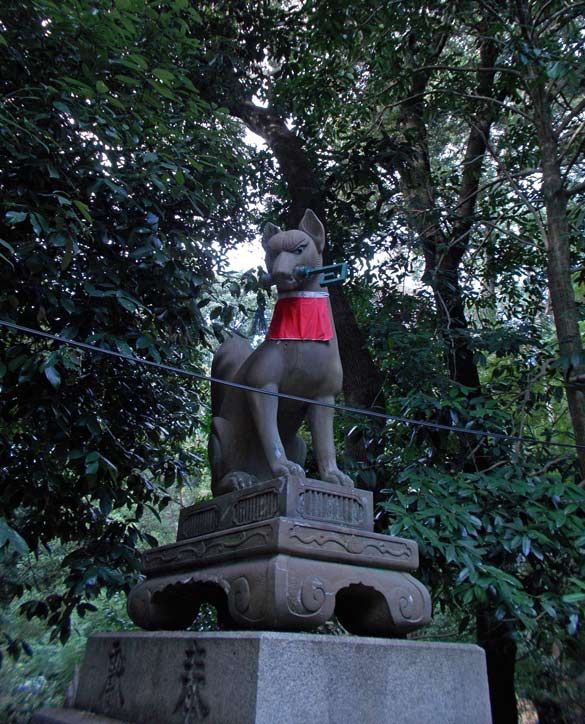


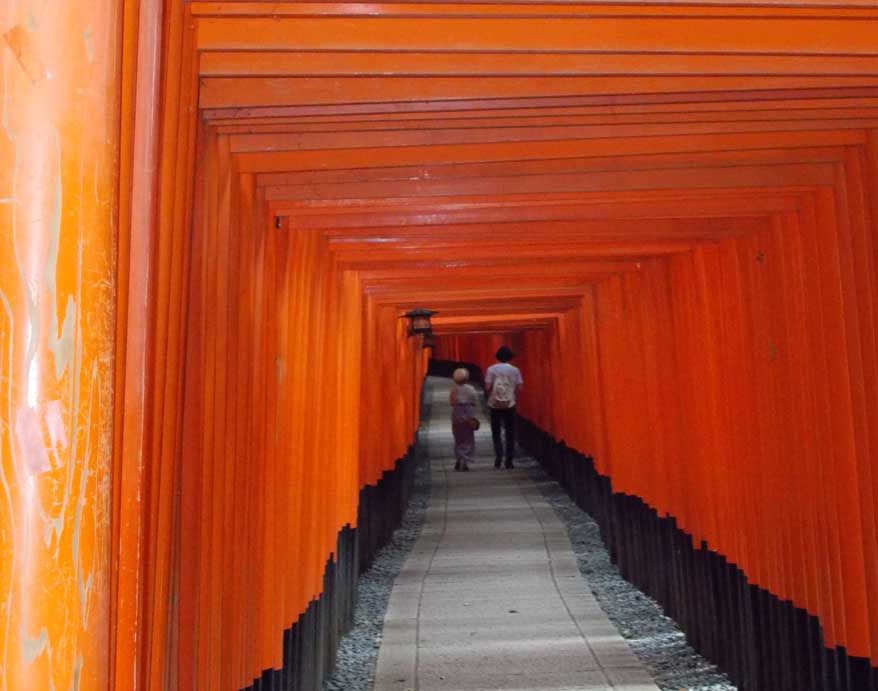


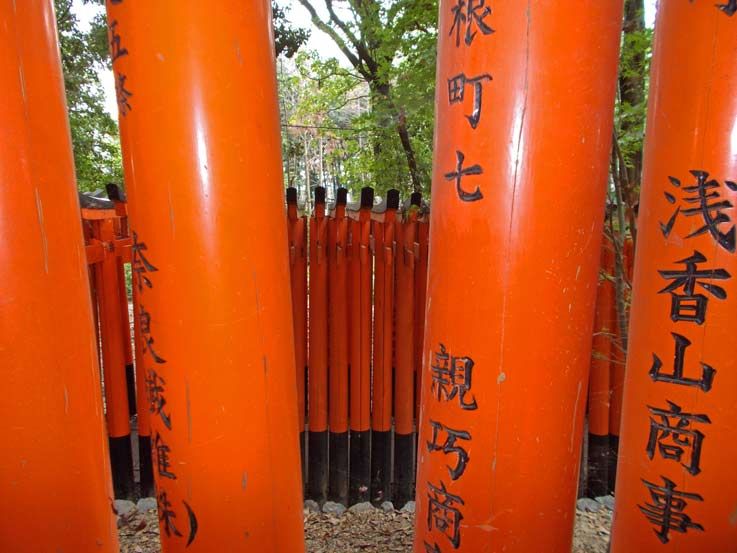
Anyhow, we're talking Shinto here, so it should be no surprise that the origins of Inari worship are veiled in pea soup thick darkness. Having said that, the history of worship at Inari Mountain has been followed quite some way back in time, archaeologists having found an old ritual site at the southern foot of the 233m "peak" that is around 2000 years old, give or take. What was actually worshiped there is of course somewhat hard to say, but to assume it was a local mountain/fertility/agriculture deity is your usual safe bet. This unknown, unnamed local deity really got a boost with the arrival of an immigrant Korean clan, the Hata, in the 400's. The Hata assumed the local deity as their own protective figure and as they prospered in their new land so did Inari. By the time of the arrival of Buddhism, as well as the later move of the Imperial capital just down the road to future Kyoto (and not hurt by the fact that the capital was established on Hata land, with the clan acting as sort-of real estate brokers on the deal) a Kami going by the name "Inari" had been worshiped just south of the new capital for some centuries. I use quotation marks here because exactly what the origin of this historical "Inari" is remains a bit unclear. It is generally stated as meaning "rice bearer" or "carrying rice" or "rice grows" or some such, but as soon as you scratch the surface of the name and the characters used to write it, things get murky quickly. Basically, as stated above "Inari" doesn't exist in the classical pantheon, and you need to do some etymological contortions to really get the name to make sense. I had been having a hard time trying to figure out the origin of the name for some time, as it seems a rare case where a modern Shinto Kami has been shown to have existed at or near the same site as its pre-historic ancestor and would have expected there to be some commentary on that. Nope, I came across one different explanation of its origins after another, and a couple sources which just gave up and listed all they could find, shrugged their shoulders and moved on. It wasn't until I was reading Dr. Smyers' book that it became clear that despite many attempts to tie the name "Inari" to various readings, concepts, and religions, the problem is the characters used to write the name found in the first extant documents just don't make any sense, possibly reflecting a tradition much older than even our historical understanding of Inari. Heck, its even possible that given it was a Korean immigrant family that brought an indigenous, pre-literate stone age Kami in to the times of recorded history, there's the chance the name "Inari" isn't even of Japanese origin.


So is there anything common across the board; anything from the old traditions that has survived as a universal truth about Inari, even if just in the symbology? Well, yes, kinda. First and foremost is the image of the fox. The fox is the messenger of Inari as well as the guardian of his/her/its shrines, and they are everywhere. There is a bit of push and pull over these foxes, as you may imagine, with the establishment priests of Inari always trying to make sure people are aware that Inari is not, in fact, a fox and you should therefore not actually worship the image of Inari's fox as a symbol of Inari. Having said that, the fox is clearly the accepted symbol of Inari. It greets you when you get off the train, its in all the tourist shops as you approach the shrine, and then as you get to the shrine a male and female pair flank nearly everything all the way to the top of the mountain. Most likely, because there is no single representative image of Inari the fox is just a simple shorthand; but the number of tales of foxes, fox magic, and fox possessions in Japanese folklore leads one to believe that people have a certain cautious reverence for the fox all on its own. As protectors they usually have one of Inari's sacred symbols: the key to the rice granary, though these days usually seen as meaning the key to accessing spiritual or temporal riches


All this was on display in bewildering variety as we climbed the mountain. By most standards, its not an enormous eminence, but once the trail starts climbing it doesn't stop. This wouldn't have been too bad except we really had no idea where the top was. Holly was soldiering on, but climbing 47,000 steps isn't her usual cup of tea.
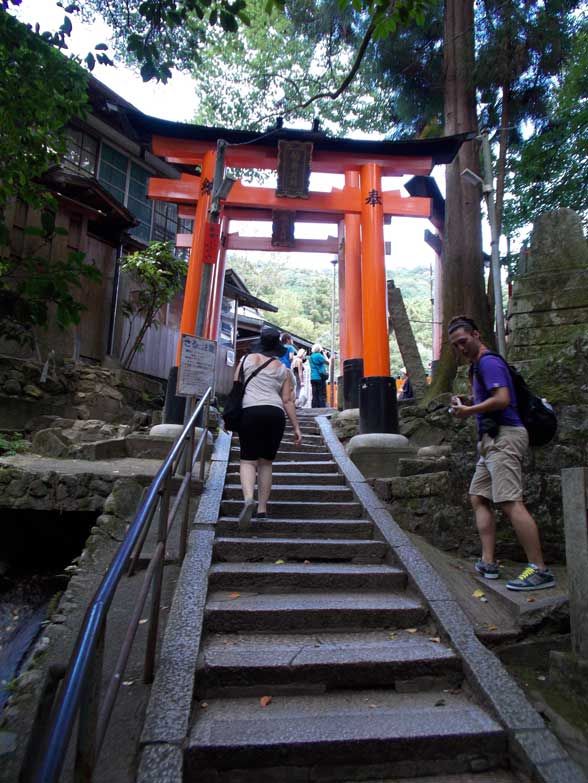


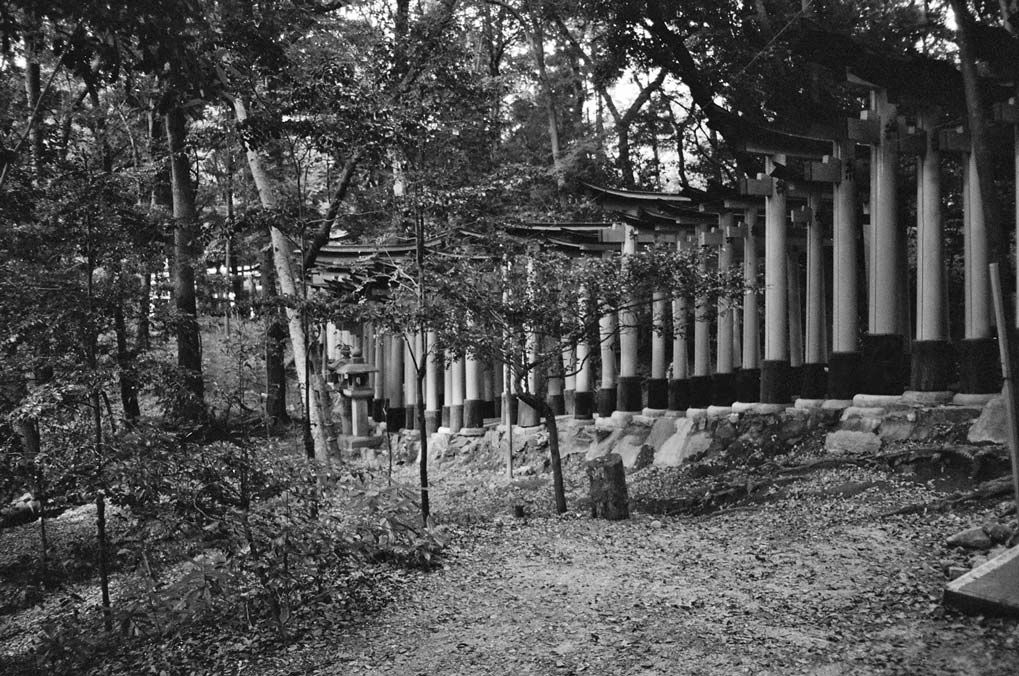

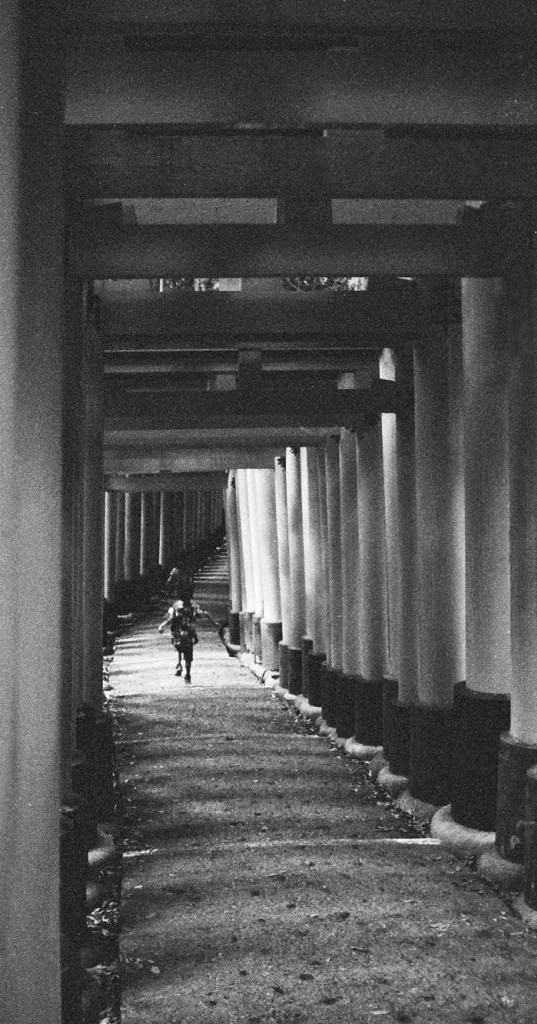
Subscribe to:
Posts (Atom)