Many, many, many, many...... many years ago when I was in Germany I heard a phrase that was described to me as an old German saying that could be roughly translated as: "If something is not specifically allowed, it is strictly forbidden". I'm not sure how true it is that it is actually a genuine German phrase, having since heard its origins are in old texts about pre-twentieth century European government, a US GI's joke from WW2, anything written by Orwell, Huxley, or Mencken, or... none of these. I do know the phrase has a corollary: "Anything not specifically forbidden is allowed", which seems less contentious and is likely of old English origin. Whatever, I bring up this pair of phrases not for their etymological interest, but because they are of particular relevance to this particular post. The first could be fairly accurately used to describe Japan (or Germany, of course, or my house when I was growing up) and its citizens in the popular imaginations of most observers, and the island society generally does itself no favors by often playing right into this stereotype. They seem especially proud of being perceived as a serious, hardworking, nose to the grindstone, solidly homogeneous and unified nation. But I think that in any society it is easy to see how the second notion often exists just below the surface, even if it needs to have a specific culturally accepted place to occur. Being interested in old bikes as my other off-the-clock main interest, I will often come across websites and pictures of groups of Japanese Rockers and greasers, and I'm tellin' you, they do NOT screw around when it comes to their own personal "thing". Even as casual observers visiting for a short while it was quite clear that this was no nation of robots; there was no feeling that the people are really frighteningly regimented. I'm not one to brush aside all cultural differences, but honestly I have yet to be anywhere on this planet (and granted I haven't been everywhere, or most everywhere, or hardly everywhere...gimme a break, its a big planet) where people seemed fundamentally
different, you know, in a "are we really from the same species" kinda way. Large cultural differences are there, no doubt, and they provide the meat on the bones for the people of any given place, but going somewhere with the attitude that we are basically cut from the same cloth tends to make, for me at least, the differences less noticeable and the similarities less remarkable; perhaps a bit counter-intuitively, I feel this is very much a Good Thing.
So what is the point of this if I'm supposed to be be rambling on about Shinto? Why...its because we get to talk about Inari Worship! I knew a
little about Inari and Fushimi Inari before we went there, which is why I knew it was a place I really wanted to see, but as with a lot of things in Japan actually experiencing in person the thing you have only seen in pictures and books often causes you to be more confused than before you were there. For a great deal of what I'm about to ramble on about I have Karen Smyers'
book
The Fox and the Jewel to thank, and you may notice this is one of
the few times I've actually cited a reference on the site. That is because Dr. Smyers' book is wonderful, simply wonderful.
She spent quite literally years doing fieldwork for the book;
exhaustively exploring nearly every nook and cranny of the incredibly
complex world of Inari worship. The book is a serious piece of
sociological and anthropological scholarship, but it seems she realized
quite early on in its creation that the intensely personal and varied
forms in which devotion to Inari takes shape could
not be handled effectively in a dry, clinical fashion. What you get,
instead, is something that is part scholarly work, part travelogue, and
part investigative journalism; it is as dense with information about the
psychology of internalizing religious discourse as it is with
introducing you to some really interesting people and their stories. If
any of you 3 people who read this blog like what you may have read about
Shinto, I'd pick it up. It really is a wonderful book.
Anyway, simply put, Fushimi Inari is (and I mean this truly in a good way)
bonkers; flippen, crazy-ape bonkers. You're not likely to find a guidebook describe it that way, and that is most definitely not a good thing because the reasons behind Fushimi Inari's wonderful "bonkers-ness" are very interesting and derive straight from the points I touched on in the first paragraph. Don't get me wrong, this isn't a "oh, those wacky Japanese" kinda bonkers. No, no, this is the warm, uplifting kind of bonkers that stems from people expressing themselves as they see fit for very personal reasons in an arena where the are allowed. Its a messy, not always pretty, everyday people getting along (sometimes badly; but, that's part of it, too) kind of thing. It is also fascinating because it well reflects how over the past 150 years the Japanese people have been pushed and prodded in so many different directions that every now and then they just say "enough! this is how I want to do X!" and the authorities, just...let them.
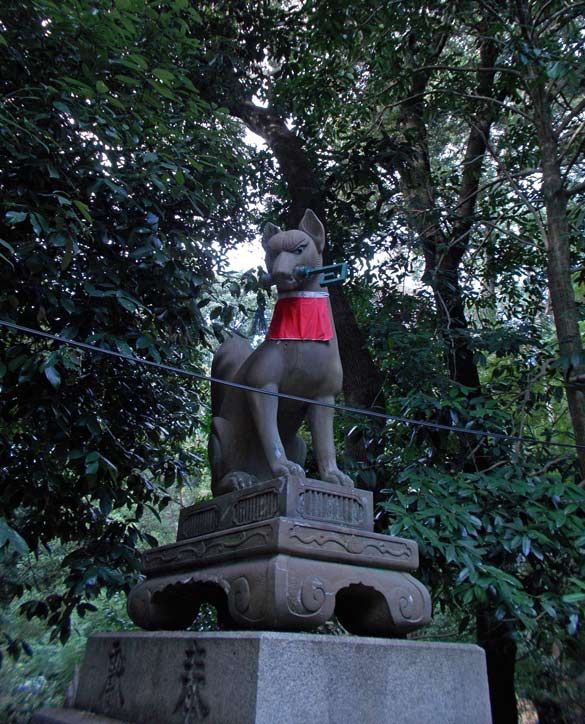
Of course very little of what I was seeing at Fushimi Inari made much sense at the time. I kept looking through my books and ravenously devoured any English language material I came across as we climbed the mountain in the hopes of answering the "but why does the fox have a red bib on? is it about to eat lobster? Its gonna have to set that damned key down first!" types of thoughts.
This all sneaked up on us, I must add. The JR train station was pretty much right in front of the shrine, and was barely a walk from there to the main shrine at the foot of the mountain. First you pass the stalls selling an array of products centered around Inari's foxes (properly, the kitsune, the Japanese notion of the fox, and specifically the spirit fox) that truly boggles the mind, but you eventually break through to the stately, almost modern and classy, promenade up to the shrine.
This was a visually striking shrine. The conditions the day we were there certainly contributed to the ocular overload of the scene before us.
This is one of the few sets of pics from the trip I really had to knead the shots from our beloved little Nikon point-and-shoot, honestly I think the crazy vermilion of the shrine and unnatural cerulean blue of the sky that afternoon overwhelmed the poor lil' bugger.
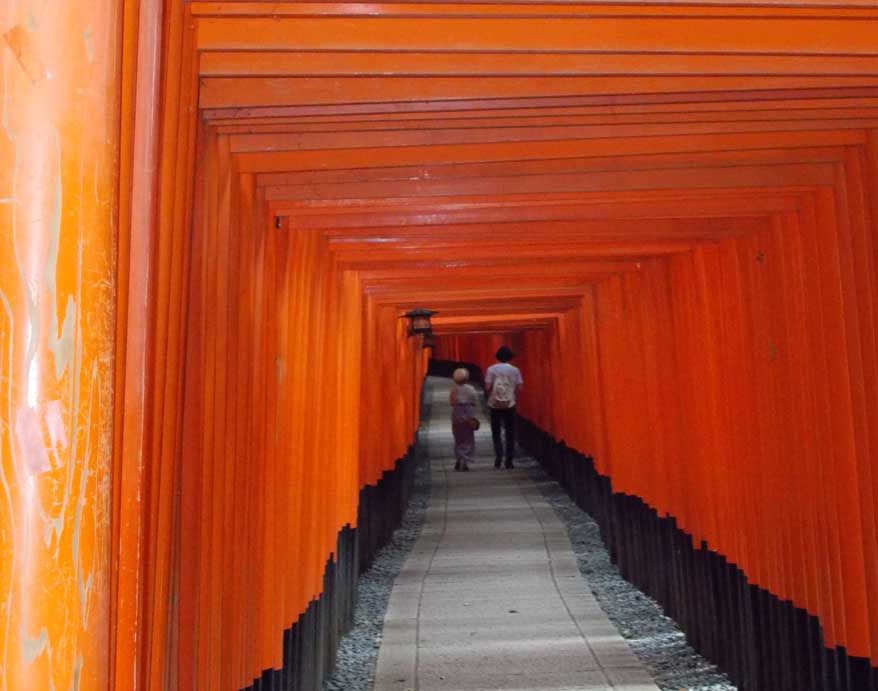
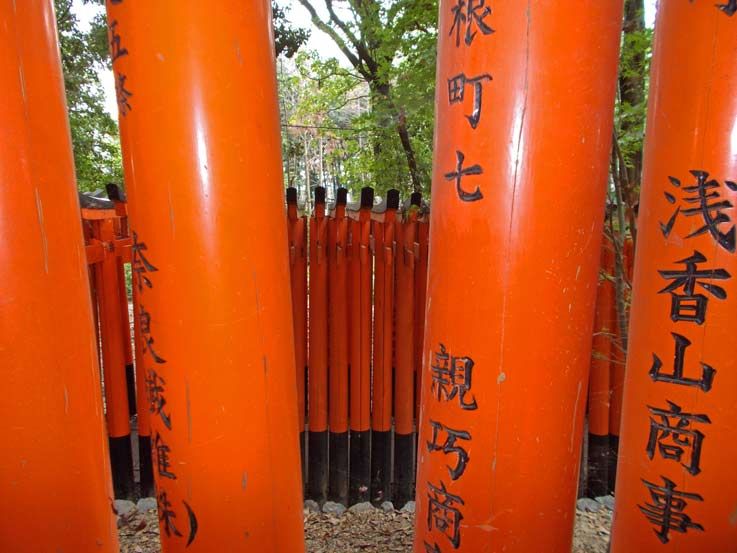
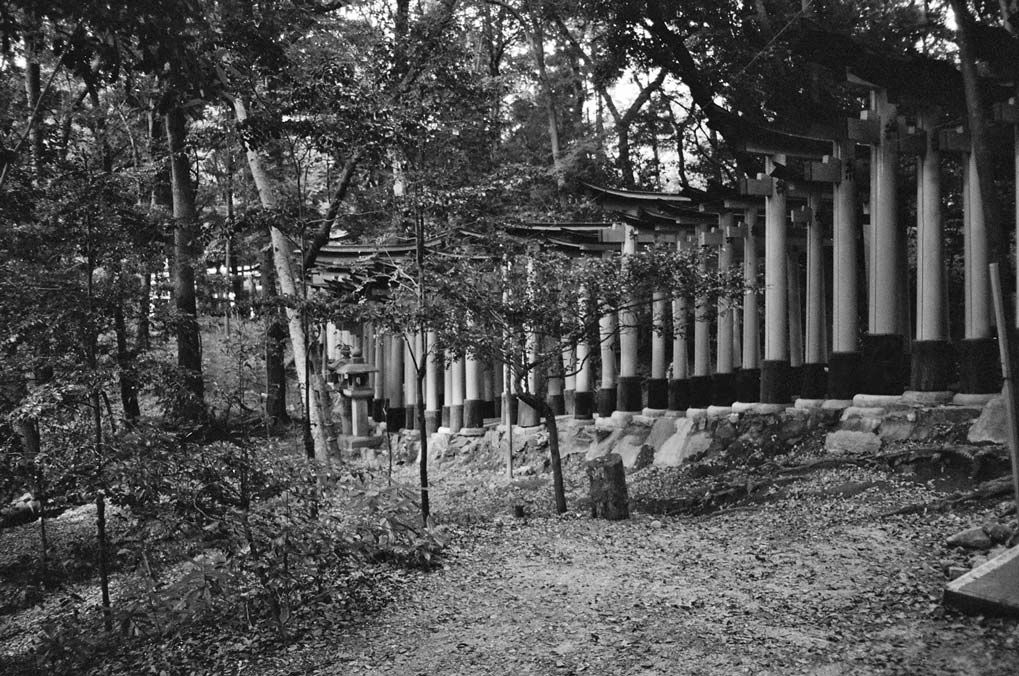
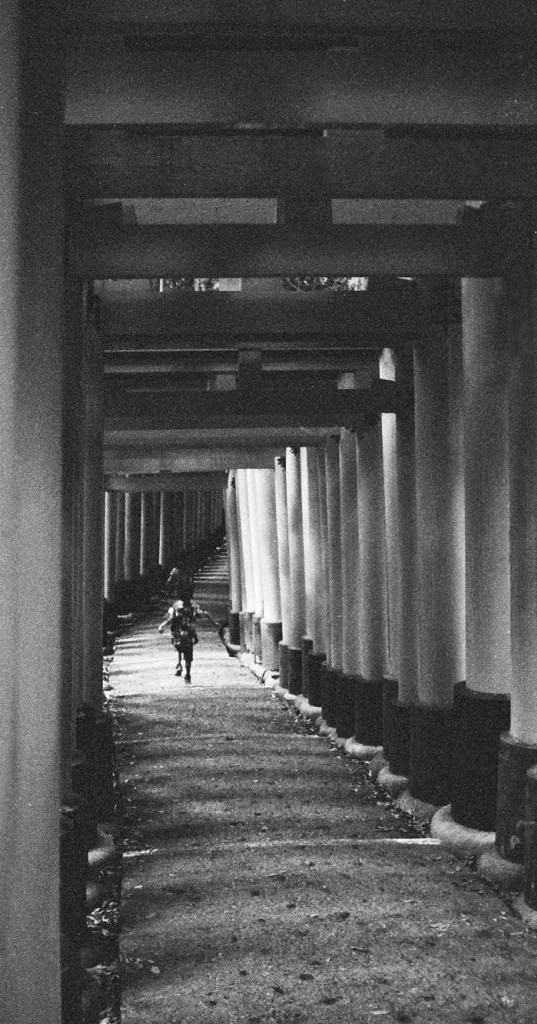
We poked around the shrine a bit, but we were really anxious to get up the mountain and get to the sight that is used for nearly every image of Fushimi Inari, the "tunnel" made of thousands and thousands of torii gates, donated by businesses and individuals from far and wide for a blessing of success, good fortune, and prosperity.
There is nothing that will prepare you for the seeing this, it is truly incredible. But what eventually starts to get to you is the sheer scale of the place and the number of donors it takes to allow something like this to exist
The cost of putting up a torii is related to a couple factors, but the main one is size. Any yahoo can buy small votive torii that they just carry up the mountain and place at whichever shrine, sub shrine, rock alter or sacred hole in a log they want. I'm not kidding. If you look in most of these picks they're like an Easter egg hunt (hey kids, bet you can't find all 1,345,456!) lurking nearly everywhere in the background. Sometimes they're stacked so thick at the shrines you'd think they are making and selling them right there.
The big torii in prominent locations can run to real money, think the yen equivalent of tens to hundreds of thousands of dollars, depending on just how big you want it and just how snazzy.
Even the simplest of arithmetic means we're talking of millions of dollars spent by people believing that Inari is one seriously powerful deity that can seriously get things done.

And it isn't just here, mind you, there are over 30,000 Inari shrines nationwide, not to mention home alters, little shrines scattered about the countryside, and even the slightly stickier Buddhist incarnation of Inari and her/his appearance in numerous temples. If this leads you to think that in the grand amorphous pantheon of Shinto divinity Inari must clearly have a long storied history placing him/her/it above the rest, clearly more powerful than other deities, therefore possessing a more refined and unified worship base....well you'd be completely wrong. There isn't really an Inari in the historical pantheon or official creation story; to fit him/her/it in, he/she/it has been sorta tacked on to other kami. No, Inari's popularity comes from somewhere else. As I briefly alluded to in an earlier post, Inari is the "whatever the heck you want him/her/it to be" of Shinto belief. There is an actual phrase to describe this:
watashi no O-Inari sama, literally "my own Inari".
Anyhow, we're talking Shinto here, so it should be no surprise that the origins of Inari worship are veiled in pea soup thick darkness. Having said that, the history of worship at Inari Mountain has been followed quite some way back in time, archaeologists having found an old ritual site at the southern foot of the 233m "peak" that is around 2000 years old, give or take. What was actually worshiped there is of course somewhat hard to say, but to assume it was a local mountain/fertility/agriculture deity is your usual safe bet. This unknown, unnamed local deity really got a boost with the arrival of an immigrant Korean clan, the Hata, in the 400's. The Hata assumed the local deity as their own protective figure and as they prospered in their new land so did Inari. By the time of the arrival of Buddhism, as well as the later move of the Imperial capital just down the road to future Kyoto (and not hurt by the fact that the capital was established on Hata land, with the clan acting as sort-of real estate brokers on the deal) a Kami going by the name "Inari" had been worshiped just south of the new capital for some centuries. I use quotation marks here because exactly what the origin of this historical "Inari" is remains a bit unclear. It is generally stated as meaning "rice bearer" or "carrying rice" or "rice grows" or some such, but as soon as you scratch the surface of the name and the characters used to write it, things get murky quickly. Basically, as stated above "Inari" doesn't exist in the classical pantheon, and you need to do some etymological contortions to really get the name to make sense. I had been having a hard time trying to figure out the origin of the name for some time, as it seems a rare case where a modern Shinto Kami has been shown to have existed at or near the same site as its pre-historic ancestor and would have expected there to be some commentary on that. Nope, I came across one different explanation of its origins after another, and a couple sources which just gave up and listed all they could find, shrugged their shoulders and moved on. It wasn't until I was reading Dr. Smyers' book that it became clear that despite many attempts to tie the name "Inari" to various readings, concepts, and religions, the problem is the characters used to write the name found in the first extant documents just don't make any sense, possibly reflecting a tradition much older than even our historical understanding of Inari. Heck, its even possible that given it was a Korean immigrant family that brought an indigenous, pre-literate stone age Kami in to the times of recorded history, there's the chance the name "Inari" isn't even of Japanese origin.

What we do know is that a legitimate old timey Kami of the land and its bounty had successfully wriggled past the Buddhist horizon. The transition to the new world was a unique experience for our Inari. From the past came the old land god notions of fertility, good fortune, and the reward of good harvest for those that give proper respect and perform the proper rites to their deities and land; while those that manage to anger the Kami are hit with the kind of wrath that can only come from deities born of mountains and the nastier side of the natural world as understood by old earthy folk traditions. The new Buddhist world Inari strode into brought structure, order and legitimacy to a great many of those old traditions. With the fine line the ruling class had to walk between the Shinto beliefs of the people and the modern "Western" (that is, Chinese) notions of government and religion, Shinto traditions that could couch themselves in the new beliefs were actually welcomed. Inari worship became connected with Buddhism quite early, around the end of the eighth century into the early ninth at latest. The story goes that Inari, already a respected local deity by the time the capital was moved from Nara to Heain-kyo (Kyoto), was made the protective deity of one of the first temples in the new capital, To-ji. Supposedly the construction of the temple's pagoda used timbers cut from Inari Mountain, which pissed the Kami off something fierce. To appease the deity, there grew a great deal of common ritual between the shrine and temple that exists to this day, as well as the awarding of Imperial Rank; both of which popularized and legitimized Inari in the court and emerging urban class' eyes. Because if this, Inari began to fill many different roles for a very disparate audience quite early. The most central concept, which made popularity so accessible across the spectrum was the older surviving notions of good harvest and prosperity. As society began to change from a rice based, agrarian society to a coin based, still mostly agrarian one but with the beginnings of modern commerce and industry, the desire for good fortune and prosperity in the new cities suited Inari just as well as in the old fields.

This widespread belief and support structure continues to evolve and move with the times, and Inari is easily one of the more popular sects in modern Shinto. Over the three day New Years holiday in 2009 approximately 2.7 million people visited Fushimi Inari.
2.7 Million! This powerful, yet fluid and evolving support structure gives the world of Inari the ability to effectively do whatever the heck it wants. Mostly this means not getting dragged into some of the stickier messes that other Shinto shrines have sometimes found themselves involved in within the modern secular state. Although pseudo Imperial connections are expressed between Inari and deities in the ruling family's creation story, and the shrine has the rank of kanpei taisha, "great state-funded shrine", it doesn't seem to have ever really bothered with Imperial ritual. All the official rites and festivals at the shrine are for rice planting, rice harvesting, rice in general and the use of all this as metaphor for modern notions of prosperity and good fortune. Of course, that's not the only thing that sets Fushimi Inari apart, the Shrine still has close connections to Inari's Buddhist sects, which fared better than most during the separation of the two religions during the Meiji Era. Heck, the Shrine and it's affiliated shrines are not even technically part of the overarching National Association of Shrines because post war they didn't want to accept the belief that the Sun Goddess at Ise Shrine (effectively the symbol of the Imperial Family, and therefore of Japan, nominally) was the greatest Kami. Are you beginning to see why I started this post on Shinto with a short talk on notions of individualism, even within rigid societies? Inari laughs at such notions! This headstrong, individualist streak seems to infect nearly every level of modern Inari worship. Even by the baseline nebulous standards of Shinto, the variations in belief are astounding and trying to separate official belief from popular belief, superstition, folk tales, shamanism, urban legends, and hucksterism is nearly impossible. Apparently, the one central common theme is that if someone tells you that you're wrong about some aspect of your beliefs, you are entitled to think they are wrong in return. Otherwise, you can just ignore the Shrine Priests, government, or anyone and do as you please.
So is there anything common across the board; anything from the old traditions that has survived as a universal truth about Inari, even if just in the symbology? Well, yes, kinda. First and foremost is the image of the fox. The fox is the messenger of Inari as well as the guardian of his/her/its shrines, and they are everywhere. There is a bit of push and pull over these foxes, as you may imagine, with the establishment priests of Inari always trying to make sure people are aware that Inari is not, in fact, a fox and you should therefore not actually worship the image of Inari's fox as a symbol of Inari. Having said that, the fox is clearly the accepted symbol of Inari. It greets you when you get off the train, its in all the tourist shops as you approach the shrine, and then as you get to the shrine a male and female pair flank nearly everything all the way to the top of the mountain. Most likely, because there is no single representative image of Inari the fox is just a simple shorthand; but the number of tales of foxes, fox magic, and fox possessions in Japanese folklore leads one to believe that people have a certain cautious reverence for the fox all on its own. As protectors they usually have one of Inari's sacred symbols: the key to the rice granary, though these days usually seen as meaning the key to accessing spiritual or temporal riches

The key is usually paired with another of Inari's symbols, a wish fulfillment jewel, which if not in the mouth is usually under a paw or somewhere else. I thought this was pretty funny because when its in the foxes mouth it looks like a dog playing with a ball, and though I don't think the image of a slobber covered tennis ball is what is supposed to be conjured by this image, there was just no helping it.
Other times the fox has a scroll, representing a book of knowledge or the Lotus Sutra, but usually of Buddhist extraction. And there are a good many other symbols which usually depend on a specific form of Inari or type of desire a given shrine or sub shrine or rock altar is intended for. For example, you will sometimes see a fox cub under the paw or between the front legs, related to hopes for maternity, healthy children, prosperity for ones children and the like.
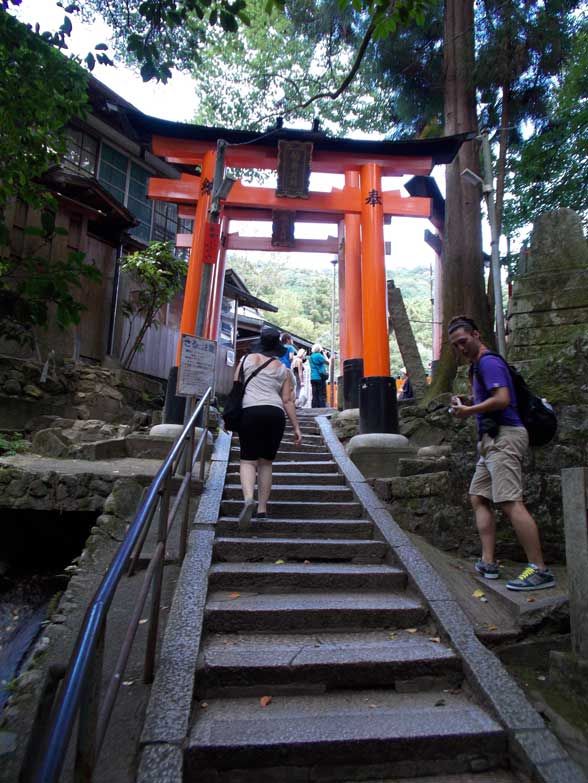
All this was on display in bewildering variety as we climbed the mountain. By most standards, its not an enormous eminence, but once the trail starts climbing it doesn't stop. This wouldn't have been too bad except we really had no idea where the top was. Holly was soldiering on, but climbing 47,000 steps isn't her usual cup of tea.
We stopped for a break at a trail junction for a sit and a cool beverage, and were greeted by an oddly beautiful panorama of the sprawl of modern Japan, almost seeming to flow by down below us
It was a very poignant moment, being surrounded by the leafy expanse of Inari's mountain and yet able to gaze out at modern Japan, decidedly in an older world as we stood up in our tree shaded haunt.

This didn't seem limited to just us. Looking around the junction a good number of others were also taking a break, looking at the world below. It was interesting to notice that everyone, through their panting and puffing seemed to be having a really good time. Holly was enjoying this break too much, she tried lying to herself "this is the top, right?" I knew what she was doing, I had learned some tricks from Divyam, "No, I'm pretty sure this isn't the top". Personally I had decided I was going to the shrine at the top; I'm not sure why, but its good to have goals. I left Holly perched on a sunny rock and headed on up the trail, in turn passing the lower two of the three peaks with their shrines and rock alters. The rock alters are purely popular additions to the mountain: prohibited by the priests in 1869, so many people kept setting them up in the dead of night the priests finally said to heck with it and applied to be able to set them up and regulate them in 1877; problem solved the Inari Way.

I eventually popped out at the highest shrine, paid my respects and bounded back down back down the trail, I had been gone a while.
Holly made a good impression of being sad she hadn't gone all the way up, while being careful not to make it seem she wasn't ready to head down, so as the sun was getting lower and the path through the torii got dim in the shadow of the mountain we headed to the bottom.
From there it was a short train trip back to the station near Yonbanchi where we could catch a quick meal before bed.

So what should one take away from Fushimi Inari? That's a bit of a tricky question, especially given the nature of the Japanese. Is it purely a religious site, the realm of belief and spirituality; important for modern notions of how humans fit into a world created and administered by deities? Or is it more a place where people go to clarify how they fit into a world created and administered by your fellow humans? Is it a cultural place or a place where society bumps into the divine? I think you know by this point that I feel it is both, and it is quite comfortably so. The great number of changes and pressures placed on the average Japanese over the past 150 years has given them almost no room to breathe. The cultural, historical and archaeological literature that has come out over the past couple decades amply illustrates that fact. At present, probably for the first time in a great while, the Japanese seem to be having a discussion among themselves that has been a long time coming. Mainly caused by the economic meltdown of a few years back and its stubborn, persistent after affects, combined with the rise of mainland issues that cause Japan to evaluate and confront its past in fairly uncomfortable ways, the nation is engaged in a period of introspection that seems to be bringing a great many questions about the society's underpinnings to the fore. When you start collectively asking questions like "what went wrong" or "where do we go from here" its only natural for people to get a bit scared and fall back on things they feel bring stability and comfort. In previous posts I've described the odd nature of Shinto in modern Japan as more of a cultural and societal force than a religious one. Inari worship is similar, but there is a bit more of a undercurrent of personal devotion, stemming in great part from the unique one on one conversation someone can have through their own relationship with Inari. To a certain extent, the thing you need to do when evaluating Shinto is look at what is actually being worshipped; that hidden layer is one of the things I feel is so unique about the "religion". As we have seen in other examples, sometimes its the culture or even neighborhood to which you belong that is being worshiped, sometimes the Emperor, or the pursuit of wealth, and yes, sometimes a deity that is willing to intercede on your behalf. However, by contrast I think the central theme with Inari is the ability to worship, well, whatever the heck you want. That personal freedom in a structured world is the real connection people seem to have with Inari. The Kami's real power seems to be in empowering the individual, and that's where the comforting feeling people receive from Inari emanates. In the end you are worshipping individual expression, a little bit of freedom, and the hope that by worshiping in your own way you will receive your reward; and really, what could be more noble than that?