Friday, December 7, 2012

Apparently, The Deer In Nara Want To Kick Your Ass!

Over the previous days we had spent a pretty good bit of time on the bikes. They were definitely the way to get around and get a feel for Kyoto, but to be honest I wasn't going to be sad to be getting to some further off destinations that didn't require pedaling through the August humidity. As a last two wheeled hurrah we headed back downtown by way of Gion and a parfait on the way to some tasty ramen before turning the bikes in. The next day we were heading a bit outside of town to Nara and Fushimi Inari. Originally we were just gonna hit Nara, but Divyam and Yasuko suggested that wasn't really a full day thing and it would be better to hit Inari on our way back. By this point their suggestions were gospel in our books, and I had really wanted to see Inari anyway, so it was off to bed. Bright and early the next morning we took the now familiar stroll down the hill from Yonbanchi to catch a bus to the station for our train to Nara. The city is separated by a low range of hills in an offshoot of the urban smear that stretches from Kyoto all the way down to Osaka, giving it a distinct "next valley over" kinda feel. It is located on the edge of the Kinai, home to the Yamato Plain, birthplace of Japan's Imperial rulers, and was both an intrinsic part of the Court's development but also a world apart.
  The books tell you the Kintetsu Line is the best way to get to Nara, dropping you off literally a couple blocks from Nara-Koen (Nara Park) and most of the sights. But with our JR passes we arrived at the Jr Nara station a bit west, more in the center of the modern city. In reality, its not a long walk, and I would highly recommend it as a good way to wander into town. Walking from the station toward the eastern hills you slowly transition from one Japan to another; from anywhere modern Japan, past the pagoda of Kofukuji into the leafiness of Nara-Koen, a  warren of temples, gardens, woods and museums leading to the main attraction that is Todai-ji. Nara is an interesting place and that walk from station to park is a reminder of how Old Japan was a very far off world indeed, and how much Japanese culture has changed despite the modern feeling that it is a timeless place with unbroken traditions stretching back to time immemorial. It is amazing to think how much Buddhism reshaped the country, and to some degree how recently that change occurred. That is on display so vividly in the Buddhist sites because early Buddhist Japan was in many ways more permanent than early Imperial Japan, making the line of demarcation between pre-Buddhism and post-Buddhism so stark. At the time of Buddhism's arival the Court was oddly very mobile. Settling down to farm came rather slowly in the country, and nomadic hunting and gathering survived quite late. When the people did finally begin to stay in one place and work the land it almost seems the ruling clans were the ones that didn't manage to find a set place to be, possibly because they came from a segment of the populace that wasn't of agrarian background. Like many details from the unknowable pre-literate history of Japan, the reasons why will require the archeologists to weigh in, but the upshot is that for a very long time there was no set capital; this is often ascribed to Shinto taboos, and though that may have been a contributing factor the principal reasons were a bit more subtle than just that. Usually a new Emperor or Empress would move the capital to be closer to his or her own family; moving reign to reign due to the complex marriage ties of the ruling families and each clan's desire to keep the throne in a "safe place" so to speak.
   Eventually, the building of a new palace each reign led to nearly the whole of the Yamato plain being peppered with Imperial Palaces. These palaces were grand enough structures, but their builders seemed to be aware of their transitory nature and they were built in a fairly "light" manner. Aside from the fact their components were often recycled into later palaces, usually they were constructed with posts set directly in the ground with lighter structural members and roofs, a style of construction that rots away beautifully and leaves even the archeologist very little to find. Often there is little more than just a change in color of the dirt to mark the one time location of post holes and a line of gravel that had once been placed where rain ran off the roof to give a fairly decent idea of size and shape of the long vanished structure. In contrast, Buddhist structures were built to last... at least longer than a decade or two. For one thing, posts were set off the ground on stone bases, floors were raised on large rammed earth platforms and the structures were overall built in a way that, honestly, required a bit more planning and organization. All around the whole shebang was built in a style that reflected the simple fact that the temple wasn't expected to move with the passing of an individual. The result of these differences are a comparatively large number of Buddhist temples in their original locations (even if not in their original structures) but no palaces from before the move to Kyoto. Intertwined in the hazy area between the politics and the changing nature of religion of the time is little old Nara. The exact origins of Nara's history are unclear; the presence of quite ancient tombs on the site certainly pushes its history far back into Japan's dark, misty past well before Buddhism arrived. It's location near the Yamato plain likely kept it important as the new ruling clans shuttled their palaces around the region, but its possible it's temple culture may have begun with Buddhist Korean immigrants that settled in the area at a time when mainland concepts of Buddhism and modern imperial government were generally beginning to flow into the island. Whatever the origin, Nara was strategically placed to take advantage of the changing religious and political landscape. But....
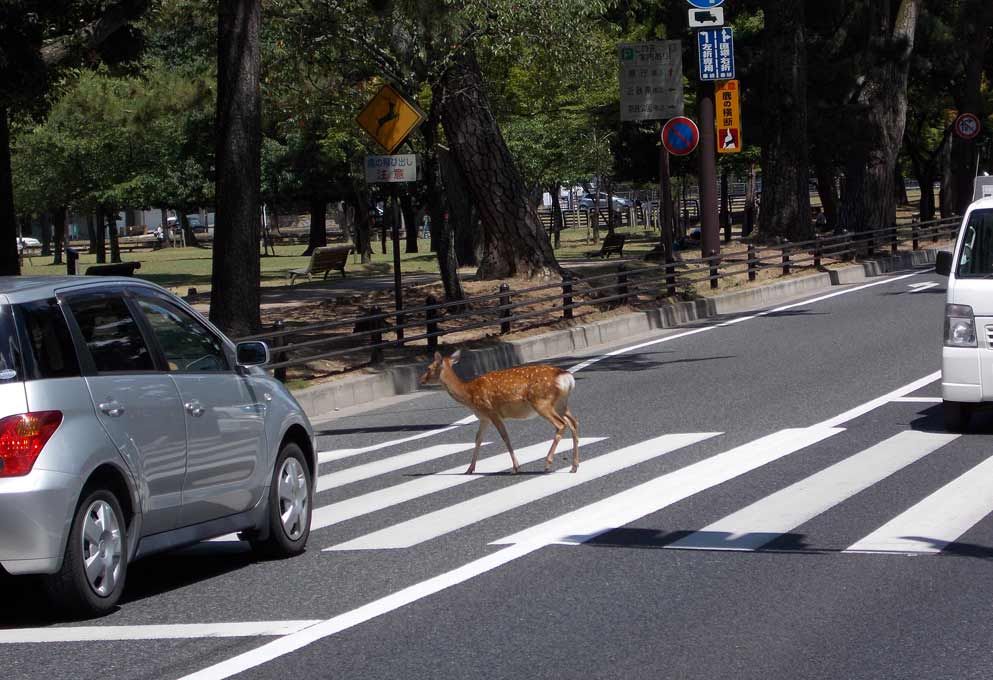
  ....Before we go any further, I must (MUST!) yap a bit about one of the truly most unique things about Nara. History and religion and politics will just have to wait a damned second, because I must (MUST!) talk about the friggen deer in Nara. That's actually their scientific name: Friggen Cervus Nippon...its true, you can look it up. They are members of a very small and exclusive group of edible living things in Japan that don't have to worry about being eaten, and they know it. Simply put, the friggen deer of Nara are, especially on a hot August day, the laziest, most ridiculous creatures on the planet
Supposedly the protective deity of the city arrived riding on the back of a deer, so the critters are now seen as symbols of that founding protection as well as being symbols of the modern city, an army of four legged, pooping mascots. The cynic would point out they're also pretty good for the tourist trade, and at that they are a heckuva lot better of an infestation than the pigeons that clog other tourist jaints like St. Marks Square. You can keep your flying rats, Nara's got friggen deer, man!
Anyhow, the protector of the city/inedible status of these deer has given them plenty of time to completely forget they may have at one time been wild animals and now have the layabout look more akin to large, lazy old dogs right down to the unrepentant countenance (known to canine owners the world over) that says "listen, homes, if you aint got any food to pass my way, then leave me alone cause I got me some serious nappin' to get on with." I'm a dog owner, I'm very familiar with this expression.
So the lil' bastards are everywhere, and they are hilarious, unmitigatedly hilarious. Probably the funniest thing was watching how people just get on with their lives around the four legged goons and how much these truly are "city friggen deer", walking around as if they actually have something to do or someplace to be.
I get the distinct feeling, however, that this many deer put in such close proximity to a long ton of tourists must lead to the occasional fracas not considered to be up to the high standards expected of the messengers of a protective deity. Apparently old ladies and kids are routinely savaged by these silly bastards if the Worlds Greatest Sign (which I am going to have to get on a shirt at some point) is to be believed.
Okay, dammit, back to Nara. Must focus. Today, especially to the outside world, the Japanese seem extremely homogenous. Compared to us Americans, a polyglot mess, the Japanese seem and often actually believe they are as old as the Japanese islands. To look at them or listen to them speak of their heritage is to not realize that they are the result of multiple different waves of immigration as well. As we have seen in other posts, these waves have brought many new ideas and technologies, often ones that had the ability to turn the country on its head. One of the greatest times of cultural exchange with the outside world was in the middle of the first millenium AD. At this time there was a great deal of interaction with the mainland, going as far as actually getting involved in fighting on the Korean peninsula. It was at this time that Buddhism began to reach and be accepted within the ruling class. It may seem strange that a new, foreign religion would be able to make such rapid, unforced inroads into the court of the time but there were some very tangible reasons why that was the case. Some of it may have been fashion, true, but to a large degree it was because it was viewed as necessary. The involvement of Japan in "foreign" mainland matters in Korea for the first time put the island in a position of possibly becoming embroiled in larger conflicts with it's larger more "modern" neighbors. The fears of foreign invasion and later of actual foreign policy interaction with mainland Tang China caused a reaction incredibly similar to that later seen in the aftermath of the Meiji Restoration, when Japan felt it needed to modernize to deal on equal terms with Western powers. At this point in its history the Court felt the need to appear as modern as possible to deal on equal (or at least not too subordinate) footing with that era's Western equivalent, the Chinese. What followed was a time sometimes referred to as the Chinese apprenticeship, with delegations traveling to China to learn about "modern" Imperial rule, Confucian ideas of governance, and Buddhism. Moving in the opposite direction were Chinese scholars, diplomats, and Buddhist missionaries as well as refugees from the fighting on the Korean Peninsula. To the Imperial court, rapidly trying to reshape itself using a Chinese model, the new religious ideals were part of the package. But it wasn't just image, pragmatism and politics at work; to a large degree, the new religion filled a niche within Japanese Imperial culture that the old proto-Shinto folk religions (which for simplicity sake I'm just gonna call Shinto) just didn't fulfill. The old beliefs were drawn from agrarian perspectives of people's interaction with the world around them, and as such were very much based on rural concepts of life within the environment which were largely at odds with the messy, dirty nature of the emerging towns and cities and knockabout realities of governance. A great deal of the day to day activities of the rising urbanism was considered downright impure by Shinto beliefs. The Buddhist missionaries that were newly arrived and the native practitioners of the new religion were quite aware of this and were more than happy to exploit the situation, happily wading into areas that made Shinto distinctly uneasy, like the mess of political thought, medicine, and perhaps most specifically, death.
  As the ruling class absorbed and accepted Buddhism, the temples grew, and grew, and grew. The wealth of Japan then and for a great long time was its land, and as time went on, more and more of that land ended up in the hands of the temples for various reasons. To start with, many temples were founded by wealthy families, Emperors and members of the ruling class for intercession in this life and what came after. However, the transitory nature of the living powerful, pitted against the enduring structure and ideology of Buddhism meant that as the wealthy and powerful came and went, the stability of the new religious establishment tended to concentrate land in temple hands. This was a problem because for much of early Japanese history, taxes were paid in produce rather than coin, and so much land on the Yamato Plain was in the hands of the temples or set aside to support the temples that by the Eighth century very little produce from these home provinces was actually being paid in taxes to the central government. This had the effect of strengthening the power of the provinces, which eventually led directly to some pretty serious societal changes down the line, as some previous posts have shown. Things weren't made any easier by the fact that individual families aligned themselves with certain temples and Buddhist sects and proxy "wars" between these clans were often fought through patronage to the temples and with the assistance of the temple's ever growing masses of manpower. Nara (Heijo at that point) was in the center of a great many of these scrums. As the "Capital" had danced around the Yamato Plain to be close to whichever branch of the ruling class was on the Imperial throne at the time, the power of the Nara temples single mindedly acquired and consolidated it's land holdings. Not that they were truly independent, they knew where their bread was buttered and were very closely intertwined with the Imperial family and the powerful clans that controlled the country, ostensibly acting in accordance with their wishes, though usually when it served to strengthen the temple's interests. A great example of this is Todai-Ji in Nara. In 741, in order to express his own piety, attempt to bring some order to the world of Japanese Buddhism, and spread a more centralized, unified concept of Buddhism, Emperor Shomu issued an edict for the construction of a national system of temples, followed two years later by an edict for the construction of a great sculpture of Vairocana Buddha. Todai-ji, therefore was to be the center of the new system of temples, and was built in a scale to reflect that fact.
This is the Nandaimon, or South Great Gate. The similarity between this structure, from the 13th century, the Sammon at Nanzenji from the 17th, and the Main gate to Heian Jingu from the late 19th is noteworthy. The architecture of Japanese temples and palaces all have the same origin, and the basic elements rarely changed, even as the sects, religions, politics and specific architectural fashions did. The Japanese had received the standard layout of a temple from Korea, who had learned it from the Chinese, who had pretty much just adapted palace architecture by sticking a stupa in the ground plan. A lot of the variety seen in layouts of temples these days mainly reflects the ravages of time and changing fortunes affecting the temple's ability to maintain or rebuild their structures. Todai-ji, as an example, has been subjected to most every form of destruction man and nature can think of. The Nandaimon above was originally built in the 8th century, destroyed by a typhoon, and rebuilt in "Chinese style" 400 years later.
  Inside this mighty gate are two fittingly mighty guardian wrestler figures called Nio protectors. The origins of the Nio imagery is suitably ancient, with roots certainly in ancient Hindu and likely even much older near eastern folk traditions.
They are the Buddhist ancestors of the Komainu you see at Shinto Shrines and are the origin of the paired guardians with the mouth open, mouth closed symbolism. This pair dates to the rebuilding of the Nandaimon and were installed in 1203. They were restored starting in the late eighties, but they seem oddly imprisoned behind a rather coarse chicken wire that apparently makes them as impossible to clean as it is to get a decent picture of them. Filthy or not, they are pretty impressive, and they need to be because its their job to guard the Daibutsu-den, the largest wooden building in the world.
The tale of the temple and the Great Buddha inside is your standard tale of Old Japan Wood Structure Destruction: completed in the 8th century, the Buddha's head fell off from an earthquake in 855; it lost both its seven story pagodas soon after completion due to lightning strikes; the Daibutsu-den itself burned in the 12th century during the Taira-Minamoto Civil War, and again in 1567 during the Sengoku Period. After the last torching the surviving bits of the Buddha sat on the ground with a temporary cover for a century until it was finally all put back together inside a new temple between 1686 and 1709. Its actually pretty inspiring to think of the dedication needed to construct the worlds largest wooden building three times, so if you ever need an example of single minded determination, well...there you go.
As you can see, the scale is incredible, if the little ant like people in its doorways aren't enough to illustrate that fact, just look at how it dwarfs even Holly's big floppy hat!
Of course, the building is not really the draw, but whats inside: the Daibutsu, the Vairocana Buddha, and it too is a lesson in determination.
The first attempts to cast the parts ended in failure, and after 2 years of work with nothing to show for the effort, an enormous team headed by a Korean master was assembled and finally managed to get it done in 4 years. Its casting swallowed up nearly all the copper and bronze in the country, evidenced by a hole in the material record of the country where for a good bit after this time there are virtually no other bronze artifacts to be found. Even some of the other statuary of the temple that were originally of bronze are now represented in clay and wood, the originals likely sacrificed to repairs of the Buddha through the centuries. In fact, its unclear how much of the current piece is original if any; after the fires its likely a lot of it ended up as puddles of molten bronze beneath the ashes. The thing is, this long hard history of failure, destruction and constant restoration gives it a great deal of its own charm which nearly outweighs the bronze its made from.
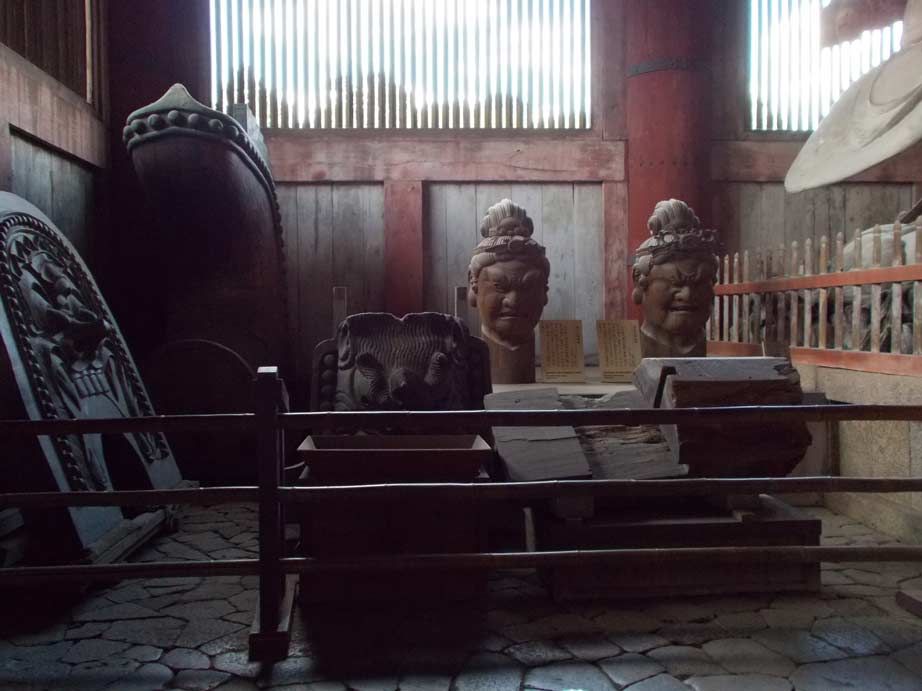
  Being as much a museum as a place of worship these days the entire building is full of artifacts of its original creation, years of rebuilding, additions, and the work needed to this day to maintain the fabric of such an immense structure and its priceless contents.
 We spent a lot longer than I expected wandering around the enormous structure, looking at the numerous displays, the other sculptures which are remarkable in and of themselves (like the Western guardian Komukuten, below), all while soaking in the oddly strange feeling that comes from being inside a structure this damned big.
But eventually it was time to get a move on and do some walking around the rest of the Temple/Shrine/Park grounds. Our next stop was up the hill from the Daibutsuden in the shape of Nigatsu-do (the "Hall of the Second Month") built around 760 and the site of the Shuni-e ceremony which has been performed there every year since...even when a fire started during the ceremony in 1667 and burnt the original structure to the ground. The current building dates from 1669.
If you've got the time, feel free to read up on the ceremony. Personally I kinda lost track somewhere around the start of the second week's activities which follows the preparatory period called the Former Seven Days, which precedes the Latter Seven Days, and is broken up into six periods: Noon Watch, Sunset Watch....erm...Register of the Names....erm...something. Anyhow, the reason to go to Nigatsu-do for the non-Buddhist is because it has a wonderful veranda that gets the refreshing breeze blowing up the hillside and allows a wonderful panorama looking out over the Daibutsuden to Nara below. Is a nice place to get a cold tea and take a break before continuing on your way.
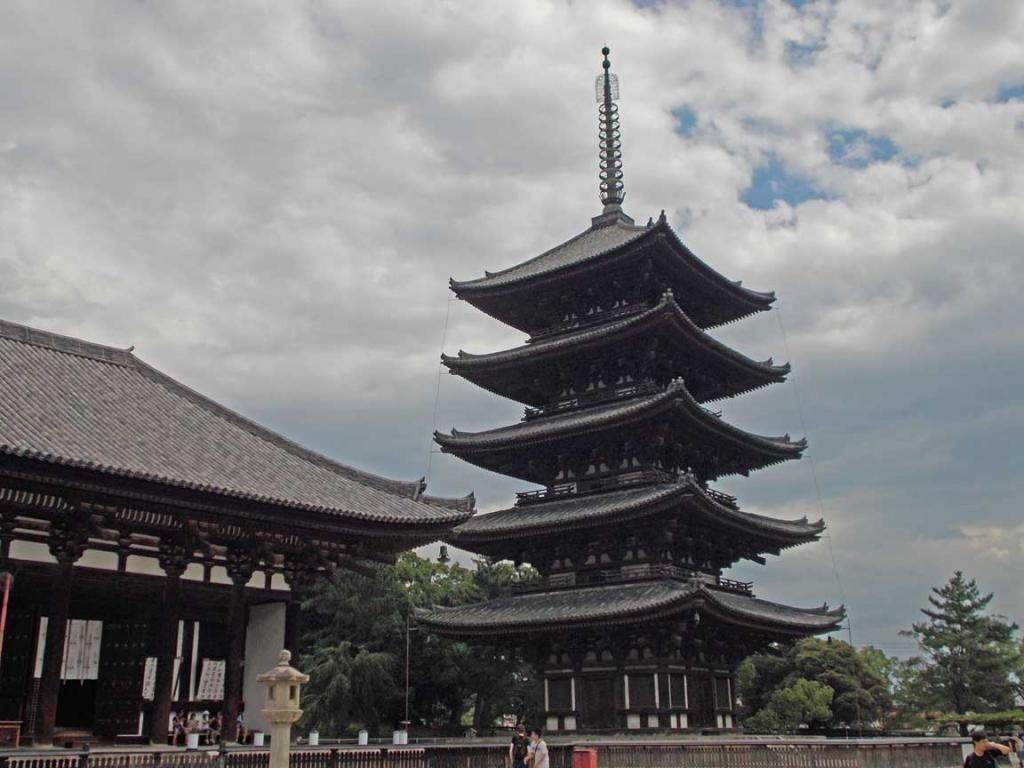
We were enjoying the stroll suggested in the Lonely Planet guide, and it was a pretty good walk around the various Temples and Shrines. After eating lunch at a decent little noodle shop we decided to head back down and have a bit of a wander through town on the way back to the station, passing through Kofukuji, home of the second tallest surviving pagoda in Japan. Note the modern addition of grounding wires running down the corners to prevent the otherwise inevitable fate that seems to await a wooden structure this size topped with a bronze ornament in a land where thunderstorms are common.
  At Kofukuji I was presented with the most annoying sight in the world. They are currently rebuilding the Chukon-do (Central Golden Hall), to the original design using traditional techniques...and they apparently don't think anyone would want to see that. All that's visible is through little openings in the giant warehouse structure they erected to build the temple within: a tip of a beam here, some scaffold there. Meh, I would have happily payed a heft admission fee to have gotten to see that. So we moved on, we popping down the market street where sadly this place wasn't open yet
And then I got another knife at a cute little shop whose main attraction was that in the window were displays of forging a knife and pair of shears step by step. Inside was a friendly ancient guy and his slightly less ancient (but equally friendly) wife. It was one of the few times I really lamented my crummy language skills, because I was really curious about the forging displays but just didn't have the words to find out who made them or why they were in his shop window. With that, it was time to go. Nara was turning its back on me; couldn't see the reconstruction of Chukon-do, the Sweet Soul Cafe wasn't open yet, and I hadn't magically become fluent in Japanese. Apparently my general ambivalence to Buddhism was slaking my karma with chi, or something, so it was time to get outta town and get back to sweet, sweet Shinto...we were headed to Inari.

Saturday, November 17, 2012

Super Fun Nerd Time, GO!!!

Take a moment to pity Holly, the wife. She has patiently been dragged to all manner of horribly educational places because of me, her husband, under the guise of going someplace nice, like Charleston. She can eat, drink, and see all the nice houses she wants, so long as I get to see the Hunley and Fort Sumter. Don't pity her too much, of course; after all she did have a choice in the husband department and likely thought marrying me was a good idea at some point. Also, I haven't subjected her to some of the really evil ones, like Sloss Furnaces; and on the plus side, Fort Sumter does involve a nice scenic boat ride to get there. My long suffering brother has actually had it worse; Holly just has to put up with me, he had to put up with me and my Dad. At a time he was beginning to think about gurlz and other such things important during your formative years, he instead was being dragged all around the United States visiting innumerable ghost towns, mining museums, and train museums. The first two probably weren't so bad, because they were usually located in scenic mountainous parts of Colorado and he could at least pretend he was there with a pretty lady instead of two dorks talking about mining equipment; but the last...well, there's no way you are going to enjoy a train museum unless you just really like trains...or are a kid, at which point liking trains is kinda automatic. I really like trains, always have; love 'em, in fact. From a very young age steam engines were the pinnacle of human achievement to my eyes. I had model railroads, but to be perfectly honest they weren't enough, they weren't actual steam engines. I like big, noisy, smoke belching locomotives. Period. I was pretty sure Holly had no real opinion about trains, not that she doesn't like them, but an ambivalent attitude towards trains at a train museum very quickly turns to boredom. I had seen this happen to my brother many times. There was no helping it, though, there was one place poor Holly was getting dragged in Kyoto and there was no way in hell I was going to miss it: Umekoji Steam Locomotive Museum.
If there's one thing Japanese history will tell you its that the Japanese are very quick to spot a good idea and get on with it. Trains are no exception. Trains weren't particularly old by the time of the Meiji Restoration, but they had come a long way in the century and a half since the introduction of the first practical working steam engines, ones that weren't laboratory curiosities or nifty toys. Primarily, they were built to replace horses, so it should come as no surprise, therefore, that engines to this day are rated in "horse power". You would think a horse is a fairly cheap thing to have running your machinery, but this is not in fact true. Horses need to be fed, they usually need a person or few to take care of them and make sure they are applying power where, when and how its needed, and in the end you are still relying on something as fickle as a living thing to reliably and continuously provide power. The first engines were built to do the tasks that needed to be repetitively and reliably accomplished, pumping water, blowing air, running a large quantity of other machinery.  Men being men, it wasn't long before someone looked at a steam engine and said, "I bet that would be awesome on wheels", and the locomotive was born. Key to this process was a man named Richard Threvithick, he advocated the use of high pressure steam engines and had a tendency to build an engine for some purpose like operating a mill, but before installing it would throw some wheels on and run it around on a track, or down the road, or to a pub, really. These early engines weren't very efficient and were still compared to horses, even being routinely put up against horses in head to head competitions like races an' such. This may all seem rather pointless and unrelated, and perhaps most of it is, but Richard Threvithick, Father of the Locomotive, is important to our story for one more reason than just that achievement, he had a grandson also named Richard who we will come back to in just a little bit.
In the years immediately following the Restoration, the Meiji government sent citizens, tradesmen and professionals all over the world to learn what they had missed in the years the country was closed. Some were sent to schools all around the globe to learn about modern concepts of science, math and engineering; others were sent as ambassadors to represent Japan's interests and learn about other forms of government; and another group was sent on a mission to visit America and Great Britain and learn about this "industrial revolution" thing everyone was talking about. When they returned, they brought the message that for Japan to be able to compete, or even just survive, in the modern world it would need to move from an agrarian based economy to one built on industry and manufacturing. What was really at stake was an attitude that to be able to achieve a position that could free them from unequal treaties and the danger of foreign pressure and influence, they needed to be seen as a country on par with the West. Modernization was not just a means of improving the nation and the lot of its citizens, but a necessity for preserving the nation as an independent institution. This is why the leadership dove into the process with such zeal, and why those underlying fears allowed the process to be easily hijacked in later years by Nationalists and Militarists. That future would have been irrelevant, of course, if the Japanese hadn't been able to so dramatically change the nation's course in the immediate aftermath of the Restoration. What is amazing is how quickly they pulled it off, and the railroads are a great example of how well they did. In 1868 there was nary an inch of rail in Japan, yet the first scheduled rail service began just 4 years later. Through fits and starts and the work of public and private rail companies by 1889 there was 1600km of lines, 3000km by 1893, and 7600km by 1906. At first, everything was imported: engines, rolling stock, rail, everything. This even extended to the engineers, conductors, and machinists to run and maintain it all. These people were not brought over to stay, they were brought over and paid well to teach. Japan would not be contracting out its own industrial revolution, that would have put them at the mercy of the foreign specialists. Instead, the Nation would move into the future with the help of those that had already learned the hard lessons about the newest technologies and then the Japanese would step in as they absorbed those lessons. Many things the Japanese trainees picked up remarkably quick, but locomotives were, at the time, some of the most complicated machines in the world and required far more practical and precision engineering skill than a train carriage. Despite the fact that large scale mechanical engineering did not exist in the country just a couple decades earlier, nor had any Japanese so much as seen the equipment needed to make such things, even that hurdle was rapidly surpassed. The first tentative steps involved modifying imported engines for different tasks, but eventually attempts were made to build an entire homegrown locomotive. In the "its a small world" department, this is where the grandson of Richard Threvithick (Father of the Locomotive, as you may have heard) re-enters our tale. Of the many Britons that went to Japan under contract was Richard F. Threvithick, and it was under his supervision at the Kobe Works that the first Japanese engine was built in 1893. That first engine used castings and components imported from England, but soon entire engines were being built under the supervision of the grandson of the inventor of the locomotive. Hell, get the best I say. Engine technology would grow by leaps and bounds from that point, the Japanese learning about the latest advances from America, Germany and England and then building their own engines, and it wasn't very long before they were looking very modern indeed.
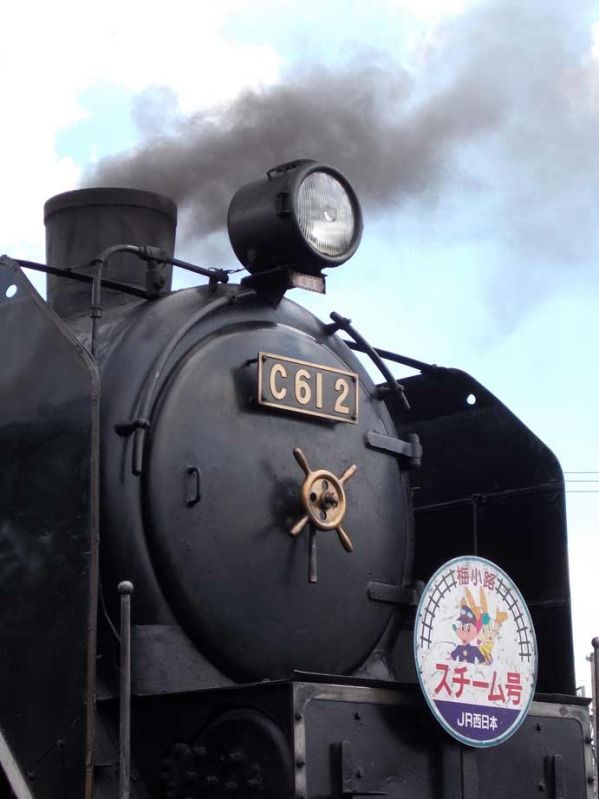
Umekoji was opened in 1972 as part of a celebration to mark 100 years of Japanese railroading. Located not far from modern Kyoto Station, it consists of two main buildings. The museum proper, the old Nijo Station, was built in 1904 and moved to Umekoji in the late 90's. Its chockablock full of stuff, a good proper lot aimed at kids, as it should be, but there's a good selection of live steam models and railroad brickabrak like a coal shoveling trainer, which woulda been fun to get Holly to try (its also got a decent gift shop where I got to buy my very own N-scale D-51). The other main building is the old roundhouse (or "Fan Shaped Locomotive House", as the brochure calls it) which houses all the museum's engines as well as a large variety of big kid nerd artifacts from the heyday of steam, like sectioned displays of engine components and the patterns used to cast them. Cool stuff. There's also usually an engine under steam that you can take for a short ride, and as soon as we arrived were informed it was about to depart so we should go get tickets.
As train rides go, well, its sorta short which isn't too surprising considering its located in the middle of a modern train yard. Pretty much, the engine reverses a couple hundred yards down a piece of track, stops, there's a short talk in Japanese about rail history which for some reason inexplicably ends with the theme song to One Piece, then its back to the station. But hell, whaddya expect for 200円.
Anyway, that's just fine. I would prefer if it really got to stretch its legs, but an engine under steam is an engine under steam, and there is just nothing that sounds, feels and smells like it. I'm normally pretty reserved and considerate in museums, but when I get around trains I get a stoopid grin and revert to my 12 year old self; snickering and getting too close to exhibits, steaming up the glass display cases and getting scolded by museum staff. Except not here, Umekoji is absolutely top notch and is staffed by friendly and enthusiastic people who seem to get a kick out of anyone who has a genuine interest in trains.
Honestly, to me it was a bit unexpected that Umekoji exists at all. In a country that puts such an emphasis in modernity and progress, it actually came as a bit of a surprise to find out there's a fairly dedicated and established rail history crowd, and there are actually a decent few museums and tourist lines running old engines. A large part of this is due to that fact that a good number of these engines ran well into the 60's and made it to the era of a growing awareness of the importance of preservation.
And truly, aside from my love of steam engines, there's good reason to preserve these archaic contraptions and what they accomplished, especially in Japan. In the times before the Restoration most transport was along the coast, by sea. Despite being master builders in wood, the Japanese were never very good at building roads or bridges, so given Japan's topography overland transport of people or goods was difficult at best. This was fine in the late Tokugawa Shogunate, because the government didn't want too many people moving around on their own and they were more than happy to control the coming and going of trade as much as possible. After the Restoration, however, the trains changed all that. With the coming of the knowledge and ability to build the railways, engines and cars, came an ability for people to move around, for whatever reason. This was radical stuff. For centuries you and your family would be born and die in the same place. Going somewhere was a concept very few people got to experience. The trains also changed and improved life in myriad other ways. In bad times the trains eased food shortages, because you could easily move resources from places with surplus to places stricken. In good times it meant you could ship your surplus to a greater variety of markets and buyers, and a greater variety of goods and materials were available to you. It meant labor for the new modernizing society could be more fluid, people could move off the farms to the cities to work in shipyards and factories or move from one city to another to find a better job or education. In many ways the railroads were a greater unifier of Japan than the Shogun or Emperor, allowing the spread of a common Japanese experience in a way never before possible. Not that it has been all smooth sailing and glamorous travel, of course. There were fights over nationalizing the railroads, the role of private "light" railroads, and of course the intense disruptions caused by the Second World War. Even when back on a solid post war footing, led by Allied reconstruction and a return to quasi-public control the railroads have had a challenging time in a changing world. Cars and planes have been a source of competition to Japanese rail just as they were here in the States, but not quite to the extent that they drove the trains to extinction, as happened to virtually all rail traffic outside of our city commuter lines. But even as the country moves through another time of transition, the trains still suit Japan, and are something the Japanese can rightfully be proud of. As much as any of the other symbols and artifacts of Japan's continuous forward progress, the trains are perhaps the only ones you can still use and not just venerate. That's why the rail heritage is important; its a chance, perhaps, to pause and take a look back at the breakneck pace of change over the past 150 years, its relevance underscored by the Shinkansen that rolls by every few minutes. I ended up with a couple other guys watching the museum crew retubing a boiler. Holly was nowhere to be seen, the others guys seemed to have abandoned their families to the AC'd museum as well. To a certain extent there was no point watching a boiler being re-tubed, its a lengthy process and just one of many steps to getting an engine restored. Its not like the crew was gonna wrap it up and take the engine for a spin in the next 20 minutes. It was more about watching these guys who get to do this all day, saving something important, playing with trains. Its the ultimate little kids dream. It was mine. Perhaps there was a touch of envy watching those guys, and that's okay, I'm still just a little kid when I get around trains. To look to my side and see a couple Japanese guys like me just intently watching, probably wishing that could be their job, too...that in itself was worth the trip to Umekoji; but to be a grown-up, and watch actual little kids run around these big wheezing dinosaurs and remember what it was like when I saw my first train, that was almost worth a trip half way around the globe, right there.


Wednesday, November 14, 2012

Its Best to Follow a Post on Religion with Politics

Our next stops were going to be scattered all across Kyoto and involve a whole bunch of pedaling. With our bellies full of another tasty breakfast and our heads awash with Buddhism and shrines it was time to jump on the bikes and get a move on. The first two places we were going to hit, after biking through the gawdawful, peasoup thick humidity that was already rearing its ugly head, were representative of a big change in the leadership of Japan. Nijo Castle and Kinkakuji were the first destinations, but we kinda hit them in reverse chronological order, so I'm gonna deal with them in historical order rather than the order we saw them on our little visit. Aside from just being built 200-odd years apart, they are from completely different worlds. If combined with the previously visited Ginkakuji, the three structures mark a clear line between the Classcal Japan and the birth of the modern nation. Why this great transition? Its all because of sex. Yes sex is a driving, dynamic force for social change and don't let anyone tell you otherwise. You see, when two people have sex, well, you end up getting more people. Its kinda a funny thing. Usually if you want more of something its a whole lotta work, but in the case of people all you need is two of 'em with relevant parts sharing the same overlapping geographic location. This is simple stuff, and if you don't follow me, ask a grown up to explain it. Anyway, you have a bunch of people having sex and soon enough you've got the central authority divorced from countryside, shoguns, the Onin War, Ginkakuji, the old order falling...its a mess. But we're getting ahead of ourselves, here. It all started because if there's one thing the nobility particularly likes to do, its have sex. As a close corollary to the above overview of this sex thing is that the aftermath of a lot of nobles having sex is you end up with a lot more nobles. One example, Emperor Saga in the 9th century, had nearly 50 children by 30 wives. This was a problem in early Japan because given the centralization of power and the rigid rank based stratification of the ruling class, that means you have a lot of nobility running around with very little to do. Can't have a Yamato noble doing the plumbing is what I'm saying. The solution was to demote large numbers of royal nobles. These demoted royals, their opportunities within the court limited, tended to move out into the countryside where a great deal of the day to day running of the country was contracted out to them. This contracting out of tasks had been going on for some time; beginning as far back as the 7th century the Imperial house had become consistently further removed from the country and people it ruled. It relied more and more on elite clans to rule and enforce policies of the emerging state. This outsourcing had created a sort of "noble beauacracy" that used the legitimacy of the legal framework created by the Imperial House to establish a new social order. At first these were clans closely linked to the old classical establishment, but as new noble classes began to establish themselves on the land that actually created the wealth of the state, the order began to shift from the court to the countryside. By nature, these new country lords were destined to cause problems. With so many clans all related back to an Imperial origin the desire to achieve supremacy was too great, and there was near constant low level fighting. These conflicts were still fairly small, often just a few score mounted troops, but sometimes rising to the level of actual battles, usually in the times of disputed Imperial succession or when some of the larger more powerful ruling clans decided to really have it out. But change was coming, and coming fast, and our second stop this day was almost the punctuation for this old era. Indeed, the last heyday of the old Classical order is well represented by Kinkakuji, the Golden Pavillion.
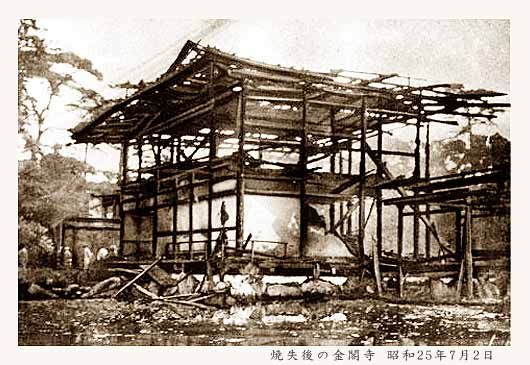
Like many historic Japanese wooden structures, the Pavilion you see today is a reconstruction, dating to 1955.
The original was built in 1394 (or '97, my sources list both dates), and survived all manner of the usual disasters, including when the rest of the compound was torched during the city wide strife of the Onin war...until 1950 when a deranged monk burned it to the ground.
The Pavilion is usually packed; we had been warned to go early or late to avoid the crowds. It certainly was well attended when we were there, and you are kinda herded through: go here, take your picture; now go this way, walk through the serene garden with a few hundred of your new friends; now buy some souvenirs, get some ice cream; goodby. Its worth seeing, no doubt, just remember its not likely to be the most quiet, serene spot you're gonna see in Kyoto. But lets face it, it is a ridiculous structure and to actually have to squint to look at it on a bright summer day is a unique experience.
Kinkakuji was built by the Shogun Ashikaga Yoshimitsu (grandfather of Ginkakuji's builder Ashikaga Yoshimasa) as a retirement villa like the later Ginkakuji; and like it became a Buddhist temple after the Shogun's death. Unlike the time of Ginkakuji, Yoshimitsu ruled over the last gasp of the old classical order, a time of relative peace. Relative, that is, to the period that almost immediately followed. His grandson had none of the interest and ability in leadership that the times required, and before he even passed away a fight over his successor rapidly escalated into a pretty nasty civil war called the Onin War. The aftermath of this nasty scrum left Kyoto almost completely devastated, the Imperial house (which had few resources to start with) completely threadbare, and began a period of near continuous warfare that would last almost uninterrupted for a century and a half. I'm not even going to begin to get into this time, called the Sengoku jidai, because it involves hundreds of dudes killing other dudes, and then being killed by other dudes, who are promptly killed by other dudes. In even general histories of Japan this goes on for page after page after page.....after page, um...after page. The only thing we need to know is that the reason why this had occurred is because no matter how much ruling classes may try, they often can't see and certainly can't stop the progress of the world around them, though sometimes they try to stem the tide until there is just no holding it back. Which brings us back to sex. Not sex among the nobility, but the kind that causes entire populations to grow. The shift of power to the provinces under the new country lords combined with improvements in farming techniques, tools, and strains of crops led to the growth of new "provincial" population centers. The upshot was there was more food to go around, creating greater food stability and less people tending to starve to death. This relative increase in the well being of the commoner, the increased range in which they could grow crops, and slightly decreased likelihood of dying before reproducing a few times caused a population explosion that fueled the expansion of the number of towns, villages and cities and the new social structures and economies within them. Even with all the war and strife of the times, the population grew from around 5 million in the 11th century to around 18 million by the end of the 16th century. Though these new countryside castle towns were essentially independent city states, they were commercially connected to a wider power base than the old court, had a broader base of skills and manpower, and the changes in commerce, warfare, and government this caused was destined to wipe away the old order. Armies were no longer a few hundred or few thousand, but massive organs with tens of thousands and later hundreds of thousands of men. They required logistics and a supply apparatus that could only exist because of the new broadly integrated social structure. For a long while there was an uneasy status quo with the rapidly changing society held in check by the trappings of the old Court structure, but it really just took a bit of a shock, like the Onin War, to yank the lid off the simmering pot and allow everything to boil over. This era of warfare affected all layers of society, but didn't cause a complete collapse, and what emerged at the beginning of the 17th century was a unified Japan that was really unified, not the old "unified" nation that was really just a confederated collection of clans willing to pretend to get along only when they weren't fighting each other at the drop of a hat. The ultimate leaders behind this unification, Oda Nobunaga, Toyotomi Hideyoshi, and finally Tokugawa Ieyasu were products of this new population based order. They had a different attitude to power and where it emanates from, and had new ideas of how to sustain it. No longer content to subcontract out ruling to a group of related nobility, they created a centralized beauracratic government and a structured order designed to keep regional warlords from being able to expand their power through military force. One of the many new instruments of change and societal control was the castle reforms, limiting how many castles a vassal could have in his territory, at the same time using the construction of new castles to tie up other vassal's resources. Nijo Castle is one of the products of this program.
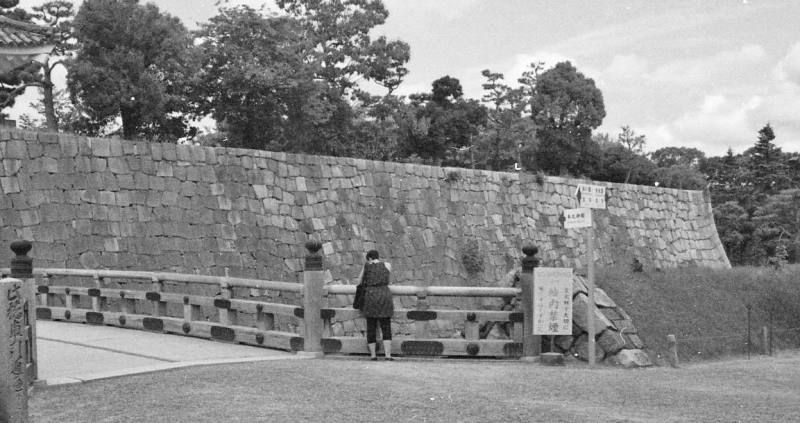
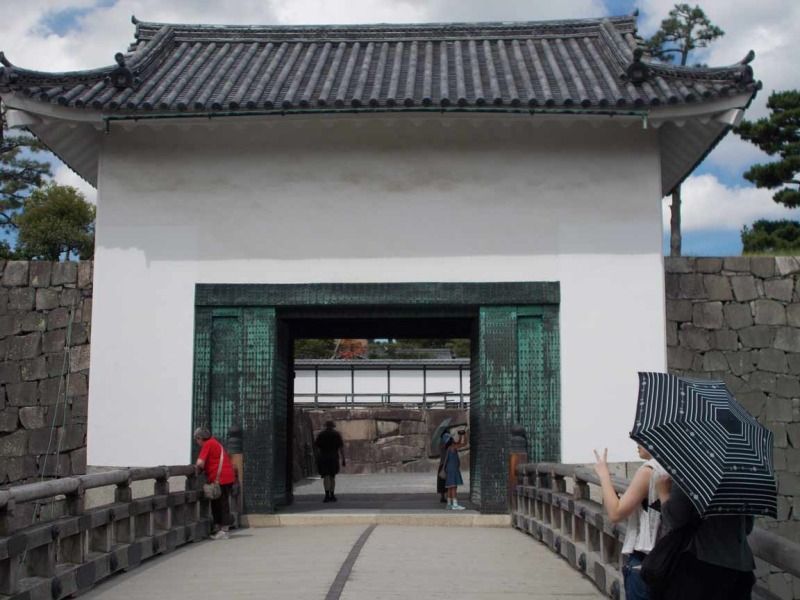
In 1602 Ieyasu ordered the feudal lords of western Japan to construct the castle, which was finally completed by his grandson 20-odd years later. As part of the new restrictions it contained parts from other castles that were dismantled, chiefly Fushimi Castle which donated its five story tower (burned after being struck by lightning in 1750, surprise!). The castle was, in effect, never really used as such. Its main purpose was to be just down the street from the Imperial Palace and right in the heart of Kyoto as a symbol of the new Shogun's power. Its tower was as much for letting the city know it was being watched as it was to defend against any real attack. It was from here that the new era of the Tokugawa Shogunate was begun and from here the edicts officially subjugating the Imperial family and court to the Shogun were issued. The castle was built at a time when the new order was rendering the old castles obsolete, but after a long period of their refinement making it both an anachronism and the pinnacle of the breed. Because of this, it is a very unique structure. It's construction should be very familiar to anyone who has seen European forts built after the advent of gunpowder, with corner turrets and other details refined to make use of and repel firearms and cannon. If you look at the stonework, you once again see that unique Japanese take on construction. There are none of the neat, straight masonry courses common in Europe at the time, as that type of construction is not very good a resisting earthquakes
Instead you get something a little closer in Inca stonework, which was built the way it was for the same reasons, though the Japanese would never do something as blatantly showy. It's construction is unique in other ways, though this has less to do with being able to resit attacks and earthquakes and more about making as big of a statement about power as possible. From the use of stone (itself something of a rarity in Japanese construction), to the sumptuous use of metalwork...
....to the woodwork, this was taking the traditionally light Japanese construction and adding the weight of authority, which is given actual physical mass in the structure of the castle.
The heart of it all is the Ninomaru palace. For the most part it was an administrative center, designed to impress and built to specifically order visitors and petitioners by rank. Sadly there's no photography allowed inside, so you'll have to take my word that it is completely ridiculous. The woodwork is incredible, the gold leaf is so artfully done that unlike Kinkakuji, where it overpowers, here it just adds class; and it is filled with the kinds of over complicated details that you can only find when price is no object, like the creepily hilarious "nightingale floors", designed to prevent sneaky people from sneaking by chirping when walked upon and still hilariously chirping to this day.
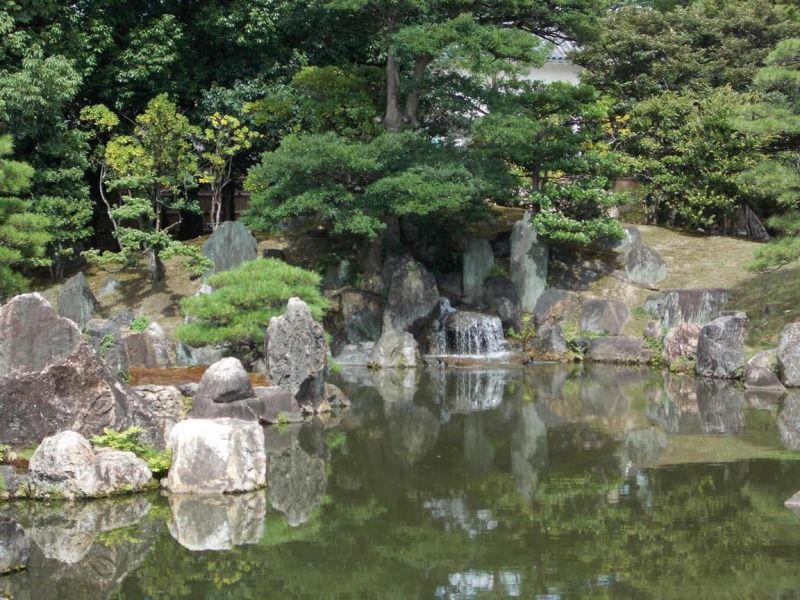
The rest of the grounds are a wonderful place to stroll, the gardens are unique because they are designed to be viewed from specific vantage points within the various palaces and structures on the grounds.
Not surprisingly, a good deal of the old castle is gone. Along with the old tower (as mentioned above, in 1750), there was also the inner palace, the Honmaru, which burned in 1788. On its site today is the Katsura Imperial Family Palace, moved from the Imperial Palace grounds to Nijo's central keep in 1893.
In the end, Nijo Castle's importance lies not so much in the fact that it was particularly central to any battles, but in that it is a symbol of its times. It marked the end of a one era and the beginning of the premodern era. The new leaders of Japan, no longer tied to the old Imperial structure and anxious to separate themselves from that old order, would officially move their seat of power to Edo (modern Tokyo), giving the name to the era of the Tokugawa Shoguns. It would mark the beginning of a time so reactive to the previous instability that there began a period of almost fanatical devotion to enforced stability. It was the coming era after the construction of the Castle that conspicuous displays of wealth and power were viewed as threats, likely where the Japanese notion of "inside" and "outside" behaviors still seen in modern Japan have their origins. The desire for stability also marked the beginning of the time of increased fears of foreign influence, leading to the xenophobia and suspicion that caused the expulsion of foreigners, the attempts to eradicate foreign influences like Christianity, and a general shuttering of the country. Though nearly forgotten and allowed to fall into disrepair over the years, the Castle maintained at least a symbolic connection to the Tokugawa of the Edo period, and that symbolic connection would resurface at the end of that era, as well. In 1863 Iemochi, the 14th and next to last Tokugawa Shogun, escaping the strife in Edo in the wake of the events following Commodore Perry's visit, would be the first Shogun to enter the Castle since the 3rd, Iemitsu, had last been there 230 years earlier. Four years later, Iemochi's son, Yoshinobu would officially hand power back to the Imperial throne from the old Ninomaru palace in Nijo Castle where 250 years earlier the 2nd Tokugawa Shogun had taken it away, thus marking the beginning of the Meiji Restoration.

Saturday, October 27, 2012

Early Mornings Were Made For Religion

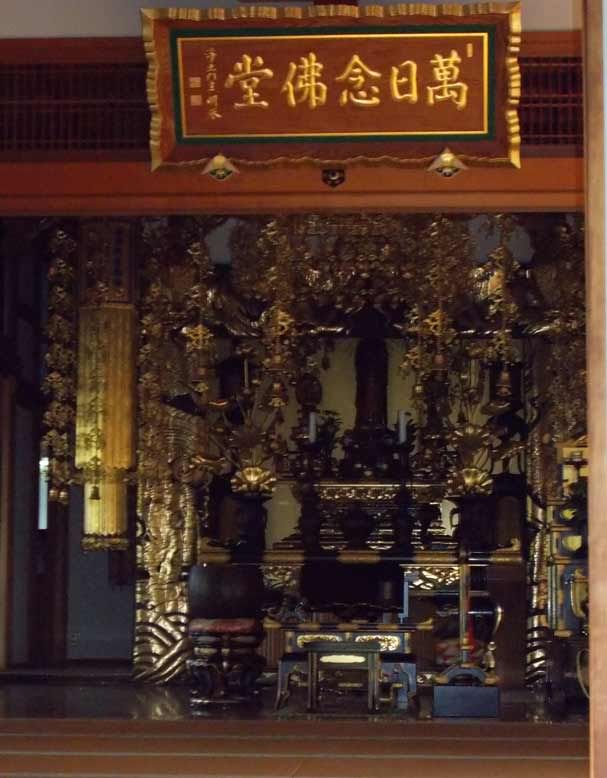
I am a creature of habit. Period. And I'm not casual about it, either, I take it to ridiculous extremes. Its not even a matter of liking what I like and "damn it, that's just how I'm gonna have my coffee, screw you". No, no. My body is programmed a certain way and even if I wanted to do otherwise I'm completely at its mercy. For example, during the week (excluding the occasional aftermath of a serious night before) I wake up at 7:30. Holly can get up and turn on lights, bang pots and pans, play the trombone...no matter, I'm dead to the world until the sun coming through the windows tells me its 7:30 and time to get up. At home this is no problem, in Japan it meant I was getting up at 5 every morning. I'm not sure how they do it in a country that is otherwise so punctual and spot on, but their clocks are just wrong. Wrong, Dammit! This wasn't some lingering effect of jet lag, it lasted the entire trip and was purely due to the fact that at 5 am the sun was the same as 7:30 at home. Harumph. Usually I would use this time to check the news, look at the maps and books to get an idea of the day ahead and wonder when I could get some coffee. This last point was a problem, because Divyam and Yasuko didn't even get up that early. The previous morning I felt I had rushed them into awake mode so had planned with Divyam the night before to take a walk through the Buddhist temple complex at the end of the street so he could get our breakfast together in peace. Next morning, I was up at 5. I went through the maps per usual then decided it was time for a walk. By this point Divyam was up, so he walked me outside and gave me incredibly detailed directions for a walking tour of the temple grounds. I stared at him, taking it as a compliment that he might think my crusty brain was actually capable of remembering it all, and managed to squirrel away "right, straight, right, left, something, right, maybe right again..." By this point Holly was up (she has no attachment to awaking at specific times; when she doesn't have to go to work her body tells her its time to sleep) and got dressed to come along. With a wave and the customary "don't forget to get lost" Divyam sent us on our way down the road to Shinnyo-do, a Tendai temple, and Kurodani, which is Pure Land Sect.
One of the reasons temples are so impressive is because the nature of Buddhism is to focus a great deal of attention on the everyday actions of the individual. This leads to an almost fanatical individual work ethic and an almost deified notion of teamwork. This also leads to some incredible technical achievements, applying the pick of technologies from the various places that Buddhism takes its origins and lets them bloom under the umbrella of a traditional Japanese aesthetic.
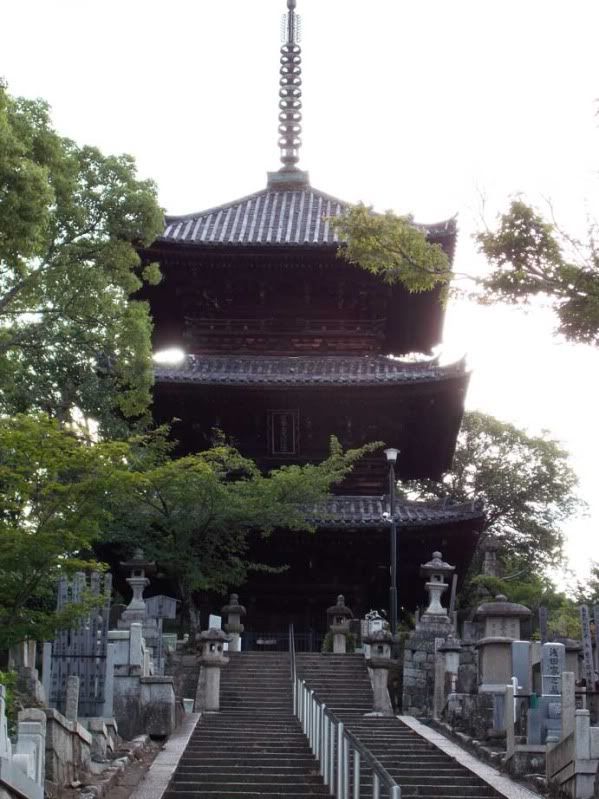
The pagoda is a wonderful example. Its origins lie far west, in Indian and Southeast Asian stupas, but as Buddhism moved northeast, these structures ran into the Chinese and their love of towers. The Chinese built all kinds of towers: watchtowers, towers for astronomical observation, and some that are likely just showing off that they had the ability to build big damned towers. Japan may be great at absorbing what it views as good ideas and running with them, but they certainly have their own native abilities at woodworking that are very peculiar to their geology. Being dead bang on the Rim of Fire makes the ground under your feet pretty seismically active, so a great deal of their monumental woodworking techniques are designed to make structures that can sway and shimmy and not fall down. They are amazing to look at, and on a superficial level seem like they are being pointlessly complicated, but its all about carrying load and safely transmitting it to the ground, which is why pretty much all tall Japanese structures from antiquity are of wood construction. This is the 3 story pagoda of Shinnyo-do, which makes it a veritable shorty by Japanese Pagoda standards. However, the taller you build these things the more likely they are to get hit by lightning. A typical plaque in front of one usually reads something like "Originally constructed 1127, struck by lighting and burned 1186, rebuilt and burned 1375, rebuilt and burned 1583...." The saddest of all was one in Tokyo which was just the foundations and a plaque with two pictures: one of it before it burned and one with it ablaze. Shinnyo-do's pagoda was last rebuilt in 1817.
Buddhism also brought with it metalcasting. Though the Japanese never managed the mighty cast irons or enormous bronzes of the mainland until quite late, they did learn the techniques for large scale bronze founding. Larger pieces are usually fairly later not because the Japanese couldn't manage the techniques, but instead because they had to wait until growing wealth and increased trade allowed the import of larger quantities of copper and bronze. As stated in an earlier post Japan was fairly metal poor. But they got it eventually, and even today a piece the size of this bell would be pretty complex and expensive (that is to say veeerrry expensive). To think of doing this with primitive furnaces (which I consider anything before about 1900) is incredible. I was particularly interested in seeing this bell because I had heard it each morning as I sat waiting for everyone to wake up and could tell by it's tone it was a mighty hunk-o-metal. I was not disappointed.
These ideas and techniques also brought a "western" (read: mainland Asia and India) notion of figurative sculpture, which I'll touch on a bit more when we get to Nara
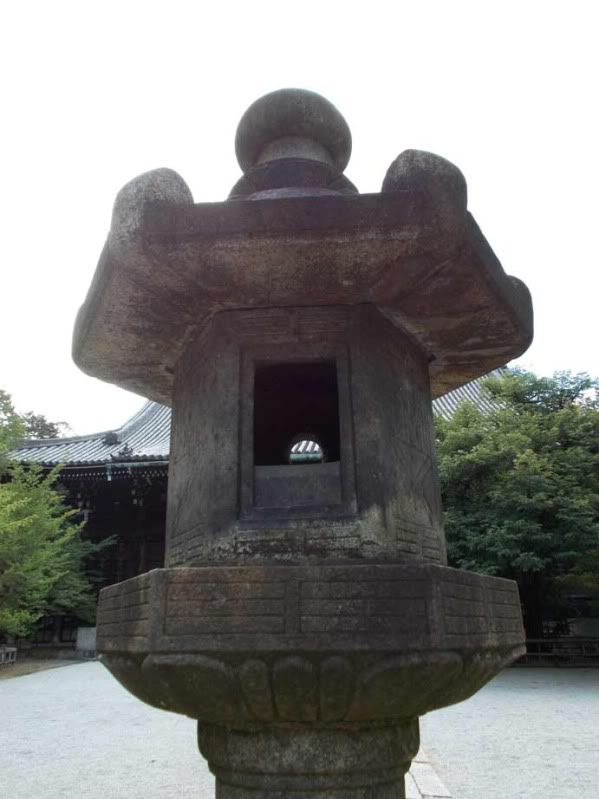
Of course no discussion of the international feel of Japanese Buddhism is complete without our old friend, the Toro Lantern
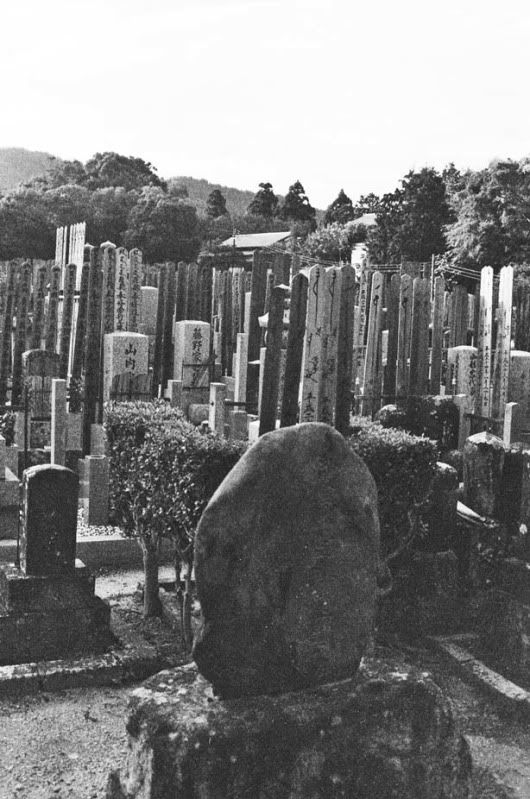
However, one of the most wonderful things we got to experience on this little walk was the incredibly unique experience of a Bhuddhist cemetary.
Nearly 90% of Japanese burials are done with Buddhist rites. Its a complex affair thanks to the incredible shortage of space in the country, as well as some of the vagaries of a Buddhist burial. The incredible cost of land means that the standard is for cremation and burial in compact family plots densely packed within the graveyard. In larger cities the cost and shortage of space has led to some fairly bizarre multi-story grave apartments, but there are still plenty of active cemeteries, especially on temple grounds. Because many family members are buried in the same monument names are usually written on elaborate wooden markers containing sutras and the new name of the deceased, issued by the temple after death and often quite expensive. But then, everything about a burial in Japan is expensive. Not even including the cost of buying a family plot it can be tens of thousands of dollars.
We spent a good bit of time strolling through the quiet of the cemetery, it was close to Obon, the Japanese festival for the dead, so everything was shining and clean in the lead up to the holiday when people traditionally visit the graves of family. Eventually, we popped out in front of Kurodani pagoda, built in 1633. Not sure if its been rebuilt since then.
Buddhism itself is wonderful conceptually, and its easy to see why it is so appealing to the new age set even if it is more at home in the stormy history of its Asian heritage. Ironically, when viewed through the modern vision of contemporary Buddhism as a faith of peace its easy to forget that its great interest in personal inner strength is why it was so favored by the warrior classes. That aside, its focus truly is on personal growth and developement as opposed to the "service" of a deity; and its ultimate goal is to achieve salvation through enlightenment, not simply through obedience to a short checklist of behaviors. As it is, most of the rituals involved are more excercises to strengthen the body and mind rather than for outward displays of piety, reflected in placing such importance on the iconography of serenity.
That's the theory, of course, but popular acceptance tends to come with influence and wealth, and some of the temples were very, very, very influential and very, very, very wealthy, which of course causes problems that have little to do with the attainment of enlightenment.
You might get the impression from this and earlier posts that I'm a bigger fan of Shinto than Buddhism, and in this you would be correct. Not that I think Shinto is somehow better, or that Buddhism is somehow worse, its just that I kinda find Shinto to be...well...more interesting. A great deal of this has to do with the rather murky knowledge of the origins of Shinto. In the case of Japanese Buddhism, those origins are well documented, as it arrived fully formed on the Island's shores. Shinto, by comparison, begins back in the dark ages before writing when there was no Japan or homogenous notion of being Japanese. I feel this is where a great deal of the interest and dynamism lies, for me, in Shinto. Religion in pre-literate societies is by nature a pretty amorphous thing. It can vary from region to region (or even village to village, or farm to farm) and through the passage of time even if it has the same original genesis. Literacy tends to remove this flexibility. When belief can be written down, it becomes doctrine: it can literally be set in stone. Buddhism arrived in Japan from China and Korea with notions of the modern imperial state. So the origins of Imperial Japan formed on the basis of a Chinese model with Buddhism as its spiritual framework and Confucionism as its conscience. As such it quickly began to follow the trend of most pre-modern religions which get in bed with politics. The belief spreads, becomes the framework for belief at court, codified doctrine proves unable to change with the temporal or political world, strife ensues. Eventually its only a matter of time before one of two things happens. Either some young firebrand gets sick of what its all become, rediscovers the true path and nails some scribblings on the church door; or a new ruler comes along, gets fed up with the entrenched power of a given religion and says "I'll divorce whomever I damned well please; oh and I'll take those taxes, too" and replaces it with a new form that is a bit more under his thumb. This was certainly the case with Japanese Buddhism, as seen in the sheer number of different sects, but its particularly relevant to Kyoto's history because the desire to escape from the pervasive power of the Buddhist establishment in Nara was one of the main reasons for moving the capital. Oddly, through all of this what would eventually be called Shinto just sorta plugged along in the background. To a large degree this was due to a rather particular aspect of Buddhism which facilitated its comparatively painless expansion. As it would move into a new society it was assumed the local deities were just the regional incarnations or servants of all the Buddhas, Devas, and Bodisatvas already within the Buddhist pantheon. There was no need to say the local's religious beliefs were wrong, they just had the names wrong. At the state level this led to much pushing and pulling and taking of sides, while the agrarian nature of the Japanese people's world in the early days of Buddhism left them mostly isolated from the political and theological handwriting at court. Therefore, if Buddhism was the connection of the ruling class to the outside world of ideas, then Shinto was the connection between the divine genesis of the ruling class and those that they ruled. It was a tricky balancing act.
  By the time we were done making the loop through the temple grounds and cemeteries, I needed a bit of a mental refresher, so it was time to pop back to the wooded slopes of Yoshida shrine.
Shinto's origins are so nebulous it is better to compare it to something like trying to find a historical Trojan war preserved in the Iliad. We may try to tease out a meaningful understanding from the tantalizing hints, clues, and anachronistic references to its unknowable past, but often the archeologist is more valuable than the folklorist or theologian. In fact, first attempts to truly codify Shinto in the early days of the Restoration in order to make it the central unifying theme behind the Imperial cult were a complete failure and for a few years they just gave up. Not that Shinto was ever completely free of an Imperial connection, the Yamato Clan was as much a part of the pre-history of Shinto as any other pre-Japanese clan, but because Shinto was made of not a single belief system but hundreds (or even thousands) of local folk traditions it was always too fluid of a concept to ever really be brought under central control.
  The archeology shows that a great many modern shrines were built on a location that had been worshiped far back into antiquity. Usually these would be an open air location that rarely had a building or specific set of rites associated with them. Tellingly, they were usually located at the edge of the fields. As the newly arrived farmers cleared the land for agriculture, the shrines were built as a place for humans and Kami (the Japanese notion of a god or spirit, its kinda a catchall word) to interact, in a sense, for placating those spirits that had been shoved out to make way for the fields and to act as a outpost to keep evil spirits from entering the human realm from the wilds beyond, causing harm to crops or humans. They seem to have been viewed as a place to invite Kami to, and also a place to not let Kami beyond. Despite having some common themes, the relative isolation of the "frontier" farming communities led to a very diverse group of traditions and rituals, with Kami too numerous to really keep track of. This all got even more complicated as the people began settling down and an entire other layer of Kami were added as the new town dwellers needed intercession with their own issues removed from those of the farm. The first written references in the Yamato court show how this began evolving into something more central. There is no real reference to agriculture or the relationship between farmers, their families, crops, the "wild" and the Kami, but instead words couched in the terminology of conquest and state power. The emphasis is on the subjugation of one Kami to more powerful Kami. A distinction is beginning to be made between Heavenly and Earthly Kami, with the implication that the Imperial line, far from just interacting with agrarian spirits but instead descended from the Gods that created Japan, had supremacy over the local spirits. In effect, this is the birth of Japan, as the boundaries at issue are no longer those between gods and man, but between man and man.
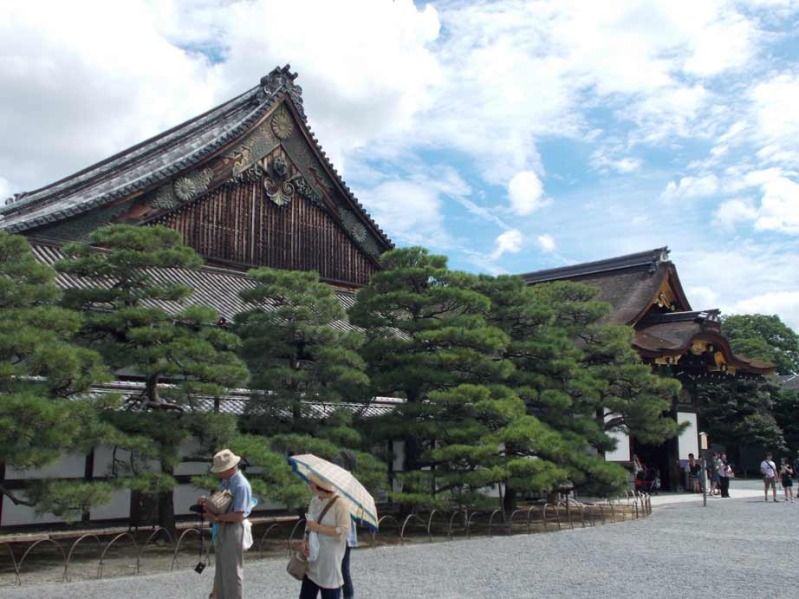
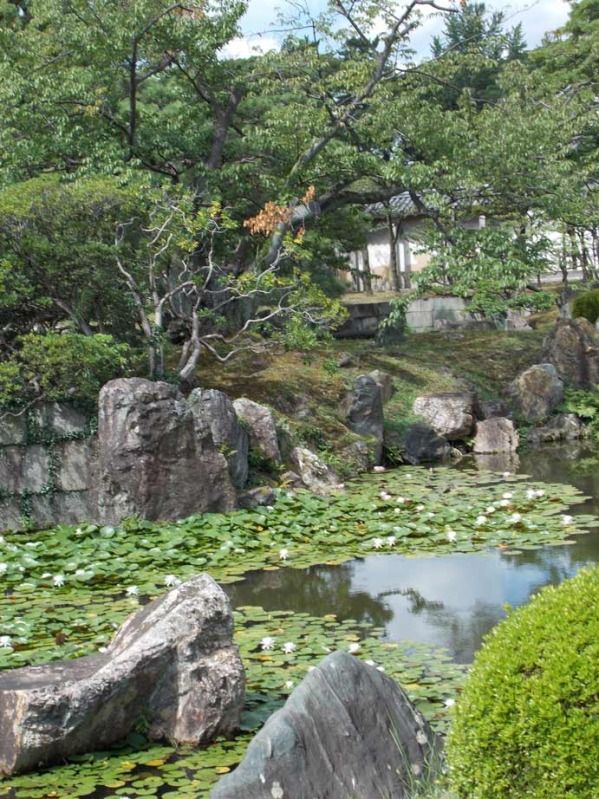
  So how does this little walk around the neighborhood from a Buddhist temple to Yoshida Shrine all fit together? Simple, you see, Yoshida Shrine is one of the birthplaces of Modern Shinto. And oddly enough, the ideas that led to this new view of the definition of Shinto were (surprise!) of Buddhist origin. Buddhism happily absorbed the Shinto Kami and rapidly became the faith of the court and city dwellers and eventually the common folk. In other places this had happened, such as Tibet, China, et. al., the native beliefs were so thoroughly ingested by Buddhism they completely disappeared or left strange regional quirks. But for the Yamato clan, trying to make the claim to the right to rule the entire land, its own creation story was a Shinto creation story, so it couldn't be allowed to just fade away. There was a bit of strife between the two, with some monks making it clear that Buddhism was supreme even over Imperial Shinto; and push back in the form of monks being banned from Imperial Shinto grounds. This reached a head in events such as when Empress Shotoku came very close to giving the Imperial throne to a Buddhist monk, leading to a distinct line being drawn between proto-Shinto and Buddhism. Emperors were not allowed to take Buddhist orders or receive tonsure until retirement, which led to its own problems with retried "Cloistered Emperors" continuing to exercise power from their respective temples. It really got bad after the beginning of the Shogunate, when the actual power moved away from the Imperial throne and into the hands of powerful clans notionally outranked by the Imperial throne but in fact completely in the driver's seat. In these times, the Emperors often didn't have the resources to influence the affairs of state until they had the power and wealth of a temple at their disposal. Despite these tensions, the two institutions, especially outside of Imperial Shinto, were thoroughly intertwined to the point that a great deal of Shinto activity was in the hands of Buddhist Kami worshipers whose role it was to administer Buddhist temple shrines. It was from this Buddhist side of things that the theory began to be formulated that instead of Japanese Kami being manifestations of various Buddhist entities, and therefore of a subservient nature, the Kami were in fact the primary forces because the Buddhas achieved enlightenment, whereas the Kami were already "divine". These ideas were developed and widely disseminated by Yoshida Kanetomo of the priestly family in charge of Yoshida Shrine. He expanded on the emerging notions of Kami supremacy and formulated the theory of "one-and-only" Shinto and pretty shamelessly promoted it (somewhat fraudulently on occasion), presiding over a grand re-imagining of Shinto as central to the Japanese people and state. His masterpiece was the Daigengu, which was an attempt to create a centralized Pantheon of Shinto Kami, empowered and legitimized by connections to Imperial Cult and located at Yoshida Shrine. The architecture of the shrine alone (being octagonal) sets it apart from others, and the surrounding courtyard filled with shrines to all Japan's Kami clearly show this was a new idea, of the shrine as a place to worship Shinto, as opposed to individual Kami. Kanetomo wasn't completely successful, certainly not in his lifetime. It would be many more years before Shinto truly extricated itself from Buddhism, and as you look at the mixed iconography at shrines today you can still see their shared heritage rather than a pure, independent theology. Even at Yoshida's Daigengu ("temple of great origin") you still have Toro lanterns flanking the entrance.
By the time of the Restoration, Shinto was a wonderfully messy mix of surviving folk tradition, Imperial cult, chamber of commerce, and (especially in the countryside) village council. When the government effectively nationalized the institution, it sent people out to try to codify, classify and order things once and for all. As stated earlier, it was nearly impossible. In the end, Shinto was effectively declared a "non-religion" and was devoted almost exclusively to Nationalistic and Imperial ritual, using the early Yamato claim to hereditary descendancy from the Sun Goddess as the basis for Imperial cult. To accomplish this, the surviving aspects of the old folk religions were purged and priests were forbidden from and even punished for performing "religious" activities. Looking back, this was a very strange and pretty unfair move. Shinto's origins lay in a time before there was anything resembling a unified notion of "shinto", a country of Japan, or even a unified concept of the "Japanese". By choosing to focus on one piece of the story of Shinto to the exclusion of all else for pretty bad reasons, its ironic that the remaining folk traditions that survived from the time before Buddhism (when "proto-Shinto" was actually the belief of the proto-Japanese) were removed in order to establish the "indigenous beliefs of the people of Japan" as State Shinto.
  Post war, though being viewed as central to the Emperor Cult and the ultra-nationalism that had helped lead to war, Shinto was mainly left to its own devices. The American occupation forces had much bigger issues and felt that without state support the cult would just fade away; and they may have also been a bit confused by it, anyhow. But no matter what the nationalization of the religion or the disaster of being set adrift post-war might have done, the incredibly fluid nature of Shinto allowed new thinkers the opportunity to move it forward. Some thought it was important to keep the Imperial connections as a way to once again unify the country as it rebuilt itself. Others sought to delve further into it's folkloric past and embrace the great diversity in its heritage, while yet others felt it needed to transition into the realm of a modern universalist religion. But, its ironic that the prewar focus on cultural ritual and Shinto as "social glue" were likely the greatest additions that allowed it to stay relevant. In the end, having no scriptures to amend has its advantages, and little bits of all these ideas helped steer Shinto through the tough postwar era.
  Buddhism certainly suffered more in the time from the restoration to the end of the war. First it had been stripped of the Shinto temples, forfeited its lands, and a great many temples were effectively looted as a movement that had shaped Japan's history likely more than Shinto was decried as a foreign religion. It has recovered a good deal since that time, but has taken its place with most other religions that are trying to find their way in modern secular states, with the resultant declines in attendance and even the shuttering of some temples despite some lingering hints at its previous central role in Japanese life, like the almost universal use of Buddhist rites of burial stated above. The ritual aspect of Shinto has allowed it to continue to be a central social aspect of many communities in a very passive way. A quite large percentage of the population goes to their local shrine to ring in the new year, much the same as tens of thousands cram into Times Square not to please a spirit or Emperor, but to be together as a community. You still see the paper fortunes sold by the shrines tied to ceremonial branches and the placards asking for good grades or to meet a mate hung on racks nearby; these are as likely to be from a devout believer as someone who considers it something you do for "good luck" in the same sense we use it, without really invoking the intercession of a specific deity.
Basically, Shinto is no longer an outpost on the edge of a newly cleared field, holding back untamed nature or evil spirits. But there is still fear, uncertainty and plain old worry out there, and people will always look for those things that make them feel at ease; for some its knowing a spirit is watching out for them, for others the community to which they belong fills that role. Shinto is both of those things, and I think that is why it puts so many at ease still. It is a reminder that you are Japanese and special, that you are part of a community that is both as large as a nation and as small as your neighborhood. And maybe, just maybe, that wish you made with a 100 yen coin to pass your math exam will just come true.