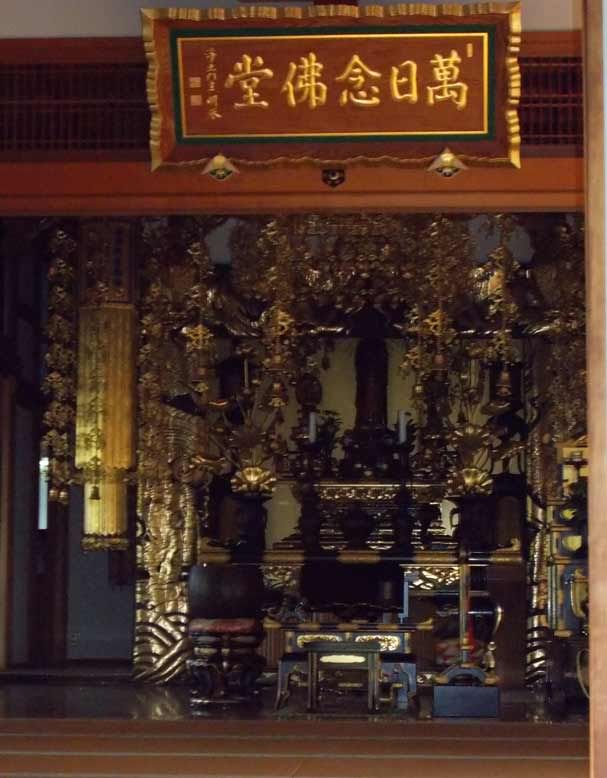
I am a creature of habit. Period. And I'm not casual about it, either, I take it to ridiculous extremes. Its not even a matter of liking what I like and "damn it, that's just how I'm gonna have my coffee, screw you". No, no. My body is programmed a certain way and even if I wanted to do otherwise I'm completely at its mercy. For example, during the week (excluding the occasional aftermath of a serious night before) I wake up at 7:30. Holly can get up and turn on lights, bang pots and pans, play the trombone...no matter, I'm dead to the world until the sun coming through the windows tells me its 7:30 and time to get up. At home this is no problem, in Japan it meant I was getting up at 5 every morning. I'm not sure how they do it in a country that is otherwise so punctual and spot on, but their clocks are just wrong. Wrong, Dammit! This wasn't some lingering effect of jet lag, it lasted the entire trip and was purely due to the fact that at 5 am the sun was the same as 7:30 at home. Harumph. Usually I would use this time to check the news, look at the maps and books to get an idea of the day ahead and wonder when I could get some coffee. This last point was a problem, because Divyam and Yasuko didn't even get up that early. The previous morning I felt I had rushed them into awake mode so had planned with Divyam the night before to take a walk through the Buddhist temple complex at the end of the street so he could get our breakfast together in peace. Next morning, I was up at 5. I went through the maps per usual then decided it was time for a walk. By this point Divyam was up, so he walked me outside and gave me incredibly detailed directions for a walking tour of the temple grounds. I stared at him, taking it as a compliment that he might think my crusty brain was actually capable of remembering it all, and managed to squirrel away "right, straight, right, left, something, right, maybe right again..." By this point Holly was up (she has no attachment to awaking at specific times; when she doesn't have to go to work her body tells her its time to sleep) and got dressed to come along. With a wave and the customary "don't forget to get lost" Divyam sent us on our way down the road to Shinnyo-do, a Tendai temple, and Kurodani, which is Pure Land Sect.

One of the reasons temples are so impressive is because the nature of Buddhism is to focus a great deal of attention on the everyday actions of the individual. This leads to an almost fanatical individual work ethic and an almost deified notion of teamwork. This also leads to some incredible technical achievements, applying the pick of technologies from the various places that Buddhism takes its origins and lets them bloom under the umbrella of a traditional Japanese aesthetic.
The pagoda is a wonderful example. Its origins lie far west, in Indian and Southeast Asian
stupas, but as Buddhism moved northeast, these structures ran into the Chinese and their love of towers. The Chinese built all kinds of towers: watchtowers, towers for astronomical observation, and some that are likely just showing off that they had the ability to build
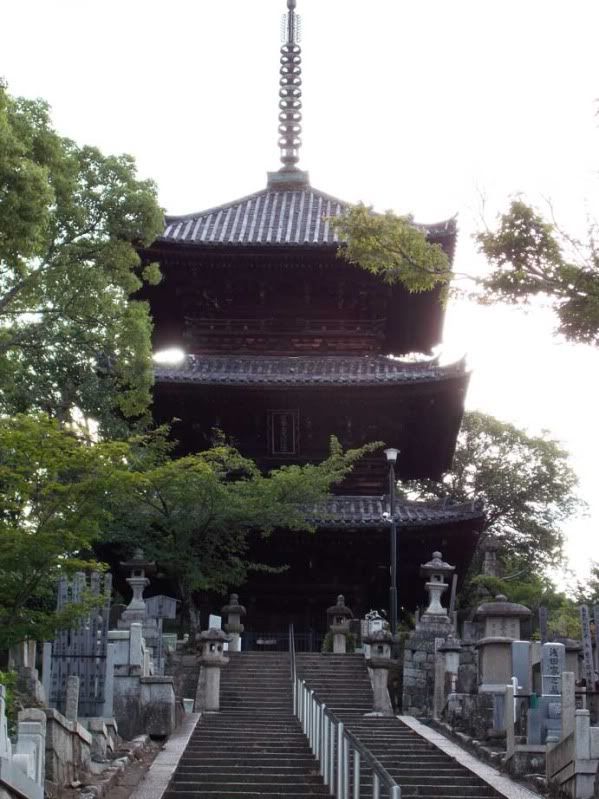
big damned towers. Japan may be great at absorbing what it views as good ideas and running with them, but they certainly have their own native abilities at woodworking that are very peculiar to their geology. Being dead bang on the Rim of Fire makes the ground under your feet pretty seismically active, so a great deal of their monumental woodworking techniques are designed to make structures that can sway and shimmy and not fall down. They are amazing to look at, and on a superficial level seem like they are being pointlessly complicated, but its all about carrying load and safely transmitting it to the ground, which is why pretty much all tall Japanese structures from antiquity are of wood construction. This is the 3 story pagoda of Shinnyo-do, which makes it a veritable shorty by Japanese Pagoda standards. However, the taller you build these things the more likely they are to get hit by lightning. A typical plaque in front of one usually reads something like "Originally constructed 1127, struck by lighting and burned 1186, rebuilt and burned 1375, rebuilt and burned 1583...." The saddest of all was one in Tokyo which was just the foundations and a plaque with two pictures: one of it before it burned and one with it ablaze. Shinnyo-do's pagoda was last rebuilt in 1817.

Buddhism also brought with it metalcasting. Though the Japanese never managed the mighty cast irons or enormous bronzes of the mainland until quite late, they did learn the techniques for large scale bronze founding. Larger pieces are usually fairly later not because the Japanese couldn't manage the techniques, but instead because they had to wait until growing wealth and increased trade allowed the import of larger quantities of copper and bronze. As stated in an earlier post Japan was fairly metal poor. But they got it eventually, and even today a piece the size of this bell would be pretty complex and expensive (that is to say veeerrry expensive). To think of doing this with primitive furnaces (which I consider anything before about 1900) is incredible. I was particularly interested in seeing this bell because I had heard it each morning as I sat waiting for everyone to wake up and could tell by it's tone it was a mighty hunk-o-metal. I was not disappointed.

These ideas and techniques also brought a "western" (read: mainland Asia and India) notion of figurative sculpture, which I'll touch on a bit more when we get to Nara
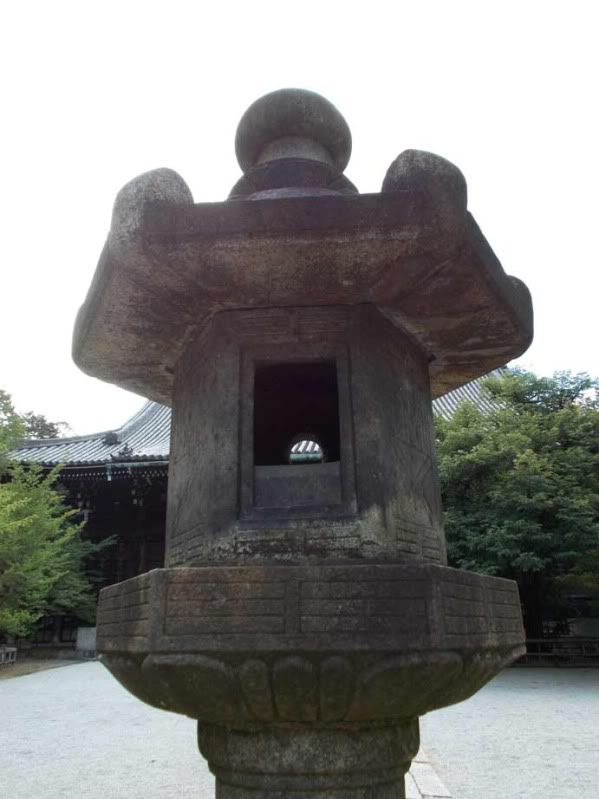
Of course no discussion of the international feel of Japanese Buddhism is complete without our old friend, the Toro Lantern
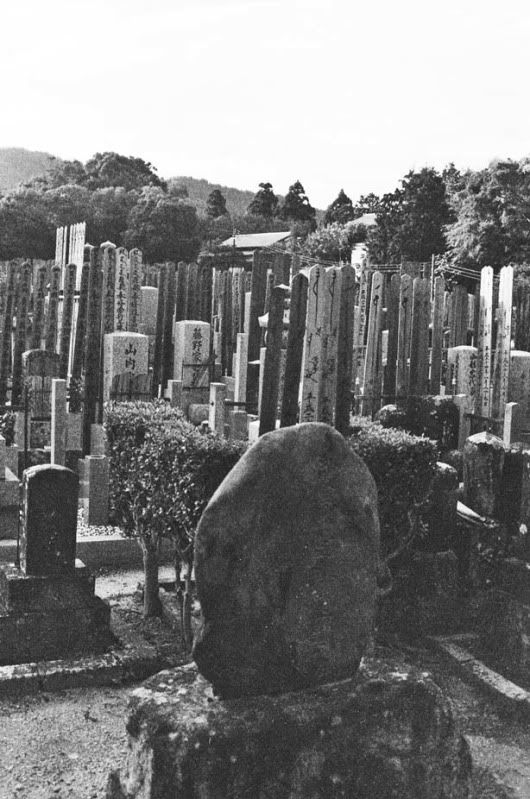
However, one of the most wonderful things we got to experience on this little walk was the incredibly unique experience of a Bhuddhist cemetary.


Nearly 90% of Japanese burials are done with Buddhist rites. Its a complex affair thanks to the incredible shortage of space in the country, as well as some of the vagaries of a Buddhist burial. The incredible cost of land means that the standard is for cremation and burial in compact family plots densely packed within the graveyard. In larger cities the cost and shortage of space has led to some fairly bizarre multi-story grave apartments, but there are still plenty of active cemeteries, especially on temple grounds. Because many family members are buried in the same monument names are usually written on elaborate wooden markers containing sutras and the new name of the deceased, issued by the temple after death and often quite expensive. But then, everything about a burial in Japan is expensive. Not even including the cost of buying a family plot it can be tens of thousands of dollars.

We spent a good bit of time strolling through the quiet of the cemetery, it was close to Obon, the Japanese festival for the dead, so everything was shining and clean in the lead up to the holiday when people traditionally visit the graves of family. Eventually, we popped out in front of Kurodani pagoda, built in 1633. Not sure if its been rebuilt since then.

Buddhism itself is wonderful conceptually, and its easy to see why it is so appealing to the new age set even if it is more at home in the stormy history of its Asian heritage. Ironically, when viewed through the modern vision of contemporary Buddhism as a faith of peace its easy to forget that its great interest in personal inner strength is why it was so favored by the warrior classes. That aside, its focus truly is on personal growth and developement as opposed to the "service" of a deity; and its ultimate goal is to achieve salvation through enlightenment, not simply through obedience to a short checklist of behaviors. As it is, most of the rituals involved are more excercises to strengthen the body and mind rather than for outward displays of piety, reflected in placing such importance on the iconography of serenity.

That's the theory, of course, but popular acceptance tends to come with influence and wealth, and some of the temples were very, very, very influential and very, very, very wealthy, which of course causes problems that have little to do with the attainment of enlightenment.

You might get the impression from this and earlier posts that I'm a bigger fan of Shinto than Buddhism, and in this you would be correct. Not that I think Shinto is somehow better, or that Buddhism is somehow worse, its just that I kinda find Shinto to be...well...more interesting. A great deal of this has to do with the rather murky knowledge of the origins of Shinto. In the case of Japanese Buddhism, those origins are well documented, as it arrived fully formed on the Island's shores. Shinto, by comparison, begins back in the dark ages before writing when there was no Japan or homogenous notion of being Japanese. I feel this is where a great deal of the interest and dynamism lies, for me, in Shinto. Religion in pre-literate societies is by nature a pretty amorphous thing. It can vary from region to region (or even village to village, or farm to farm) and through the passage of time even if it has the same original genesis. Literacy tends to remove this flexibility. When belief can be written down, it becomes doctrine: it can literally be set in stone. Buddhism arrived in Japan from China and Korea with notions of the modern imperial state. So the origins of Imperial Japan formed on the basis of a Chinese model with Buddhism as its spiritual framework and Confucionism as its conscience. As such it quickly began to follow the trend of most pre-modern religions which get in bed with politics. The belief spreads, becomes the framework for belief at court, codified doctrine proves unable to change with the temporal or political world, strife ensues. Eventually its only a matter of time before one of two things happens. Either some young firebrand gets sick of what its all become, rediscovers the true path and nails some scribblings on the church door; or a new ruler comes along, gets fed up with the entrenched power of a given religion and says "I'll divorce whomever I damned well please; oh and I'll take those taxes, too" and replaces it with a new form that is a bit more under his thumb. This was certainly the case with Japanese Buddhism, as seen in the sheer number of different sects, but its particularly relevant to Kyoto's history because the desire to escape from the pervasive power of the Buddhist establishment in Nara was one of the main reasons for moving the capital. Oddly, through all of this what would eventually be called Shinto just sorta plugged along in the background. To a large degree this was due to a rather particular aspect of Buddhism which facilitated its comparatively painless expansion. As it would move into a new society it was assumed the local deities were just the regional incarnations or servants of all the Buddhas, Devas, and Bodisatvas already within the Buddhist pantheon. There was no need to say the local's religious beliefs were wrong, they just had the names wrong. At the state level this led to much pushing and pulling and taking of sides, while the agrarian nature of the Japanese people's world in the early days of Buddhism left them mostly isolated from the political and theological handwriting at court. Therefore, if Buddhism was the connection of the ruling class to the outside world of ideas, then Shinto was the connection between the divine genesis of the ruling class and those that they ruled. It was a tricky balancing act.
By the time we were done making the loop through the temple grounds and cemeteries, I needed a bit of a mental refresher, so it was time to pop back to the wooded slopes of Yoshida shrine.

Shinto's origins are so nebulous it is better to compare it to something like trying to find a historical Trojan war preserved in the Iliad. We may try to tease out a meaningful understanding from the tantalizing hints, clues, and anachronistic references to its unknowable past, but often the archeologist is more valuable than the folklorist or theologian. In fact, first attempts to truly codify Shinto in the early days of the Restoration in order to make it the central unifying theme behind the Imperial cult were a complete failure and for a few years they just gave up. Not that Shinto was ever completely free of an Imperial connection, the Yamato Clan was as much a part of the pre-history of Shinto as any other pre-Japanese clan, but because Shinto was made of not a single belief system but hundreds (or even thousands) of local folk traditions it was always too fluid of a concept to ever really be brought under central control.
The archeology shows that a great many modern shrines were built on a location that had been worshiped far back into antiquity. Usually these would be an open air location that rarely had a building or specific set of rites associated with them. Tellingly, they were usually located at the edge of the fields. As the newly arrived farmers cleared the land for agriculture, the shrines were built as a place for humans and Kami (the Japanese notion of a god or spirit, its kinda a catchall word) to interact, in a sense, for placating those spirits that had been shoved out to make way for the fields and to act as a outpost to keep evil spirits from entering the human realm from the wilds beyond, causing harm to crops or humans. They seem to have been viewed as a place to invite Kami to, and also a place to not let Kami beyond. Despite having some common themes, the relative isolation of the "frontier" farming communities led to a very diverse group of traditions and rituals, with Kami too numerous to really keep track of. This all got even more complicated as the people began settling down and an entire other layer of Kami were added as the new town dwellers needed intercession with their own issues removed from those of the farm. The first written references in the Yamato court show how this began evolving into something more central. There is no real reference to agriculture or the relationship between farmers, their families, crops, the "wild" and the Kami, but instead words couched in the terminology of conquest and state power. The emphasis is on the subjugation of one Kami to more powerful Kami. A distinction is beginning to be made between Heavenly and Earthly Kami, with the implication that the Imperial line, far from just interacting with agrarian spirits but instead descended from the Gods that created Japan, had supremacy over the local spirits. In effect, this is the birth of Japan, as the boundaries at issue are no longer those between gods and man, but between man and man.
So how does this little walk around the neighborhood from a Buddhist temple to Yoshida Shrine all fit together? Simple, you see, Yoshida Shrine is one of the birthplaces of Modern Shinto. And oddly enough, the ideas that led to this new view of the definition of Shinto were (surprise!) of Buddhist origin. Buddhism happily absorbed the Shinto Kami and rapidly became the faith of the court and city dwellers and eventually the common folk. In other places this had happened, such as Tibet, China, et. al., the native beliefs were so thoroughly ingested by Buddhism they completely disappeared or left strange regional quirks. But for the Yamato clan, trying to make the claim to the right to rule the entire land, its own creation story was a Shinto creation story, so it couldn't be allowed to just fade away. There was a bit of strife between the two, with some monks making it clear that Buddhism was supreme even over Imperial Shinto; and push back in the form of monks being banned from Imperial Shinto grounds. This reached a head in events such as when Empress Shotoku came very close to giving the Imperial throne to a Buddhist monk, leading to a distinct line being drawn between proto-Shinto and Buddhism. Emperors were not allowed to take Buddhist orders or receive tonsure until retirement, which led to its own problems with retried "Cloistered Emperors" continuing to exercise power from their respective temples. It really got bad after the beginning of the Shogunate, when the actual power moved away from the Imperial throne and into the hands of powerful clans notionally outranked by the Imperial throne but in fact completely in the driver's seat. In these times, the Emperors often didn't have the resources to influence the affairs of state until they had the power and wealth of a temple at their disposal. Despite these tensions, the two institutions, especially outside of Imperial Shinto, were thoroughly intertwined to the point that a great deal of Shinto activity was in the hands of Buddhist Kami worshipers whose role it was to administer Buddhist temple shrines. It was from this Buddhist side of things that the theory began to be formulated that instead of Japanese Kami being manifestations of various Buddhist entities, and therefore of a subservient nature, the Kami were in fact the primary forces because the Buddhas
achieved enlightenment, whereas the Kami were already "divine". These ideas were developed and widely disseminated by Yoshida Kanetomo of the priestly family in charge of Yoshida Shrine. He expanded on the emerging notions of Kami supremacy and formulated the theory of "one-and-only" Shinto and pretty shamelessly promoted it (somewhat fraudulently on occasion), presiding over a grand re-imagining of Shinto as central to the Japanese people and state. His masterpiece was the Daigengu, which was an attempt to create a centralized Pantheon of Shinto Kami, empowered and legitimized by connections to Imperial Cult and located at Yoshida Shrine. The architecture of the shrine alone (being octagonal) sets it apart from others, and the surrounding courtyard filled with shrines to all Japan's Kami clearly show this was a new idea, of the shrine as a place to worship Shinto, as opposed to individual Kami. Kanetomo wasn't completely successful, certainly not in his lifetime. It would be many more years before Shinto truly extricated itself from Buddhism, and as you look at the mixed iconography at shrines today you can still see their shared heritage rather than a pure, independent theology. Even at Yoshida's Daigengu ("temple of great origin") you still have Toro lanterns flanking the entrance.

By the time of the Restoration, Shinto was a wonderfully messy mix of surviving folk tradition, Imperial cult, chamber of commerce, and (especially in the countryside) village council. When the government effectively nationalized the institution, it sent people out to try to codify, classify and order things once and for all. As stated earlier, it was nearly impossible. In the end, Shinto was effectively declared a "non-religion" and was devoted almost exclusively to Nationalistic and Imperial ritual, using the early Yamato claim to hereditary descendancy from the Sun Goddess as the basis for Imperial cult. To accomplish this, the surviving aspects of the old folk religions were purged and priests were forbidden from and even punished for performing "religious" activities. Looking back, this was a very strange and pretty unfair move. Shinto's origins lay in a time before there was anything resembling a unified notion of "shinto", a country of Japan, or even a unified concept of the "Japanese". By choosing to focus on one piece of the story of Shinto to the exclusion of all else for pretty bad reasons, its ironic that the remaining folk traditions that survived from the time before Buddhism (when "proto-Shinto" was
actually the belief of the proto-Japanese) were removed in order to establish the "indigenous beliefs of the people of Japan" as State Shinto.
Post war, though being viewed as central to the Emperor Cult and the ultra-nationalism that had helped lead to war, Shinto was mainly left to its own devices. The American occupation forces had much bigger issues and felt that without state support the cult would just fade away; and they may have also been a bit confused by it, anyhow. But no matter what the nationalization of the religion or the disaster of being set adrift post-war might have done, the incredibly fluid nature of Shinto allowed new thinkers the opportunity to move it forward. Some thought it was important to keep the Imperial connections as a way to once again unify the country as it rebuilt itself. Others sought to delve further into it's folkloric past and embrace the great diversity in its heritage, while yet others felt it needed to transition into the realm of a modern universalist religion. But, its ironic that the prewar focus on cultural ritual and Shinto as "social glue" were likely the greatest additions that allowed it to stay relevant. In the end, having no scriptures to amend has its advantages, and little bits of all these ideas helped steer Shinto through the tough postwar era.
Buddhism certainly suffered more in the time from the restoration to the end of the war. First it had been stripped of the Shinto temples, forfeited its lands, and a great many temples were effectively looted as a movement that had shaped Japan's history likely more than Shinto was decried as a foreign religion. It has recovered a good deal since that time, but has taken its place with most other religions that are trying to find their way in modern secular states, with the resultant declines in attendance and even the shuttering of some temples despite some lingering hints at its previous central role in Japanese life, like the almost universal use of Buddhist rites of burial stated above. The ritual aspect of Shinto has allowed it to continue to be a central social aspect of many communities in a very passive way. A quite large percentage of the population goes to their local shrine to ring in the new year, much the same as tens of thousands cram into Times Square not to please a spirit or Emperor, but to be together as a community. You still see the paper fortunes sold by the shrines tied to ceremonial branches and the placards asking for good grades or to meet a mate hung on racks nearby; these are as likely to be from a devout believer as someone who considers it something you do for "good luck" in the same sense we use it, without really invoking the intercession of a specific deity.

Basically, Shinto is no longer an outpost on the edge of a newly cleared field, holding back untamed nature or evil spirits. But there is still fear, uncertainty and plain old worry out there, and people will always look for those things that make them feel at ease; for some its knowing a spirit is watching out for them, for others the community to which they belong fills that role. Shinto is both of those things, and I think that is why it puts so many at ease still. It is a reminder that you are Japanese and special, that you are part of a community that is both as large as a nation and as small as your neighborhood. And maybe, just maybe, that wish you made with a 100 yen coin to pass your math exam will just come true.