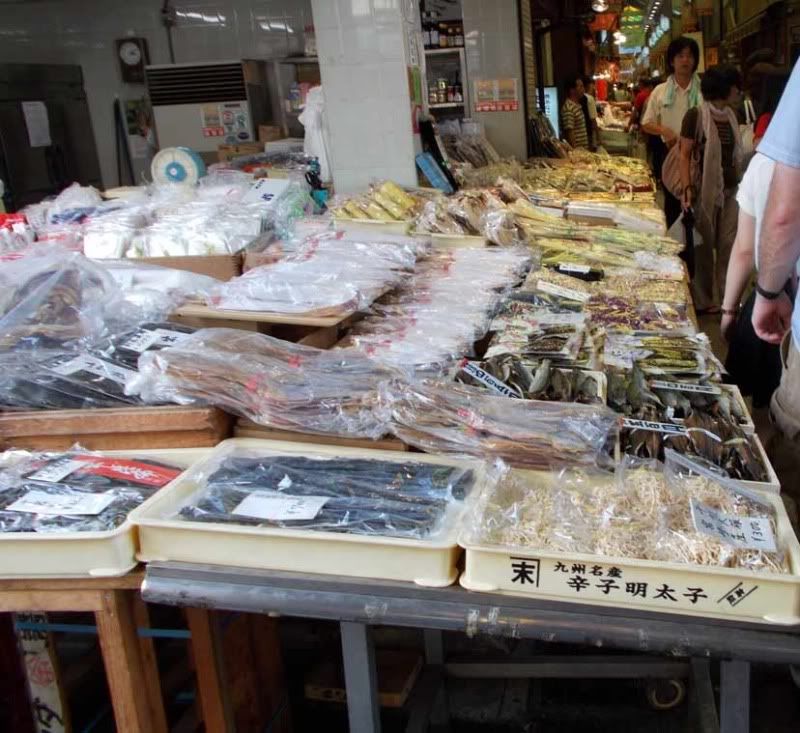
It was time for a change of pace, so jumping back on the bikes we rode past more shrines and temples and headed for the more Downtown-ish part of town. We kinda chose the wrong route, crossing the Kamo River over the Shijo bridge and having to walk the bikes through a densely crowded shopping area. This area was a teeming network of shopping arcades with restaurants, modern chain stores, game arcades and Karaoke parlors. But we had to press on because at the heart of this beehive of commerce was the venerable Nishiki market, with a nice storied history involving at one point being called "Excrement Alley". I've been to numerous markets both at home and abroad and they've ranged from hip upscale farmers markets to horrifying charnel houses with juices from meats and fish running across your shoes, or places that were more flea market, tourist attraction or more akin to a modern mall. Although kinda a combination of all these things, the Nishiki gives a sense of that usual Japanese Uniqueness as soon as you walk in. Considering that torii gates mark the beginning of sacred ground, it should tell you something about how the Japanese feel about their markets.

This is no crummy little market, it is big and crowded in a wonderful kind of way, but still the place a lot of Kyoto-ites go to do their daily shopping.
I had seen and read a good bit about Japanese markets, and being an eater of anything put in front of me was pretty familiar with their food, but the sheer variety of unidentifiable items for sale was staggering. Not 5 feet would go by without Holly stooping down to peer at a bag or bucket and ask what I thought it was, like this was some giant food based Rorschach Test. Usually I would punt and answer with "um, fish..or something", which was probably true. I think the thing that amazed me about the scale of this and other markets we saw was that this wasn't just local produce, with racks and racks of pedestrian items like bread or oranges or whatever, this was the pick of ingredients rare and sublime from
everywhere. Given the nature of Japan's geography and ecology, the diversity shouldn't be surprising, but to see stall after stall and then think of the rather bland offerings at even gourmet grocers over here makes one realize the close vicinity of Kyoto to the produce of innumerable different types of coasts, rivers, marshes, mountains, plains, not to mention places as far away as China, Korea, or even the American East Coast.
A great deal of the quirks in modern Japan have a very similar origin. As the previous posts have shown, the island nation was in contact with the outside world for much of its modern history, but at the same time it really wasn't. If one thing is consistent about Japan, its the rather
inconsistent nature of contacts with the outside world. This tends to create the image of a "sprint and drift" pace of change, as new ideas or technologies come in in waves, punctuated by isolation, internal conflict, indigenous evolution of the imports, and then a new wave and the cycle repeats. One such import was writing, which means that Japan's prehistory was very close to the rise of its cities. It truly was just a couple centuries from "back in mists of time", the purview of archaeologists and paleontologists, to tales of Emperors and the founding of Kyoto. The archeology tells us that despite there being people on the archipelago at least as early as 30,000 BC (and possibly even a few much, much earlier), the population didn't really explode until a period of large migrations from China and Korea. These migrations brought more than just bodies and mouths to feed, they also brought mainland farming techniques that fairly rapidly displaced earlier hunter-gatherer cultures and swelled the population to near 4 million as rice based agriculture took hold. The Chinese (our main chroniclers of the time, the Japanese being non-literate for another 400 years), by the time they mention the people that would one day be the called the Japanese (the Wa or Wo at the time), tell us that they were a divided, quarrelsome, clannish bunch. Among other tidbits, such as describing some religious practices still seen today in Shinto rites, they also mention the presence of markets, something seen by the Chinese as a marker of an ordered society along with tax collection and a hierarchical class structure (the Chinese also found it a societal virtue to be impressed with the Chinese, of course). In many ways this is very important, because markets truly are the reason for cities to exist, being the hallmark of a civilization that is beginning to settle down with age. As the hunter-gatherer becomes farmer, farming becomes agriculture, agriculture becomes commodity and commerce, society becomes more specialized. A farm no longer supplies just the needs of the family living on that farm, but grows produce which can be traded for tools, other produce, or (heavens) luxury goods. By the 4th century AD or so, a wave of new ideas and the notion of modern cities began to cross from the mainland. Markets were by this time big business, and were seen as a way to centralize trade for greater control and tax collection. Defined market districts were part of the original plan for Heian kyo (laid out to mimic the Chinese capital Chang-En) way back in in 794, one of which still survives as the Central Food Market near Kyoto Station. The Nishiki Market is a baby by that standard, but the long established ties to the Nation's early veneration of agriculture and (a good bit later) commerce in a more modern sense is still well on display. Simply put, as the new commercial class moved to these new places to trade the products of the countryside, so the old gods came along from the countryside, giving the markets a very unique quality. Its a mall as sacred space, just imagine a church
inside your local Publix.
Aside from just wanting to gawk at bizarre foods and get some takoyaki from the worlds most complicated takoyaki stand (involving no less than 312 steps in order to receive your delicious takoyaki and promptly incinerate the roof of your mouth.) we were in the market to see
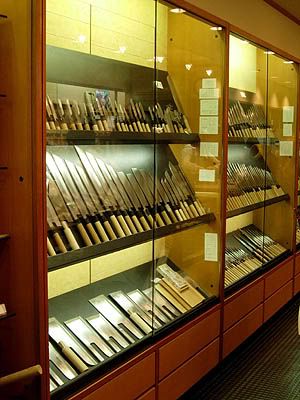
Aritsugu Knives, a very nice, clean, convenient store with enough foreign traffic that you can actually ask for and about a knife you might want to buy. In doing some poking around for this post, I came upon a bevy of positively insipid online discussions about buying Japanese cutlery while visiting the country. A great many people seemed to have a romantic notion that they will find a little smithy with a little old man who will briefly put down his hammer and will be so impressed by your 5 Japanese words and interest in buying a purty santoku that he pours you some tea while he hand forges you a knife as his family has for 145 generations, hands it to you, still warm, charging pennies because he was so touched by your visit..... Online Knife Collectors of the world I give you this sage advice: this will never,
ever actually happen. Whatever knife you get will be to varying degrees mass produced. This is not a bad thing, they are still incredibly good. However, having interacted with Japanese smiths demonstrating traditional tool and blade making at various conferences...you would gack at the cost of the hand forged article. You are a tourist...you are gonna get a good knife...go someplace convenient and well displayed with good selection and get a friggen knife.

Rant aside, why is Japan so known for its swords and knives? What is the romantic allure? Well, for one thing its because they are very good and the story of why they are the way they are makes them an artifact of Japan's history. A country is defined and described by its artifacts, with them being a product of a country's natural environment and how its citizens have lived in and made use of the place they call home. Even the heaviest or most high tech of industry still requires a hole dug in the ground to pull out the materials needed to make axes, plows, guns, ships and the like. What you can accomplish as a civilization depends in large measure on what you can pull out of the holes on your territory. If you don't have what you need you trade for it, get some more territory to get what you need or get very creative with what you do have. Simplistic, I know, but thousands of years of kings and politicians words have yet to change those simple facts, so there you are. We tend to break down eras in the evolution of civilization into the materials used in a given stage of technological growth: Wood, Stone, Bronze, Iron, and Steel. To a certain degree, these divisions aren't very relevant to the story of Japan's Industrial-social history, because other than wood and stone, they didn't really have much of the ingredients for the other steps. Of particular interest to our current tale is iron. Japan does have iron, sorta, but certainly not large deposits that could be easily mined and smelted in the massive amounts seen in the West. What Japan has is iron sands. Sometimes called magnetite, its a grainy black form of iron weathered out of mountains and settled into stream beds, beaches and other places a heavy sand could collect where it is "mined" like placer gold in our frontier days. It was processed by roasting with charcoal until semi liquid in incredibly inefficient furnaces and kinda refined into a spongy mass. It was horrendously laborious and expensive. Hitachi Metals has a wonderful site that skips over some of the more poetic notions of the Tatara (Japan's take on the bloomery, likely of Manchurian origin by way of Korea in the 6th century or so) and dishes out some fairly nerdy meat, such as the fact that in a standard run, the furnace will only give about a 28% recovery rate at best, and I know from other sources that only about half of that was actually good enough for decent forge work. Because of that, Japan was down right miserly with its use of iron. Most iron objects you see that date from before the beginning of large scale steel imports are thin sheet items because it was the best way to get the most out of a small amount material. The standard example of this is the difference between Western and Japanese saws. The Western saw is of course designed to be
pushed (hopefully that's an "of course" statement), which requires far more metal to support the cutting action than the Japanese saw which is
pulled with a relatively short stroke. They are thinner, shorter, and as such require less than half as much metal for saws of similar cutting capacity.

The Japanese got away with this for a good long while because their main food staples didn't require the sheer amount of stuff needed for equipment intensive European land farming. For rice you mainly need a small hand held sickle. For fish, pretty much just a small knife. Also, spared the nearly continuous massive conflicts and invasions of Europe and mainland Asia until much later in history (though ably defended by the weather a couple times when the Mongols came knocking), the need for high quality, incredibly expensive slashing weapons remained in the hands of the elites. Despite being nearly constantly at war amongst themselves, these clan battles tended
to be fairly small skirmishes until much later, by which time massed troops, archers and (later) firearms
had started making their appearance, which (lets face it) even the most expensive blades are little use against. However, even before the arrival and adoption of firearms the complex blades had already begun to be increasingly more ceremonial and decorative. The 1876 sword ban and the elimination of the Samurai class in the Meiji Period pretty much meant the end of sword making (for a time). But the smiths never went away and other types of blades and tools benefited from steadily increasing imports of good quality, comparatively cheap foreign steels (and eventually the techniques to produce Western style steels within Japan) as well as the ability to export its own products and the culture that goes with them. I think nothing speaks more to this point (as well as illustrating the vast industrial changes that occurred during the Meiji era) as well as the following graph, found in the Hitachi Metals archive. It is clear, looking at it, how little iron the Japanese could produce with their old techniques (the red line), and also how quickly the country was able to modernize and absorb tremendous quantities of resources.

It is also clear how traditional iron production and the specialized techniques needed to forge historic blades effectively was going extinct. Utility blades were all produced from the new foundry steels, the ability to finally make them cheaply enough to be affordable to nearly everyone pushed the traditional steels out almost overnight. There was a brief revival of Japanese sword making due to the increased demand for officer's swords during the militaristic and nationalistic period leading to WW2, and though many were made of modern steel, some tataras were actually fired back up, and swords (usually of dubious quality) were cranked out. Thousands of these "Samurai Swords" were brought back by American troops after the war along with granddad's tales of the "fanatics" that carried them in places like Guadalcanal or Okinawa. Combined with a century of war movies, martial arts movies, Samurai and ninja in pop culture and the expansion of world cuisines out of immigrant communities in major cities into television and peoples home kitchens, you get the ingredients for the legend of the legendary Japanese blade, ready for you to pick up at your local Williams-Sonoma. Of course, there is almost nothing in common between the materials and techniques used to forge historical blades and modern "hand forged" blades other than the history. Luckily, though, a great deal of the old traditions still survive in more than just romance and legend. Since the 1970's, the
NBTHK (Society for the Preservation of Japanese Art Swords) has run a traditional tatara producing Japanese steel for the production of a new generation of Japanese blades, now divorced from the military class and appreciated for their craft and heritage. At the same time, attempts have also been made to keep other aspects of traditional forge work alive in the the use of tools and, yes, knives. Keeping those old traditions alive permeates even the world of production knives and gives them a quality that more than matches their reputation. Me, I bought a nice carbon steel chef's knife and hammer forged hatchet. Neither was still warm from the smithy out back (if by "out back" I mean Osaka), but as I sat watching my knife get sharpened by the helpful guy that had sold them to me and was given rigorous instructions on how to sharpen and maintain my knife all while hearing about his recent snowboarding trip to Washington, I can say that Aritsugu was someplace convenient and well displayed with good selection and I got a good friggen knife. Worth every penny.





No comments:
Post a Comment