Our next stops were going to be scattered all across Kyoto and involve a whole bunch of pedaling. With our bellies full of another tasty breakfast and our heads awash with Buddhism and shrines it was time to jump on the bikes and get a move on. The first two places we were going to hit, after biking through the gawdawful, peasoup thick humidity that was already rearing its ugly head, were representative of a big change in the leadership of Japan. Nijo Castle and Kinkakuji were the first destinations, but we kinda hit them in reverse chronological order, so I'm gonna deal with them in historical order rather than the order we saw them on our little visit. Aside from just being built 200-odd years apart, they are from completely different worlds. If combined with the previously visited Ginkakuji, the three structures mark a clear line between the Classcal Japan and the birth of the modern nation. Why this great transition? Its all because of sex. Yes sex is a driving, dynamic force for social change and don't let anyone tell you otherwise. You see, when two people have sex, well, you end up getting more people. Its kinda a funny thing. Usually if you want more of something its a whole lotta work, but in the case of people all you need is two of 'em with relevant parts sharing the same overlapping geographic location. This is simple stuff, and if you don't follow me, ask a grown up to explain it. Anyway, you have a bunch of people having sex and soon enough you've got the central authority divorced from countryside, shoguns, the Onin War, Ginkakuji, the old order falling...its a mess. But we're getting ahead of ourselves, here. It all started because if there's one thing the nobility particularly likes to do, its have sex. As a close corollary to the above overview of this sex thing is that the aftermath of a lot of nobles having sex is you end up with a lot more nobles. One example, Emperor Saga in the 9th century, had nearly 50 children by 30 wives. This was a problem in early Japan because given the centralization of power and the rigid rank based stratification of the ruling class, that means you have a lot of nobility running around with very little to do. Can't have a Yamato noble doing the plumbing is what I'm saying. The solution was to demote large numbers of royal nobles. These demoted royals, their opportunities within the court limited, tended to move out into the countryside where a great deal of the day to day running of the country was contracted out to them. This contracting out of tasks had been going on for some time; beginning as far back as the 7th century the Imperial house had become consistently further removed from the country and people it ruled. It relied more and more on elite clans to rule and enforce policies of the emerging state. This outsourcing had created a sort of "noble beauacracy" that used the legitimacy of the legal framework created by the Imperial House to establish a new social order. At first these were clans closely linked to the old classical establishment, but as new noble classes began to establish themselves on the land that actually created the wealth of the state, the order began to shift from the court to the countryside. By nature, these new country lords were destined to cause problems. With so many clans all related back to an Imperial origin the desire to achieve supremacy was too great, and there was near constant low level fighting. These conflicts were still fairly small, often just a few score mounted troops, but sometimes rising to the level of actual battles, usually in the times of disputed Imperial succession or when some of the larger more powerful ruling clans decided to really have it out. But change was coming, and coming fast, and our second stop this day was almost the punctuation for this old era. Indeed, the last heyday of the old Classical order is well represented by Kinkakuji, the Golden Pavillion.

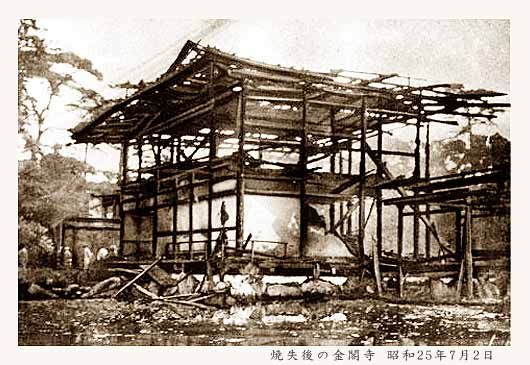
Like many historic Japanese wooden structures, the Pavilion you see today is a reconstruction, dating to 1955.
The original was built in 1394 (or '97, my sources list both dates), and survived all manner of the usual disasters, including when the rest of the compound was torched during the city wide strife of the Onin war...until 1950 when a deranged monk burned it to the ground.
The Pavilion is usually packed; we had been warned to go early or late to avoid the crowds. It certainly was well attended when we were there, and you are kinda herded through: go here, take your picture; now go this way, walk through the serene garden with a few hundred of your new friends; now buy some souvenirs, get some ice cream; goodby. Its worth seeing, no doubt, just remember its not likely to be the most quiet, serene spot you're gonna see in Kyoto. But lets face it, it is a ridiculous structure and to actually have to squint to look at it on a bright summer day is a unique experience.

Kinkakuji was built by the Shogun Ashikaga Yoshimitsu (grandfather of Ginkakuji's builder Ashikaga Yoshimasa) as a retirement villa like the later Ginkakuji; and like it became a Buddhist temple after the Shogun's death. Unlike the time of Ginkakuji, Yoshimitsu ruled over the last gasp of the old classical order, a time of relative peace. Relative, that is, to the period that almost immediately followed. His grandson had none of the interest and ability in leadership that the times required, and before he even passed away a fight over his successor rapidly escalated into a pretty nasty civil war called the Onin War. The aftermath of this nasty scrum left Kyoto almost completely devastated, the Imperial house (which had few resources to start with) completely threadbare, and began a period of near continuous warfare that would last almost uninterrupted for a century and a half. I'm not even going to begin to get into this time, called the Sengoku jidai, because it involves hundreds of dudes killing other dudes, and then being killed by other dudes, who are promptly killed by other dudes. In even general histories of Japan this goes on for page after page after page.....after page, um...after page. The only thing we need to know is that the reason why this had occurred is because no matter how much ruling classes may try, they often can't see and certainly can't stop the progress of the world around them, though sometimes they try to stem the tide until there is just no holding it back. Which brings us back to sex. Not sex among the nobility, but the kind that causes entire populations to grow. The shift of power to the provinces under the new country lords combined with improvements in farming techniques, tools, and strains of crops led to the growth of new "provincial" population centers. The upshot was there was more food to go around, creating greater food stability and less people tending to starve to death. This relative increase in the well being of the commoner, the increased range in which they could grow crops, and slightly decreased likelihood of dying before reproducing a few times caused a population explosion that fueled the expansion of the number of towns, villages and cities and the new social structures and economies within them. Even with all the war and strife of the times, the population grew from around 5 million in the 11th century to around 18 million by the end of the 16th century. Though these new countryside castle towns were essentially independent city states, they were commercially connected to a wider power base than the old court, had a broader base of skills and manpower, and the changes in commerce, warfare, and government this caused was destined to wipe away the old order. Armies were no longer a few hundred or few thousand, but massive organs with tens of thousands and later hundreds of thousands of men. They required logistics and a supply apparatus that could only exist because of the new broadly integrated social structure. For a long while there was an uneasy status quo with the rapidly changing society held in check by the trappings of the old Court structure, but it really just took a bit of a shock, like the Onin War, to yank the lid off the simmering pot and allow everything to boil over. This era of warfare affected all layers of society, but didn't cause a complete collapse, and what emerged at the beginning of the 17th century was a unified Japan that was
really unified, not the old "unified" nation that was really just a confederated collection of clans willing to pretend to get along only when they weren't fighting each other at the drop of a hat. The ultimate leaders behind this unification, Oda Nobunaga, Toyotomi Hideyoshi, and finally Tokugawa Ieyasu were products of this new population based order. They had a different attitude to power and where it emanates from, and had new ideas of how to sustain it. No longer content to subcontract out ruling to a group of related nobility, they created a centralized beauracratic government and a structured order designed to keep regional warlords from being able to expand their power through military force. One of the many new instruments of change and societal control was the castle reforms, limiting how many castles a vassal could have in his territory, at the same time using the construction of new castles to tie up other vassal's resources. Nijo Castle is one of the products of this program.

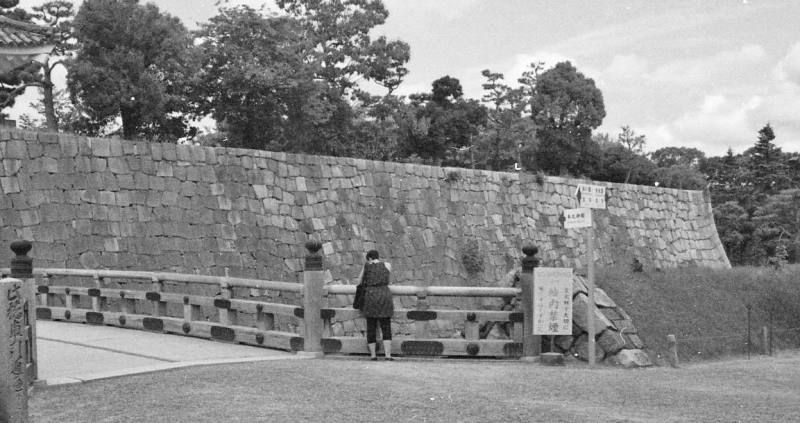
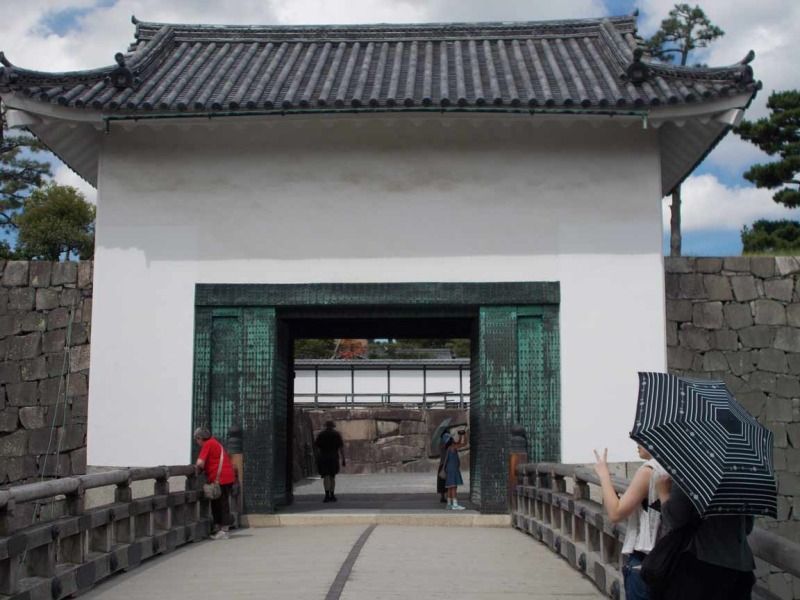
In 1602 Ieyasu ordered the feudal lords of western Japan to construct the castle, which was finally completed by his grandson 20-odd years later. As part of the new restrictions it contained parts from other castles that were dismantled, chiefly Fushimi Castle which donated its five story tower (burned after being struck by lightning in 1750, surprise!). The castle was, in effect, never really used as such. Its main purpose was to be just down the street from the Imperial Palace and right in the heart of Kyoto as a symbol of the new Shogun's power. Its tower was as much for letting the city know it was being watched as it was to defend against any real attack. It was from here that the new era of the Tokugawa Shogunate was begun and from here the edicts officially subjugating the Imperial family and court to the Shogun were issued. The castle was built at a time when the new order was rendering the old castles obsolete, but after a long period of their refinement making it both an anachronism and the pinnacle of the breed. Because of this, it is a very unique structure. It's construction should be very familiar to anyone who has seen European forts built after the advent of gunpowder, with corner turrets and other details refined to make use of and repel firearms and cannon. If you look at the stonework, you once again see that unique Japanese take on construction. There are none of the neat, straight masonry courses common in Europe at the time, as that type of construction is not very good a resisting earthquakes


Instead you get something a little closer in Inca stonework, which was built the way it was for the same reasons, though the Japanese would never do something as blatantly showy. It's construction is unique in other ways, though this has less to do with being able to resit attacks and earthquakes and more about making as big of a statement about power as possible. From the use of stone (itself something of a rarity in Japanese construction), to the sumptuous use of metalwork...
....to the woodwork, this was taking the traditionally light Japanese construction and adding the weight of authority, which is given actual physical mass in the structure of the castle.
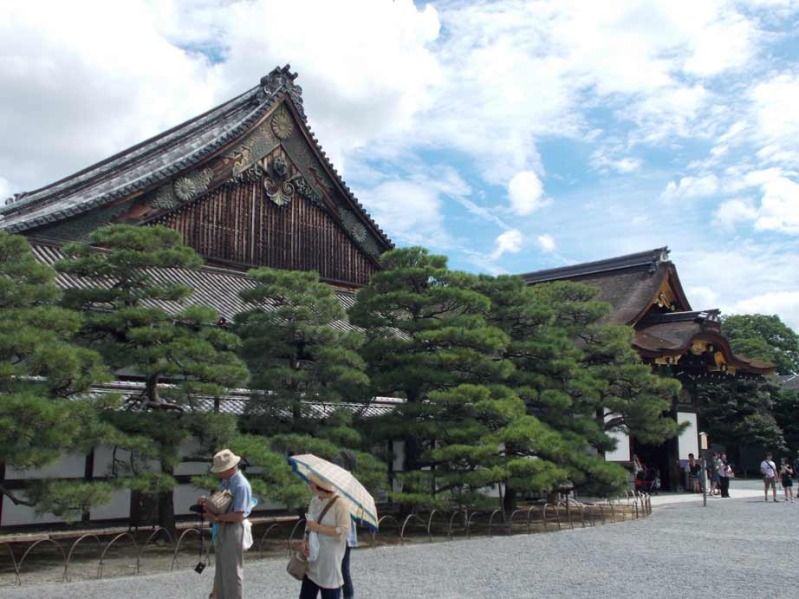
The heart of it all is the Ninomaru palace. For the most part it was an administrative center, designed to impress and built to specifically order visitors and petitioners by rank. Sadly there's no photography allowed inside, so you'll have to take my word that it is completely ridiculous. The woodwork is incredible, the gold leaf is so artfully done that unlike Kinkakuji, where it overpowers, here it just adds class; and it is filled with the kinds of over complicated details that you can only find when price is no object, like the creepily hilarious "nightingale floors", designed to prevent sneaky people from sneaking by chirping when walked upon and still hilariously chirping to this day.
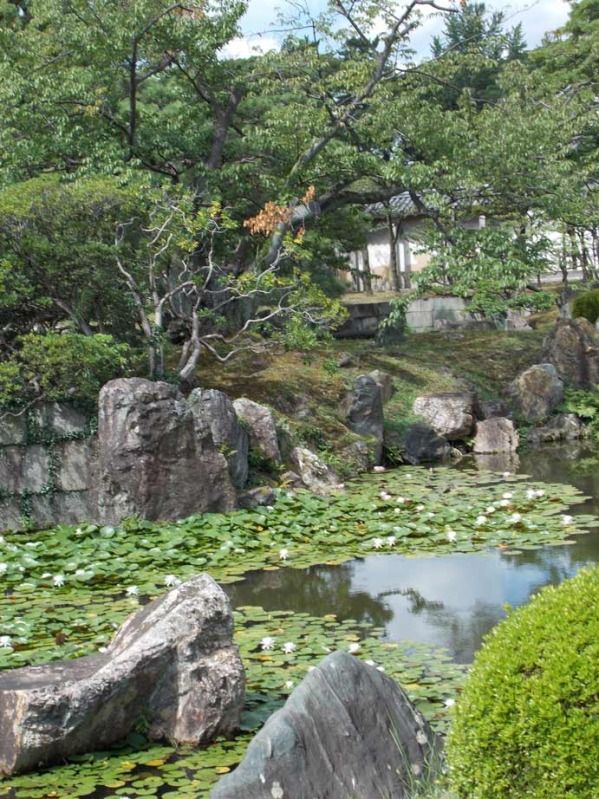
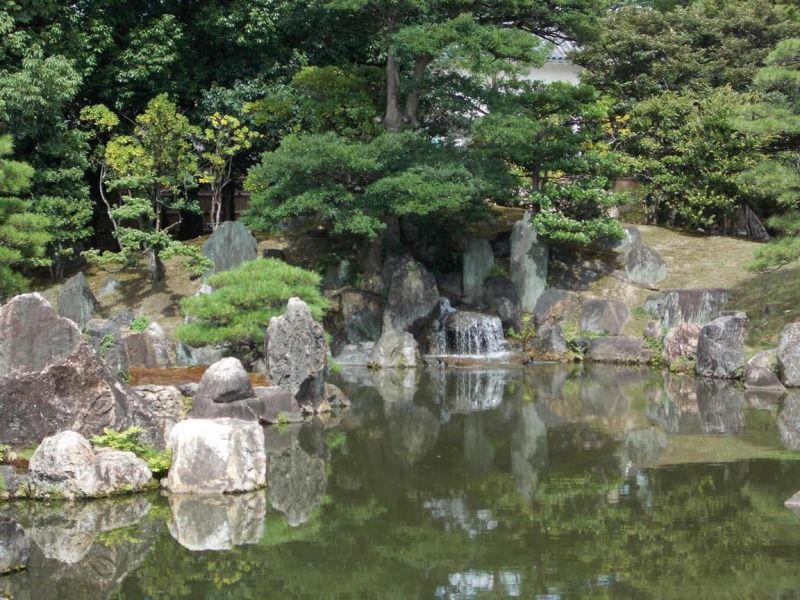
The rest of the grounds are a wonderful place to stroll, the gardens are unique because they are designed to be viewed from specific vantage points within the various palaces and structures on the grounds.
Not surprisingly, a good deal of the old castle is gone. Along with the old tower (as mentioned above, in 1750), there was also the inner palace, the Honmaru, which burned in 1788. On its site today is the Katsura Imperial Family Palace, moved from the Imperial Palace grounds to Nijo's central keep in 1893.

In the end, Nijo Castle's importance lies not so much in the fact that it was particularly central to any battles, but in that it is a symbol of its times. It marked the end of a one era and the beginning of the premodern era. The new leaders of Japan, no longer tied to the old Imperial structure and anxious to separate themselves from that old order, would officially move their seat of power to Edo (modern Tokyo), giving the name to the era of the Tokugawa Shoguns. It would mark the beginning of a time so reactive to the previous instability that there began a period of almost fanatical devotion to enforced stability. It was the coming era after the construction of the Castle that conspicuous displays of wealth and power were viewed as threats, likely where the Japanese notion of "inside" and "outside" behaviors still seen in modern Japan have their origins. The desire for stability also marked the beginning of the time of increased fears of foreign influence, leading to the xenophobia and suspicion that caused the expulsion of foreigners, the attempts to eradicate foreign influences like Christianity, and a general shuttering of the country. Though nearly forgotten and allowed to fall into disrepair over the years, the Castle maintained at least a symbolic connection to the Tokugawa of the Edo period, and that symbolic connection would resurface at the end of that era, as well. In 1863 Iemochi, the 14th and next to last Tokugawa Shogun, escaping the strife in Edo in the wake of the events following Commodore Perry's visit, would be the first Shogun to enter the Castle since the 3rd, Iemitsu, had last been there 230 years earlier. Four years later, Iemochi's son, Yoshinobu would officially hand power back to the Imperial throne from the old Ninomaru palace in Nijo Castle where 250 years earlier the 2nd Tokugawa Shogun had taken it away, thus marking the beginning of the Meiji Restoration.









No comments:
Post a Comment