Over the previous days we had spent a pretty good bit of time on the bikes. They were definitely the way to get around and get a feel for Kyoto, but to be honest I wasn't going to be sad to be getting to some further off destinations that didn't require pedaling through the August humidity. As a last two wheeled hurrah we headed back downtown by way of Gion and a parfait on the way to some tasty ramen before turning the bikes in. The next day we were heading a bit outside of town to Nara and Fushimi Inari. Originally we were just gonna hit Nara, but Divyam and Yasuko suggested that wasn't really a full day thing and it would be better to hit Inari on our way back. By this point their suggestions were gospel in our books, and I had really wanted to see Inari anyway, so it was off to bed. Bright and early the next morning we took the now familiar stroll down the hill from Yonbanchi to catch a bus to the station for our train to Nara. The city is separated by a low range of hills in an offshoot of the urban smear that stretches from Kyoto all the way down to Osaka, giving it a distinct "next valley over" kinda feel. It is located on the edge of the Kinai, home to the Yamato Plain, birthplace of Japan's Imperial rulers, and was both an intrinsic part of the Court's development but also a world apart.
The books tell you the Kintetsu Line is the best way to get to Nara, dropping you off literally a couple blocks from Nara-Koen (Nara Park) and most of the sights. But with our JR passes we arrived at the Jr Nara station a bit west, more in the center of the modern city. In reality, its not a long walk, and I would highly recommend it as a good way to wander into town. Walking from the station toward the eastern hills you slowly transition from one Japan to another; from anywhere modern Japan, past the pagoda of Kofukuji into the leafiness of Nara-Koen, a warren of temples, gardens, woods and museums leading to the main attraction that is Todai-ji. Nara is an interesting place and that walk from station to park is a reminder of how Old Japan was a very far off world indeed, and how much Japanese culture has changed despite the modern feeling that it is a timeless place with unbroken traditions stretching back to time immemorial. It is amazing to think how much Buddhism reshaped the country, and to some degree how recently that change occurred. That is on display so vividly in the Buddhist sites because early Buddhist Japan was in many ways more permanent than early Imperial Japan, making the line of demarcation between pre-Buddhism and post-Buddhism so stark. At the time of Buddhism's arival the Court was oddly very mobile. Settling down to farm came rather slowly in the country, and nomadic hunting and gathering survived quite late. When the people did finally begin to stay in one place and work the land it almost seems the ruling clans were the ones that didn't manage to find a set place to be, possibly because they came from a segment of the populace that wasn't of agrarian background. Like many details from the unknowable pre-literate history of Japan, the reasons why will require the archeologists to weigh in, but the upshot is that for a very long time there was no set capital; this is often ascribed to Shinto taboos, and though that may have been a contributing factor the principal reasons were a bit more subtle than just that. Usually a new Emperor or Empress would move the capital to be closer to his or her own family; moving reign to reign due to the complex marriage ties of the
ruling families and each clan's desire to keep the throne in a "safe
place" so to speak.
Eventually, the building of a new palace each reign led to nearly the whole of the Yamato plain being peppered with Imperial Palaces. These palaces were grand enough structures, but their builders seemed to be aware of their transitory nature and they were built in a fairly "light" manner. Aside from the fact their components were often recycled into later palaces, usually they were constructed with posts set directly in the ground with lighter structural members and roofs, a style of construction that rots away beautifully and leaves even the archeologist very little to find. Often there is little more than just a change in color of the dirt to mark the one time location of post holes and a line of gravel that had once been placed where rain ran off the roof to give a fairly decent idea of size and shape of the long vanished structure. In contrast, Buddhist structures were built to last... at least longer than a decade or two. For one thing, posts were set off the ground on stone bases, floors were raised on large rammed earth platforms and the structures were overall built in a way that, honestly, required a bit more planning and organization. All around the whole shebang was built in a style that reflected the simple fact that the temple wasn't expected to move with the passing of an individual. The result of these differences are a comparatively large number of Buddhist temples in their original locations (even if not in their original structures) but no palaces from before the move to Kyoto. Intertwined in the hazy area between the politics and the changing nature of religion of the time is little old Nara. The exact origins of Nara's history are unclear; the presence of quite ancient tombs on the site certainly pushes its history far back into Japan's dark, misty past well before Buddhism arrived. It's location near the Yamato plain likely kept it important as the new ruling clans shuttled their palaces around the region, but its possible it's temple culture may have begun with Buddhist Korean immigrants that settled in the area at a time when mainland concepts of Buddhism and modern imperial government were generally beginning to flow into the island. Whatever the origin, Nara was strategically placed to take advantage of the changing religious and political landscape. But....
....Before we go any further, I must (MUST!) yap a bit about one of the truly most unique things about Nara. History and religion and politics will just have to wait a damned second, because I
must (MUST!) talk about the friggen deer in Nara. That's actually their scientific name: Friggen Cervus Nippon...its true, you can look it up. They are members of a very small and exclusive group of edible living things in Japan that don't have to worry about being eaten, and they know it. Simply put, the friggen deer of Nara are, especially on a hot August day, the laziest, most ridiculous creatures on the planet
Supposedly the protective deity of the city arrived riding on the back of a deer, so the critters are now seen as symbols of that founding protection as well as being symbols of the modern city, an army of four legged, pooping mascots. The cynic would point out they're also pretty good for the tourist trade, and at that they are a heckuva lot better of an infestation than the pigeons that clog other tourist jaints like St. Marks Square. You can keep your flying rats, Nara's got friggen deer, man!

Anyhow, the protector of the city/inedible status of these deer has given them plenty of time to completely forget they may have at one time been wild animals and now have the layabout look more akin to large, lazy old dogs right down to the unrepentant countenance (known to canine owners the world over) that says "listen, homes, if you aint got any food to pass my way, then leave me alone cause I got me some serious nappin' to get on with." I'm a dog owner, I'm very familiar with this expression.
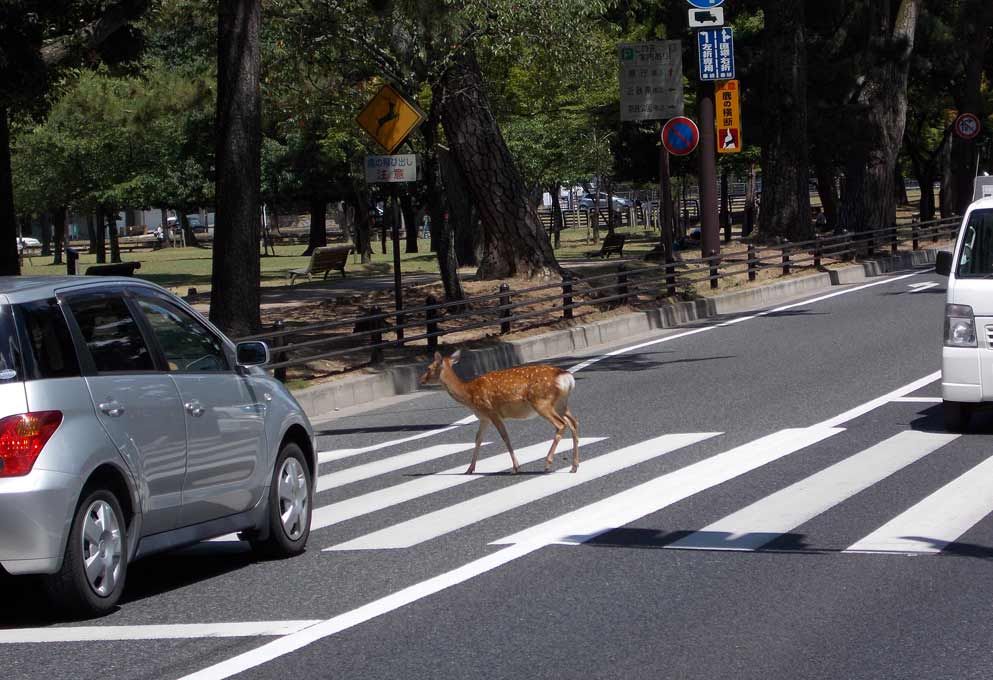
So the lil' bastards are everywhere, and they are hilarious, unmitigatedly hilarious. Probably the funniest thing was watching how people just get on with their lives around the four legged goons and how much these truly are "city friggen deer", walking around as if they actually have something to do or someplace to be.
I get the distinct feeling, however, that this many deer put in such close proximity to a long ton of tourists must lead to the occasional fracas not considered to be up to the high standards expected of the messengers of a protective deity. Apparently old ladies and kids are routinely savaged by these silly bastards if the Worlds Greatest Sign (which I am going to have to get on a shirt at some point) is to be believed.

Okay, dammit, back to Nara. Must focus. Today, especially to the outside world, the Japanese seem extremely homogenous. Compared to us Americans, a polyglot mess, the Japanese seem and often actually believe they are as old as the Japanese islands. To look at them or listen to them speak of their heritage is to not realize that they are the result of multiple different waves of immigration as well. As we have seen in other posts, these waves have brought many new ideas and technologies, often ones that had the ability to turn the country on its head. One of the greatest times of cultural exchange with the outside world was in the middle of the first millenium AD. At this time there was a great deal of interaction with the mainland, going as far as actually getting involved in fighting on the Korean peninsula. It was at this time that Buddhism began to reach and be accepted within the ruling class. It may seem strange that a new, foreign religion would be able to make such rapid, unforced inroads into the court of the time but there were some very tangible reasons why that was the case. Some of it may have been fashion, true, but to a large degree it was because it was viewed as necessary. The involvement of Japan in "foreign" mainland matters in Korea for the first time put the island in a position of possibly becoming embroiled in larger conflicts with it's larger more "modern" neighbors. The fears of foreign invasion and later of actual foreign policy interaction with mainland Tang China caused a reaction incredibly similar to that later seen in the aftermath of the Meiji Restoration, when Japan felt it needed to modernize to deal on equal terms with Western powers. At this point in its history the Court felt the need to appear as modern as possible to deal on equal (or at least not too subordinate) footing with that era's Western equivalent, the Chinese. What followed was a time sometimes referred to as the Chinese apprenticeship, with delegations traveling to China to learn about "modern" Imperial rule, Confucian ideas of governance, and Buddhism. Moving in the opposite direction were Chinese scholars, diplomats, and Buddhist missionaries as well as refugees from the fighting on the Korean Peninsula. To the Imperial court, rapidly trying to reshape itself using a Chinese model, the new religious ideals were part of the package. But it wasn't just image, pragmatism and politics at work; to a large degree, the new religion filled a niche within Japanese Imperial culture that the old
proto-Shinto folk religions (which for simplicity sake I'm just gonna
call Shinto) just didn't fulfill. The old beliefs were drawn from
agrarian perspectives of people's interaction with the world around them, and as such were very much based on rural concepts of life within the environment which were largely at odds with the messy, dirty nature of the emerging
towns and cities and knockabout realities of governance. A great deal of the day to day activities of the rising urbanism was considered downright impure by Shinto
beliefs. The Buddhist missionaries that were newly arrived and the native practitioners of the new religion were
quite aware of this and were more than happy to exploit the situation,
happily wading into areas that made Shinto distinctly uneasy, like the
mess of political thought, medicine, and perhaps most specifically, death.
As the ruling class absorbed and accepted Buddhism, the temples grew, and grew, and grew. The wealth of Japan then and for a great long time was its land, and as time went on, more and more of that land ended up in the hands of the temples for various reasons. To start with, many temples were founded by wealthy families, Emperors and members of the ruling class for intercession in this life and what came after. However, the transitory nature of the living powerful, pitted against the enduring structure and ideology of Buddhism meant that as the wealthy and powerful came and went, the stability of the new religious establishment tended to concentrate land in temple hands. This was a problem because for much of early Japanese history, taxes were paid in produce rather than coin, and so much land on the Yamato Plain was in the hands of the temples or set aside to support the temples that by the Eighth century very little produce from these home provinces was actually being paid in taxes to the central government. This had the effect of strengthening the power of the provinces, which eventually led directly to some pretty serious societal changes down the line, as some previous posts have shown. Things weren't made any easier by the fact that individual families aligned themselves with certain temples and Buddhist sects and proxy "wars" between these clans were often fought through patronage to the temples and with the assistance of the temple's ever growing masses of manpower. Nara (Heijo at that point) was in the center of a great many of these scrums. As the "Capital" had danced around the Yamato Plain to be close to whichever branch of the ruling class was on the Imperial throne at the time, the power of the Nara temples single mindedly acquired and consolidated it's land holdings. Not that they were truly independent, they knew where their bread was buttered and were very closely intertwined with the Imperial family and the powerful clans that controlled the country, ostensibly acting in accordance with their wishes, though usually when it served to strengthen the temple's interests. A great example of this is Todai-Ji in Nara. In 741, in order to express his own piety, attempt to bring some order to the world of Japanese Buddhism, and spread a more centralized, unified concept of Buddhism, Emperor Shomu issued an edict for the construction of a national system of temples, followed two years later by an edict for the construction of a great sculpture of Vairocana Buddha. Todai-ji, therefore was to be the center of the new system of temples, and was built in a scale to reflect that fact.

This is the Nandaimon, or South Great Gate. The similarity between this structure, from the 13th century, the Sammon at Nanzenji from the 17th, and the Main gate to Heian Jingu from the late 19th is noteworthy. The architecture of Japanese temples and palaces all have the same origin, and the basic elements rarely changed, even as the sects, religions, politics and specific architectural fashions did. The Japanese had received the standard layout of a temple from Korea, who had learned it from the Chinese, who had pretty much just adapted palace architecture by sticking a stupa in the ground plan. A lot of the variety seen in layouts of temples these days mainly reflects the ravages of time and changing fortunes affecting the temple's ability to maintain or rebuild their structures. Todai-ji, as an example, has been subjected to most every form of destruction man and nature can think of. The Nandaimon above was originally built in the 8th century, destroyed by a typhoon, and rebuilt in "Chinese style" 400 years later.
Inside this mighty gate are two fittingly mighty guardian wrestler figures called Nio protectors. The origins of the Nio imagery is suitably ancient, with roots certainly in ancient Hindu and likely even much older near eastern folk traditions.
They are the Buddhist ancestors of the Komainu you see at Shinto Shrines and are the origin of the paired guardians with the mouth open, mouth closed symbolism. This pair dates to the rebuilding of the Nandaimon and were installed in 1203. They were restored starting in the late eighties, but they seem oddly imprisoned behind a rather coarse chicken wire that apparently makes them as impossible to clean as it is to get a decent picture of them. Filthy or not, they are pretty impressive, and they need to be because its their job to guard the Daibutsu-den, the largest wooden building in the world.

The tale of the temple and the Great Buddha inside is your standard tale of Old Japan Wood Structure Destruction: completed in the 8th century, the Buddha's head fell off from an earthquake in 855; it lost both its seven story pagodas soon after completion due to lightning strikes; the Daibutsu-den itself burned in the 12th century during the Taira-Minamoto Civil War, and again in 1567 during the Sengoku Period. After the last torching the surviving bits of the Buddha sat on the ground with a temporary cover for a century until it was finally all put back together inside a new temple between 1686 and 1709. Its actually pretty inspiring to think of the dedication needed to construct the worlds largest wooden building
three times, so if you ever need an example of single minded determination, well...there you go.
As you can see, the scale is incredible, if the little ant like people in its doorways aren't enough to illustrate that fact, just look at how it dwarfs even Holly's big floppy hat!
Of course, the building is not really the draw, but whats inside: the Daibutsu, the Vairocana Buddha, and it too is a lesson in determination.

The first attempts to cast the parts ended in failure, and after 2 years of work with nothing to show for the effort, an enormous team headed by a Korean master was assembled and finally managed to get it done in 4 years. Its casting swallowed up nearly all the copper and bronze in the country, evidenced by a hole in the material record of the country where for a good bit after this time there are virtually no other bronze artifacts to be found. Even some of the other statuary of the temple that were originally of bronze are now represented in clay and wood, the originals likely sacrificed to repairs of the Buddha through the centuries. In fact, its unclear how much of the current piece is original if any; after the fires its likely a lot of it ended up as puddles of molten bronze beneath the ashes. The thing is, this long hard history of failure, destruction and constant restoration gives it a great deal of its own charm which nearly outweighs the bronze its made from.
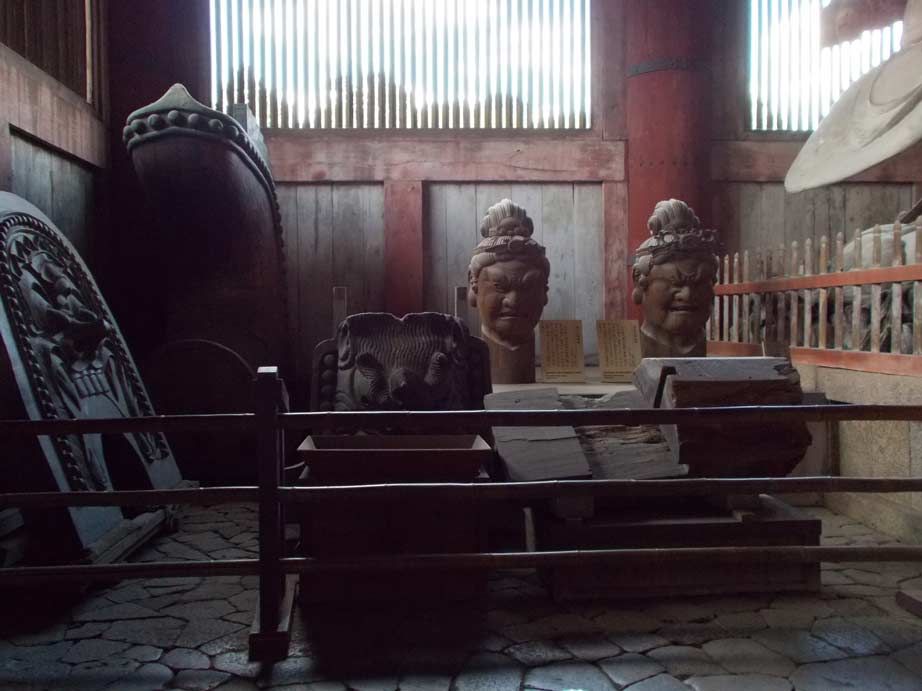
Being as much a museum as a place of worship these days the entire building is full of artifacts of its original creation, years of rebuilding, additions, and the work needed to this day to maintain the fabric of such an immense structure and its priceless contents.
We spent a lot longer than I expected wandering around the enormous structure, looking at the numerous displays, the other sculptures which are remarkable in and of themselves (like the Western guardian Komukuten, below), all while soaking in the oddly strange feeling that comes from being inside a structure this damned big.
But eventually it was time to get a move on and do some walking around the rest of the Temple/Shrine/Park grounds. Our next stop was up the hill from the Daibutsuden in the shape of Nigatsu-do (the "Hall of the Second Month") built around 760 and the site of the Shuni-e ceremony which has been performed there every year since...even when a fire started during the ceremony in 1667 and burnt the original structure to the ground. The current building dates from 1669.

If you've got the time, feel free to read up on the ceremony. Personally I kinda lost track somewhere around the start of the second week's activities which follows the preparatory period called the Former Seven Days, which precedes the Latter Seven Days, and is broken up into six periods: Noon Watch, Sunset Watch....erm...Register of the Names....erm...something. Anyhow, the reason to go to Nigatsu-do for the non-Buddhist is because it has a wonderful veranda that gets the refreshing breeze blowing up the hillside and allows a wonderful panorama looking out over the Daibutsuden to Nara below. Is a nice place to get a cold tea and take a break before continuing on your way.

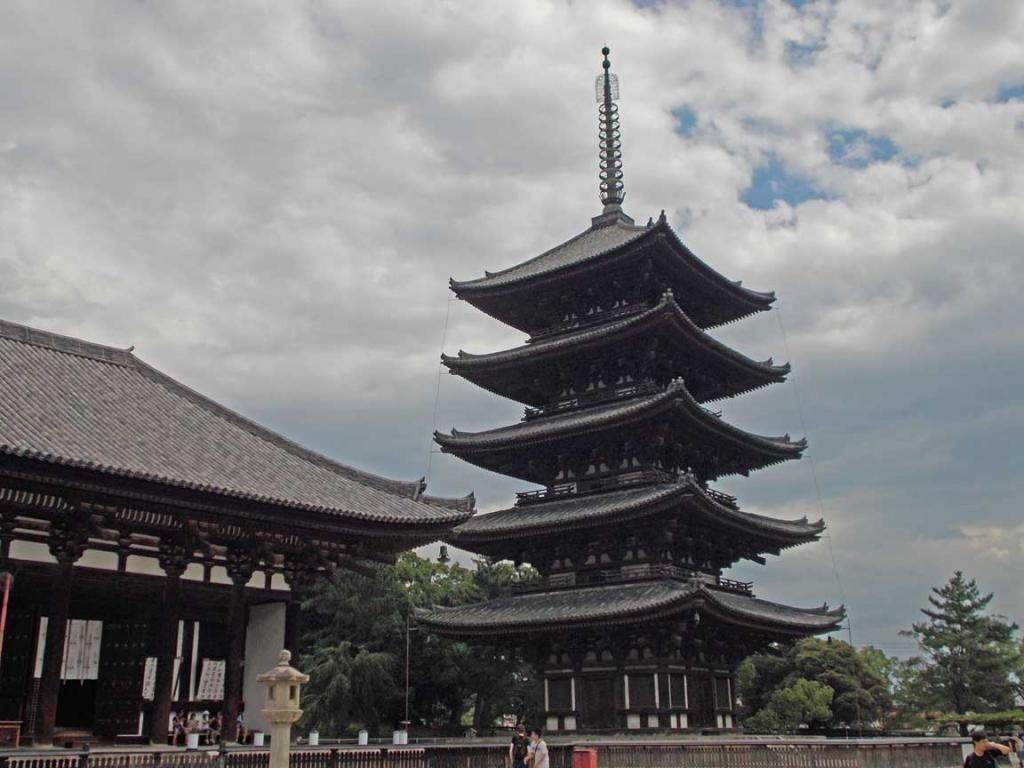
We were enjoying the stroll suggested in the Lonely Planet guide, and it was a pretty good walk around the various Temples and Shrines. After eating lunch at a decent little noodle shop we decided to head back down and have a bit of a wander through town on the way back to the station, passing through Kofukuji, home of the second tallest
surviving pagoda in Japan. Note the modern addition of grounding wires running down the corners to prevent the otherwise inevitable fate that seems to await a wooden structure this size topped with a bronze ornament in a land where thunderstorms are common.
At Kofukuji I was presented with the most annoying sight in the world. They are currently rebuilding the Chukon-do (Central Golden Hall), to the original design using traditional techniques...and they apparently don't think anyone would want to see that. All that's visible is through little openings in the giant warehouse structure they erected to build the temple within: a tip of a beam here, some scaffold there. Meh, I would have happily payed a heft admission fee to have gotten to see that. So we moved on, we popping down the market street where sadly this place wasn't open yet

And then I got another knife at a cute little shop whose main attraction was that in the window were displays of forging a knife and pair of shears step by step. Inside was a friendly ancient guy and his slightly less ancient (but equally friendly) wife. It was one of the few times I really lamented my crummy language skills, because I was really curious about the forging displays but just didn't have the words to find out who made them or why they were in his shop window. With that, it was time to go. Nara was turning its back on me; couldn't see the reconstruction of Chukon-do, the Sweet Soul Cafe wasn't open yet, and I hadn't magically become fluent in Japanese. Apparently my general ambivalence to Buddhism was slaking my karma with chi, or something, so it was time to get outta town and get back to sweet, sweet Shinto...we were headed to Inari.








No comments:
Post a Comment